Chatbots for dead, endangered, and extinct languages are being developed at the FHNW School of Business. One well-known example is @llegra, a chatbot for Vallader. Oliver Bendel recently tested the reach of GPTs for endangered languages such as Irish (Irish Gaelic), Maori, and Basque. According to ChatGPT, there is a relatively large amount of training material for them. On May 12, 2024 – after Irish Girl and Maori Girl – a first version of Adelina, a chatbot for Basque, was created. It was later improved in a second version. As part of the kAIxo project (the Basque “kaixo” corresponds to the english “hello”), the chatbot or voice assistant kAIxo is to be developed that speaks Basque. The purpose is to keep users practicing written or spoken language or to develop the desire to learn the endangered language. The chatbot should be based on a Large Language Model (LLM). Both prompt engineering and fine-tuning are conceivable for customization. Retrieval Augmented Generation (RAG) can play a central role. The result will be a functioning prototype. Nicolas Lluis Araya, a student of business informatics, has been recruited to implement the project. The kick-off meeting will take place on September 3, 2024.
Continuation of the AAAI Spring Symposia
On 27 August 2024, AAAI announced the continuation of the AAAI Spring Symposium Series, to be held March 31 – April 2, 2025, at San Francisco Airport Marriott Waterfront in Burlingame, CA. The Call for Proposals for the Spring Symposium Series is available on the Spring Symposium Series website. According to the organizers, proposals are due October 4, 2024, and early submissions are encouraged. “The Spring Symposium Series is an annual set of meetings run in parallel at a common site. It is designed to bring colleagues together in an intimate forum while at the same time providing a significant gathering point for the AI community.” (Website AAAI) The traditional conference will therefore not be held at Stanford University in 2025 – as it was in 2023. It returned there in 2024 to the delight of all participants. The Covid-19 pandemic had hit the conference hard before. The AAAI can only be advised to return to Stanford in 2026. Only there will the conference live up to its promise.
Closing Event of a Successful Conference
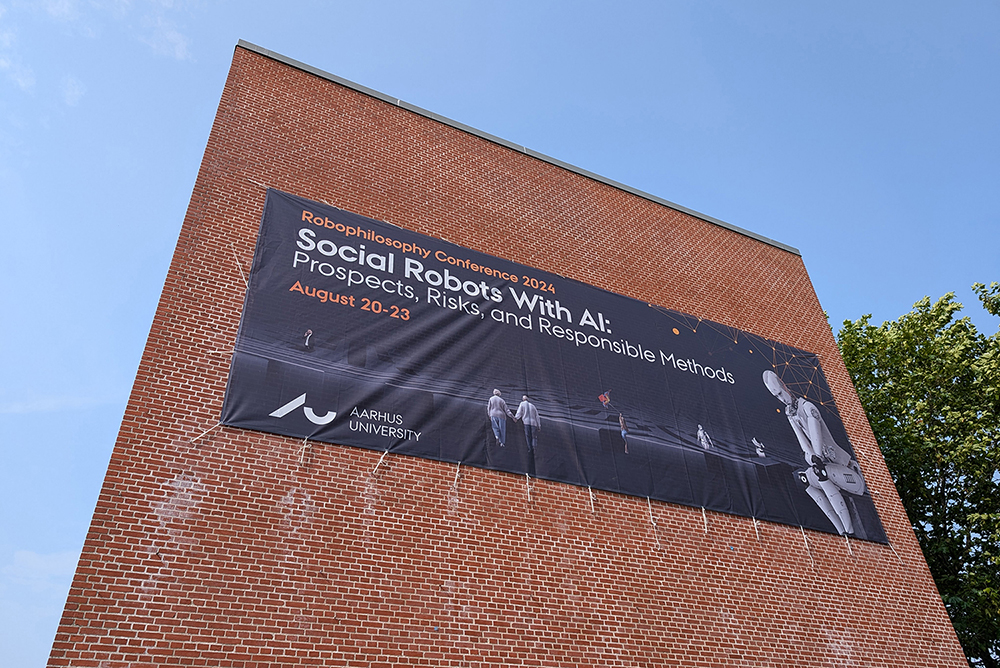
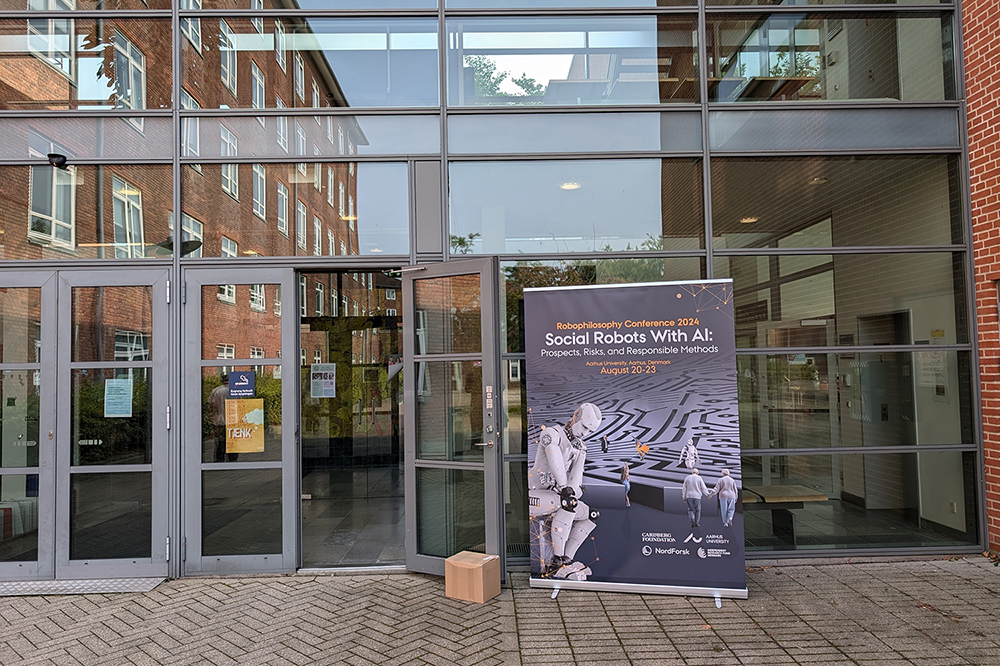
Robophilosophy 2024 took place for three and a half days in Aarhus (Denmark). It is a biennial dedicated to social robotics. Alongside the ICSR, it is the most important conference in this field. The program was again very extensive. Workshops were held and presentations given in four different tracks. There were keynotes and plenary sessions by well-known names, from Wendell Wallach to Hiroshi Ishiguro. After a sunny start, it began to rain, which made it all the easier to concentrate on the scientific exchange. In the end, the sun came out again in time for the closing event. Johanna Seibt, the brains behind Robophilosophy, received a bouquet of flowers and a standing ovation. The experts will meet again in two years’ time. Where has not yet been decided. A few potential hosts spoke up. Edinburgh would be an option, but so would California.
Talk by Hiroshi Ishiguro
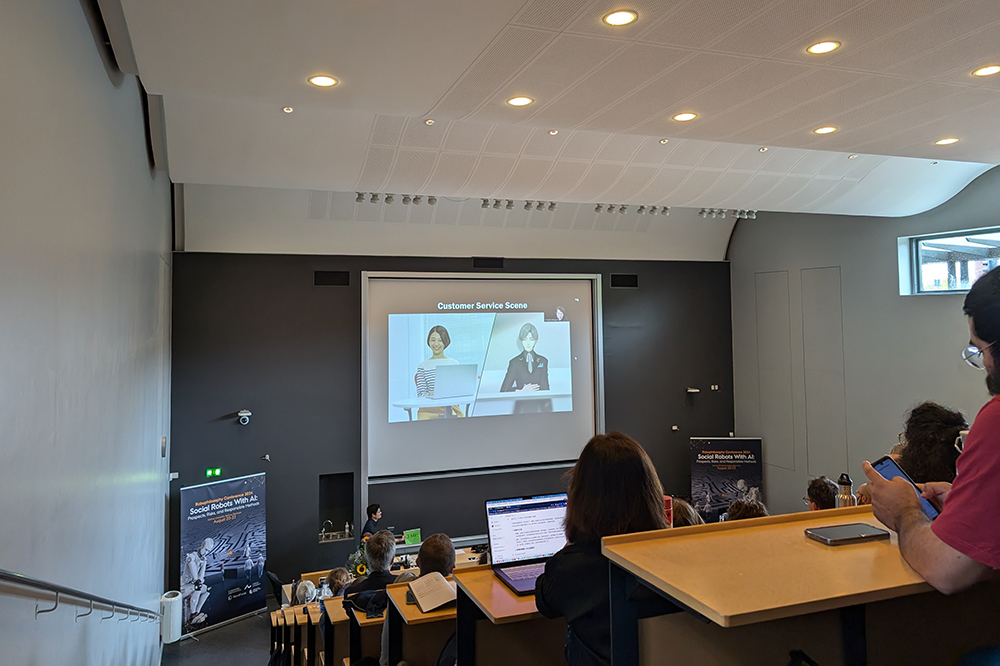
On the fourth day of Robophilosophy 2024, Hiroshi Ishiguro, Professor at the Department of Systems Innovation in the Graduate School of Engineering Science at Osaka University, gave a talk entitled “AI Avatars and the Future Society”. From the abstract: “In this lecture, the presenter will report on the research and development of remotely operated robots and CG agents, also known as avatars. Avatar technology has advanced significantly in recent years, thanks to progress in AI technology. We will discuss the various services that can be deployed using avatars and the kind of society we can realize as a result.” (Website Robophilosophy 2024) After the lecture, the roboticist was questioned by Raja Chatila, Sorbonne University (France), and Mihaela Constantinescu, Faculty of Philosophy, University of Bucharest (Romania). Hiroshi Ishiguro had been a regular guest at Robophilosophy. In 2018, he appeared on site in Vienna.
The Rainbow Above the Museum
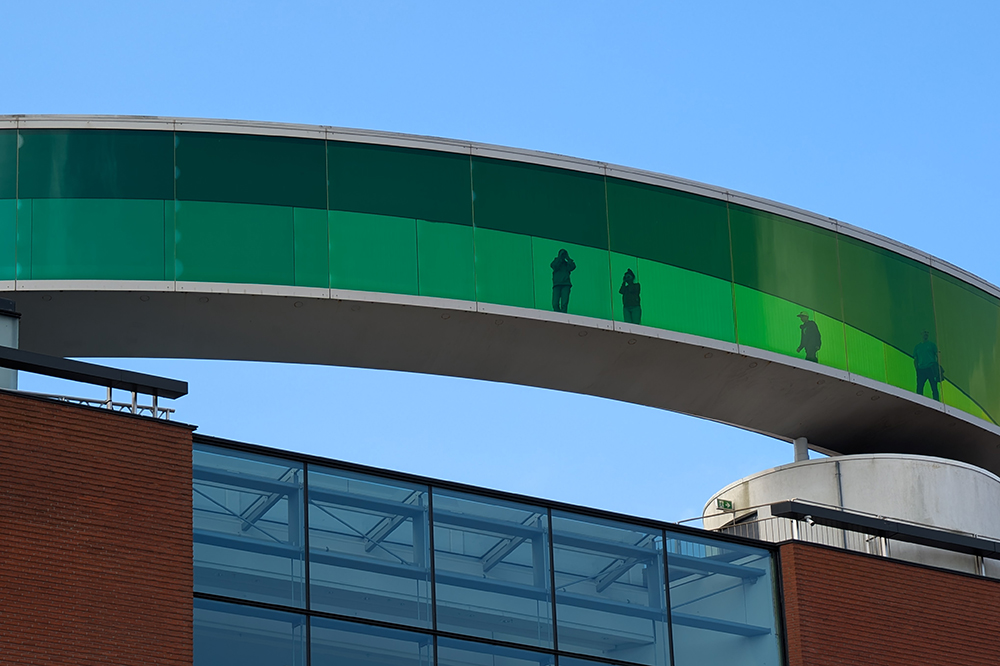
The Robophilosophy community consists of philosophers, psychologists, roboticists, and representatives of other disciplines. It is a tradition for everyone to come together for a social event to get new inspiration and chat about their work and motivation in an informal atmosphere. This time, they attended a robot performance in the theater on the second day. On the third day, the conference dinner was held together in the rooftop restaurant of the AROS Art Museum. One of the highlights was the tour of the ninth floor. The Danish-Icelandic artist Olafur Eliasson has created Your rainbow panorama which was officially opened in May 2011. You can see Aarhus with its church towers, residential buildings, streets, and people through the colorful panes. Afterwards, the tireless went out into the city’s nightlife.
Keynote by Emily Cross
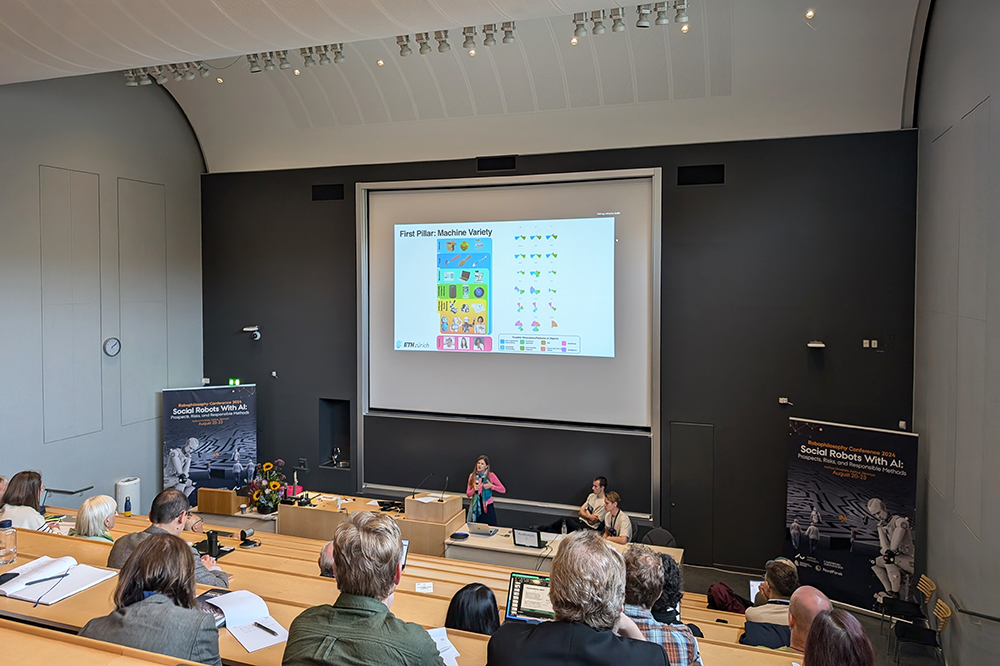
On the third day of Robophilosophy 2024, Emily Cross, a dancer and cognitive neuroscientist from ETHZ, gave a keynote speech entitled “Mind Meets Machine – Neurocognitive Perspectives on Human-Robot Interaction”. From the abstract: “Understanding how we perceive and interact with others is a core challenge of social cognition research. This challenge is poised to intensify in importance as the ubiquity of artificial intelligence and the presence of humanoid robots in society grows. This talk examines how established theories and methods from psychology and neuroscience are revealing fundamental aspects of how people perceive, interact with, and form social relationships with robots. Robots provide a resolutely new approach to studying brain and behavioural flexibility manifest by humans during social interaction. As machines, they can deliver behaviours that can be perceived as “social”, even though they are artificial agents and, as such, can be programmed to deliver a perfectly determined and reproducible set of actions. As development of service robots, home companion robots and assistance robots for schools, hospitals and care homes continues apace, whether we perceive such machines as social agents and how we engage with them over the long term remains largely unexplored. This talk describes research that bridges social cognition, neuroscience and robotics, with important implications not only for the design of social robots, but equally critically, for our understanding of the neurocognitive mechanisms supporting human social behaviour more generally.” (Website Robophilosophy 2024)
Start of Robophilosophy 2024
On August 20, 2024, Robophilosophy 2024 was opened with words of welcome from Maja Horst, Dean of the Faculty of Arts at Aarhus University, and Johanna Seibt, Professor of the School of Culture and Society at Aarhus University. The website says: “The international research conference RP2024 will discuss the questions that really matter in view of the new technological potential of social robotics. In over 100 research talks, RP2024 will address concrete and deep issues that reach far beyond safety and privacy concerns into the conceptual and normative fabric of our societies and individual self-comprehension.” (Website Robophilosophy 2024) The first keynote on the first day of the conference was given by Wendell Wallach, one of the world’s best-known machine ethicists. With his book “Moral Machines” (2009), he laid the foundation for a discipline that has been developing in science fiction and science for years and decades. This was followed in 2011 by “Machine Ethics” by Michael Anderson and Susan L.eigh Anderson. In addition to machine ethics, Robophilosophy is dedicated to robot ethics and other interesting perspectives on social robots.
A Cobot as Conductor of a Symphony
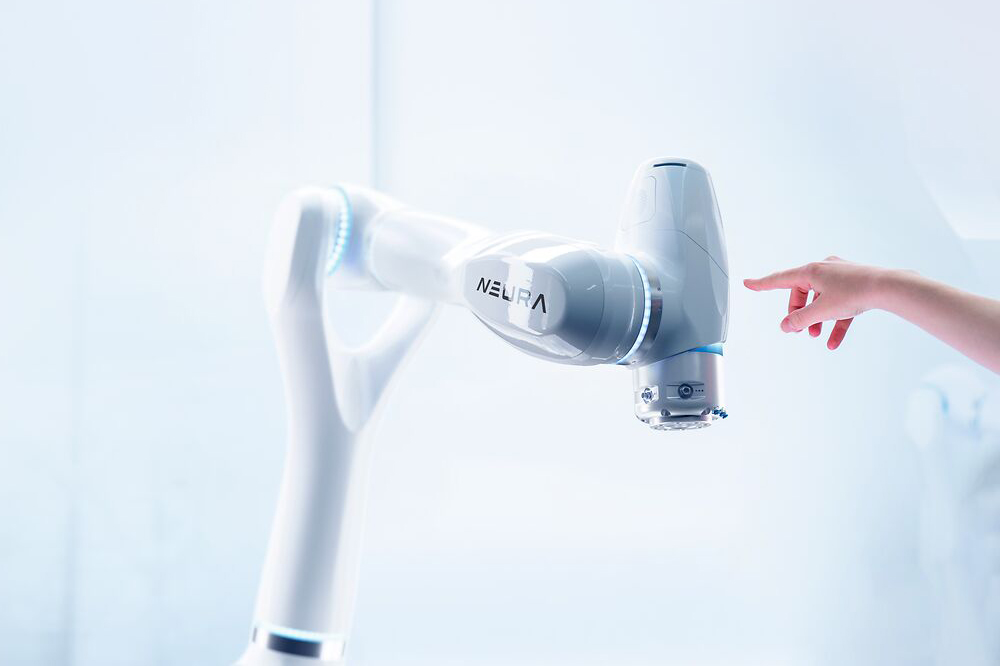
Cobots that dance with humans have been around for a long time. In 2016, the audience at Südpol Luzern witnessed dance and robot history being written by Huang Yi, a choreographer from Taiwan. Cobots that set the pace for humans, on the other hand, are not yet the order of the day. The Dresden Symphony Orchestra is about to perform the “Roboter.Sinfonie”. After a while, conductor Michael Helmrath will hand over to MAiRA Pro S, a product from NEURA Robotics. According to Deutschlandfunk, the machine’s three arms will be able to guide the orchestra, which is divided into groups, through the most complex passages independently of each other. This will break completely new musical ground. According to the Dresden Symphony Orchestra’s calendar, the concerts will take place on October 12 and 13, 2024 at the Europäisches Zentrum der Künste Hellerau (Image: NEURA Robotics).
Cow Whisperer, Horse Whisperer, and Dog Whisperer
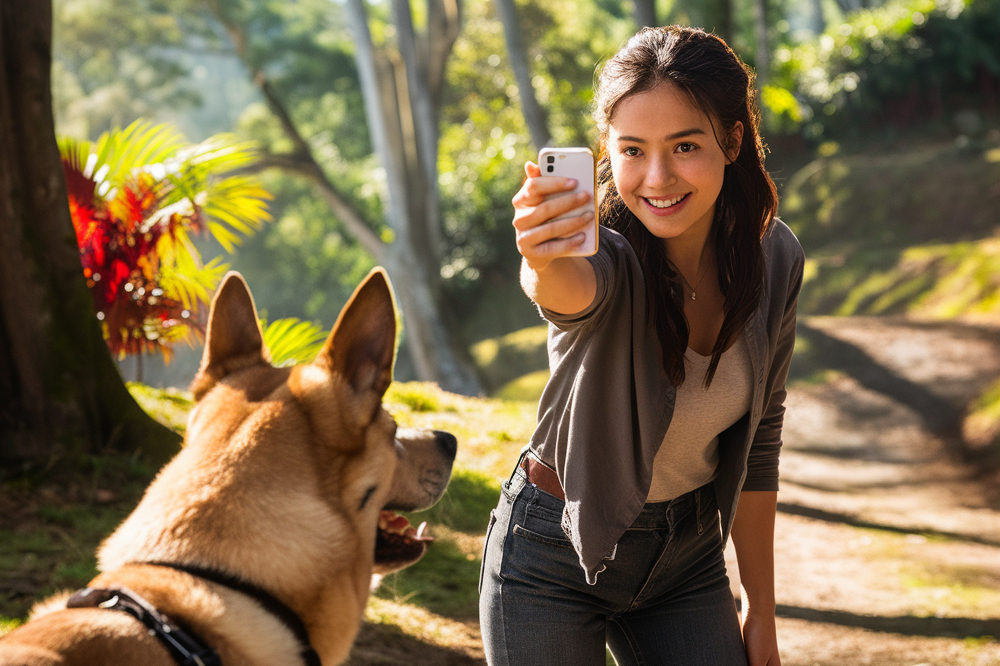
On August 5, 2024, the final presentation for the project “The Animal Whisperer” took place at the FHNW School of Business. It was initiated by Prof. Dr. Oliver Bendel, who has been working on animal-computer interaction and animal-machine interaction for many years. Nick Zbinden, a budding business informatics specialist, was recruited as a project collaborator. From March 2024, he developed three applications based on GPT-4o, the Cow Whisperer, the Horse Whisperer and the Dog Whisperer. They can be used to analyze the body language, behaviour, and environment of cows, horses and dogs. The aim is to avert danger to humans and animals. For example, a hiker can receive a recommendation on their smartphone not to cross a pasture if a mother cow and her calves are present. All they have to do is call up the application and take photos of the surroundings. The three apps are now available as prototypes. With the help of prompt engineering, they have been given extensive knowledge and skills. Above all, self-created and labeled photos were used. In the majority of cases, the apps correctly describe the animals’ body language and behavior. Their recommendations for human behavior are also adequate. The project team summarized the results in a paper and submitted it to an international conference (Image: Ideogram).
An AI-generated Teen Collection
Spanish fashion chain Mango has launched an advertising campaign created using AI models. First, all the clothes were photographed, then an AI model was trained to place the images on artificially generated models. The images were then retouched and edited. This was reported by Golem in an article dated July 30, 2024. Digital models are not new. They have been used for decades in various contexts, from computer games to mobile phone applications. Cameron-James Wilson founded an agency for digital models in London in 2019. He is the creator of the digital supermodel Shudu. Her sisters are Noonoouri and Lil Miquela. Since the triumph of generative AI, models have moved into another league. There are now beauty pageants for AI-generated models. The winners of Miss AI 2024 are Kenza Layli (Morocco), Lalina (France), and Olivia C (Portugal). They are already successfully represented on Instagram, showing themselves in various poses and dresses. According to Golem, Mango plans to sell the advertised collection in 95 countries. With this step, the company aims to reduce the costs that would otherwise be incurred for photographers, models and the entire production process (Image: DALL-E 3).