Registration for the 11th International Congress on Love and Sex with Robots (LSR 2026) is now open. Building on a conference series that began in 2011 and has helped establish the academic study of human-robot intimacy as an interdisciplinary field, LSR 2026 will take place on August 21–22 at the Université du Québec à Montréal (UQAM), with sessions hosted in the Pavillon J.A. DeSève in Montreal’s Latin Quarter. The conference is organized by Dr. Simon Dubé (Kinsey Institute, Indiana University Bloomington), Dr. David Levy, founder of the conference series, and Bobbi Bidochka (imagine ideation). The keynote speakers are Ellen M. Kaufman (Kinsey Institute, Indiana University Bloomington), Charlotte Poitras (multidisciplinary artist), and Valerie A. Lapointe (Université du Québec à Montréal), whose work spans informatics, psychology, media, and emerging technologies related to intimacy and AI. Further information on registration, the program, submissions, travel, and accommodation is available on the official conference website: www.lovewithrobots.com.
Playboy Interview on Chatbots, Love Dolls, and Sex Robots
At the end of July 2025, Playboy interviewed Prof. Dr. Oliver Bendel about relationships with chatbots, love dolls, and sex robots. The Playboy Special Edition was published in conjunction with the exhibition SEX NOW, which ran from September 5, 2025, to May 3, 2026. Beginning on September 11, 2025, the German magazine was available at the NRW-Forum Düsseldorf. It is visually stunning and delights readers with its playful and engaging language throughout. “Great Art in Playboy” presents “a small exhibition of significant visual artists and their works under the sign of the rabbit” (own translation). It features nude works ranging from Dalí to Warhol. “The Woman Without Taboos” is Beate Uhse, who, according to Playboy, “made the sexual revolution part of everyday life in Germany”. The magazine pays tribute to her with “an ode to an educator and businesswoman”. “Our Second-Best Friend” is the vibrator, whose cultural history is said to reveal “more about the relationship between the sexes than any sociology textbook”. A four-page feature includes a three-page interview with Oliver Bendel, a philosopher of technology based in Zurich. The interview was conducted by Christina Weiß. In the table of contents, it appears under the heading “Sex Devices”. The conversation explores sometimes exciting but always one-sided relationships with chatbots, love dolls, and sex robots. With the kind permission of Florian Boitin, Editor-in-Chief of Playboy Germany, the article has been available for download here since July 7, 2026.
Queering Sex Robots
An article titled “Queering Sex Robots Beyond Diversifying Design? Insights from Queer Lacanian Psychoanalysis and New Materialism” by Maaike van der Horst and Anna Puzio was published in the journal Philosophy & Technology in March 2026. Surprisingly, it does not reference several works that are highly relevant to the topic, including publications by Tanja Kubes and Oliver Bendel. As a result, some of the article’s claims to originality appear less convincing than they might otherwise have been. Following an exchange with one of the journal’s editors, Luciano Floridi, Oliver Bendel therefore submitted a commentary, which was published in Philosophy & Technology on June 10, 2026. From the abstract: “This commentary discusses Maaike van der Horst and Anna Puzio’s article ‘Queering Sex Robots Beyond Diversifying Design? Insights from Queer Lacanian Psychoanalysis and New Materialism’. While acknowledging the article’s valuable contribution, particularly its integration of Queer Lacanian Psychoanalysis and New Materialism, the commentary argues that its account of prior scholarship is incomplete. Several key themes and proposals presented as novel – including critiques of humanoid mimicry, new-materialist approaches to sexuality and technology, queer design concepts, relational ontology, and transformative sex robot forms – had already been developed in earlier work by Tanja Kubes and Oliver Bendel. The omission of these contributions affects assessments of originality, the reconstruction of the field’s intellectual development, and the allocation of scholarly credit. The commentary therefore calls for a more comprehensive scholarly genealogy of queer and new-materialist approaches to sex robots and argues that careful citation practices are essential to maintaining the integrity of academic discourse.” The article “Who Queered the Sex Robot? Notes on Attribution and Conceptual History” can be accessed at link.springer.com/article/10.1007/s13347-026-01123-3 (Photo: Cybrothel).
SEX NOW
The exhibition “SEX NOW” will take place from September 5, 2025, to May 3, 2026, at the NRW-Forum Düsseldorf. According to the website, “Sex can be beautiful, exciting, provocative, and political”. “With the exhibition SEX NOW, we invite visitors to rediscover sexuality in all its complexity. A central starting point of the exhibition is the observation that the sex industry has shifted in recent years from a predominantly male-dominated field to one increasingly shaped by women. What are the causes of this transformation? How does this development affect the way sexuality is portrayed in the media and society? What impact does it have on the design and marketing of products and on sexual self-determination?” (Website NRW-Forum, own translation) The exhibition features works by Paul McCarthy, Peaches, Zheng Bo, Tom of Finland, Joëlle Dubois, Poulomi Basu, Miyo van Stenis, Antigoni Tsagkaropoulou, Martin de Crignis, and Melody Melamed, among others. Starting September 11, a Playboy Special Edition will be available. It includes works or contributions by Helmut Newton, Erika Lust, and Ana Dias, as well as an interview with Oliver Bendel on relationships with chatbots, love dolls, and sex robots. More information is available at www.nrw-forum.de/ausstellungen/sex-now.
What We Can Do with Sex Robots
“Anthropomorphic love dolls – the successors of basic blowup dolls – are widely used these days, both in brothels and at home. While they can offer physical comfort and sexual satisfaction, they certainly cannot engage in more complex interactions with their counterparts. However, sex robots can – or at least they ought to. For now, the offer is not extensive and prices are high. The motor abilities of current models are limited and mainly focus on the head, while the body is usually identical to that of a love doll. Obviously, sex robots are made primarily to have sex with. But the user can also talk to and even form a relationship with them. This in mind, we are now starting to think about other applications of humanoid sex robots in the future – at least when their motor skills have improved. The possibilities might surprise you …” (De Gruyter Conversations, 23 April 2021) The full article is available via blog.degruyter.com/what-we-can-do-with-sex-robots-besides-the-obvious/ …
Intimate Relationships with Humanoid Robots
In October 2020 the book “Maschinenliebe” (ed. Oliver Bendel) was published by Springer. The title means “Machine Love”, “Machines for Love” or “Machines of Love”. Three contributions are in English. One of them (“Intimate Relationships with Humanoid Robots”) is by Yuefang Zhou and Martin H. Fischer (University of Potsdam). From the abstract: “The topic of human-robot intimate relationships is not only an intensely emotional one that is present in the mass media because of its ability to stir excitement. The very same topic also requires our understanding of basic mechanisms of the human mind and of social cognition in particular. A scientifically-minded framing of the debate around whether and how we might engage in intimate relationships with humanoid robots in the near future might in turn improve our understanding of human sexuality. Viewed from this angle, intimate human-robot interaction is then merely one of many examples of studying human-machine interactions for the benefit of users and as a means of improving our knowledge about humans and the human mind. In this chapter we will adopt such a stance and discuss both social-cognitive and sexual aspects of this innovative topic, review available empirical evidence and offer some suggestions for further research.” More information via www.springer.com/de/book/9783658298630.
Love Dolls and Sex Robots in Prisons
On 24 October 2020 the article “Love Dolls and Sex Robots in Unproven and Unexplored Fields of Application” by Oliver Bendel was published in Paladyn, Journal of Behavioral Robotics. From the abstract: “Love dolls, the successors of blow-up dolls, are widespread. They can be ordered online or bought in sex shops and can be found in brothels and households. Sex robots are also on the rise. Research, however, has been slow to address this topic thoroughly. Often, it does not differentiate between users and areas of application, remaining vague, especially in the humanities and social sciences. The present contribution deals with the idea and history of love dolls and sex robots. Against this background, it identifies areas of application that have not been investigated or have hardly been investigated at all. These include prisons, the military, monasteries and seminaries, science, art and design as well as the gamer scene. There is, at least, some relevant research about the application of these artefacts in nursing and retirement homes and as such, these will be given priority. The use of love dolls and sex robots in all these fields is outlined, special features are discussed, and initial ethical, legal and pragmatic considerations are made. It becomes clear that artificial love servants can create added value, but that their use must be carefully considered and prepared. In some cases, their use may even be counterproductive.” The article is available here for free as an open access publication.
Guys and Dolls
In October 2020 the book “Maschinenliebe” (ed. Oliver Bendel) was published by Springer. The title means “Machine Love”, “Machines for Love” or “Machines of Love”. Three contributions are in English. One of them (“Guys and Dolls”) is by Kate Devlin and Chloé Locatelli (King’s College London). From the abstract: “This chapter explores the creators and potential consumers of sex robots. With Realbotix as our case study, we take a closer look at the language and sentiments of those developing the technology and those who are testing, consuming, or showing an interest in it. We do this by means of website and chat forum analysis, and via interviews with those involved. From this, we can see the motivation for developing a sexual companion robot places the emphasis firmly on the companionship aspect, and that those involved in creating and consuming the products share an ideology of intimacy and affection, with sexual gratification only playing a minor role.” More information via www.springer.com/de/book/9783658298630.
Talking to Harmony
At the end of June 2020, DIE WELT conducted an interview with Prof. Dr. Oliver Bendel about sex robots and love dolls. It was especially about their natural language skills. Particularly owners and users who want to have a relationship are interested in conversations of all kinds, about God and the world and in the sense of “dirty talk”. Companies like Realbotix go very far in this respect. Harmony for example can talk to her partners for hours in a quite convincing way. The engineers experiment with GPT-2, but also with other language models. Kino Coursey, AI boss of Realbotix, deals with this topic in his article “Speaking with Harmony” for the book “Maschinenliebe” (“Machine Love”) which will be released in October. The interview with Oliver Bendel was published on 11 July 2020 in the printed edition of DIE WELT, under the title “Intelligente Sexroboter sind begehrte Gesprächspartner” (already published the day before in the electronic edition, under the title “Was Sexpuppen können” …). In addition, an English version – “Intelligent sex robots are sought-after dialogue partners” – is available.
Jealousy 4.0
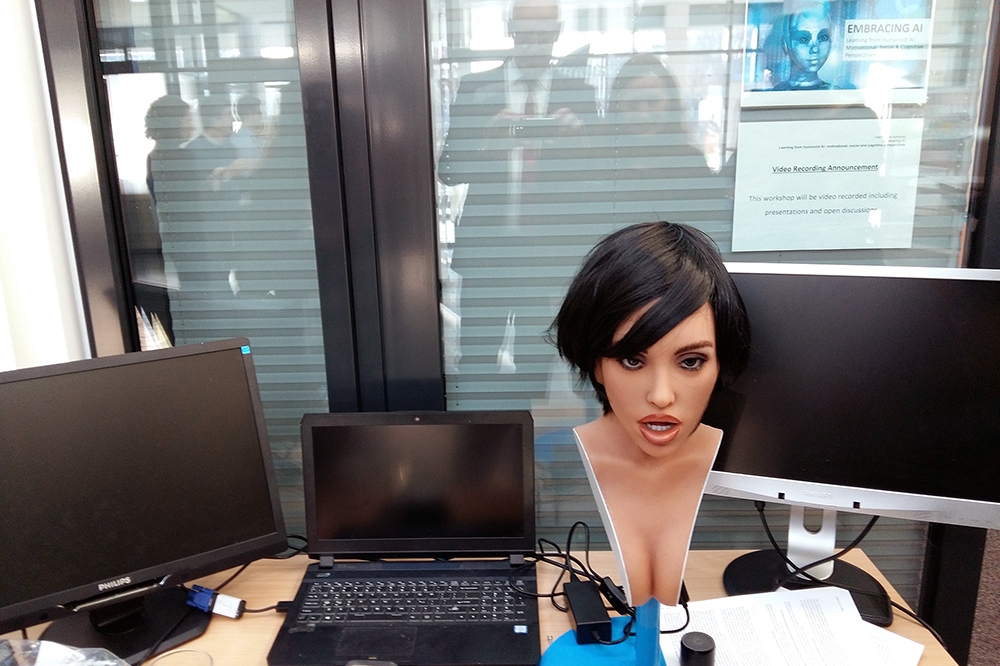
The international workshop “Learning from Humanoid AI: Motivational, Social & Cognitive Perspectives” took place from 30 November – 1 December 2019 at the University of Potsdam. Dr. Jessica Szczuka raised the question: “What do men and women see in sex robots?” … Her talk was based on the paper “Jealousy 4.0? An empirical study on jealousy-related discomfort of women evoked by other women and gynoid robots” by herself and Nicole Krämer. In their introduction the authors write: “In a paper discussing machine ethics, Bendel asked whether it is ‘possible to be unfaithful to the human love partner with a sex robot, and can a man or a woman be jealous because of the robot’s other love affairs?’ … In this line, the present study aims to empirically investigate whether women perceive robots as potential competitors to their relationship in the same way as they perceive other women to be so. As the degree of human-likeness of robots contributes to the similarity between female-looking robots and women, we additionally investigated differences between machine-like female-looking robots and human-like female-looking robots with respect to their ability to evoke jealousy-related discomfort.” (Paper) The paper can be accessed here.