The upcoming “SAGA: Sexuality and Generative AI” symposium, taking place on April 30, 2026 at the Université du Québec à Montréal, explores how generative AI is reshaping intimacy, desire, relationships, and sexual expression. The first block, titled “Societal Impacts”, brings together a set of talks that examine how emerging technologies are already influencing human connection and cultural norms. Brian Willoughby (Brigham Young University, United States) opens with “Engagement with Romantic AI: Implications for Young Adult Dating and Relationships”, addressing how AI companions may alter expectations and behaviors in modern dating. Arnaud Anciaux (Université Laval, Canada) follows with “Toward a Great Bypass? Property, Consent, and Value Creation in AI-Generated Sexual Content”, focusing on legal and ethical questions around ownership and consent. Émilie Gaudet (Université de Montréal, Canada) contributes “AI-Generated Pornography and Problematic Pornography Use”, exploring the psychological and societal risks associated with synthetic sexual media. Finally, Oliver Bendel (FHNW School of Business, Switzerland) looks ahead in “Physical AI and the Future of Intimacy”, considering how embodied AI systems could transform intimate relationships. The program also features “Panel 1 – Technological Solutions to the Challenges of AI”, with contributions from Sophie Mortimer (UK Revenge Porn Helpline, United Kingdom), Alex Georges (AetherLab, United States), and Madelaine Thomas (Image Angel, United Kingdom), who discuss practical responses to harms such as non-consensual content and digital abuse. Overall, the symposium is structured into four thematic blocks and includes two panels, offering a compact yet wide-ranging exploration of one of the most sensitive and rapidly evolving intersections of technology and human life. The SAGA conference program is now available online and can be downloaded here.
Robophilosophy 2026 Now Open for Registration
The Robophilosophy Conference 2026 (RP2026), titled “Connected Futures – Nature, Robots, and Society”, will take place August 11-14, 2026, in Dublin, Ireland, bringing together researchers from across disciplines to examine how robotics and artificial intelligence are reshaping human societies and the natural world. As robotic systems become increasingly embedded in everyday life, the conference aims to foster dialogue between fields ranging from social robotics, computer science, and human-robot interaction to the humanities, social sciences, law, economics, and environmental research. Central questions include how robotic technologies can uphold human dignity and social justice, how legal systems must adapt to autonomous decision-making, and whether robots can contribute to sustainability rather than accelerate ecological decline. The event marks the seventh installment in the Robophilosophy conference series and features plenary speakers such as Lynne Baillie, Ryan Calo, Hideki Kajima, Arno Klein, Bertram Malle, and Shannon Vallor. Importantly, the submission deadline for research papers, posters, and artistic contributions has been extended to March 15, 2026, offering additional time for scholars and practitioners to contribute to this interdisciplinary conversation. Registration is now open, and further details are available at www.rp2026.org.
Guest Lecture by Luca M. Leisten
The elective module “Soziale Roboter” by Prof. Dr. Oliver Bendel will be held again from March 30 to April 1, 2026, at FHNW in Olten. It is primarily aimed at prospective business AI students, but students of information systems can also take part. Luca Marie Leisten has been invited as a guest speaker. She is a third-year doctoral student in learning sciences and human-robot interaction at ETHZ and EPFL. With a background in psychology and social sciences, Luca’s research focuses on social robot companions in the learning domain. Specifically, she is interested in investigating the barriers and opportunities of social robot deployment as well as the perception of different robots. In this context, Luca is testing the long-term effects of affordable DIY robotic toolkits using a mix of quantitative and qualitative methods. Unitree Go2, Alpha Mini, Cozmo, Vector, AIBI, Eilik, Furby, Booboo, and Hugvie from Oliver Bendel’s private Social Robots Lab will also be on site. Social Robotics Girl, a so-called GPT specializing in this topic, will be available as a tutor throughout the event. Key works include “Soziale Roboter” (2021) and “300 Keywords Soziale Robotik” (2021). At the end of the elective module, students design social robots – also with the help of generative AI – that they find useful, meaningful, or simply attractive. The elective module has been offered since 2021 and is very popular at the university.
New Perspectives on Queering Sex Robots
A new article titled “Queering Sex Robots Beyond Diversifying Design? Insights from Queer Lacanian Psychoanalysis and New Materialism” (van der Horst & Puzio, 2026) has been published in Philosophy & Technology. The authors argue that queering sex robots should go beyond diversifying their physical design and instead involve a broader reconsideration of sexuality, identity, and human-technology relations. The paper starts from a critique widely discussed in the literature: current sex robot models largely reproduce heteronormative and stereotypical representations of femininity. Similar observations and related arguments can be found in earlier contributions in the volume “Maschinenliebe” (Bendel 2020). In that book, Tanja Kubes addresses the topic in her chapter “Queere Sexroboter”, while Oliver Bendel discusses transformations of gender and embodiment in “Trans-Formers”. Both contributions also refer to examples such as the Harmony robot from Realbotix/RealDollX. The main novelty of the new article lies in its theoretical framework, which combines Queer Lacanian psychoanalysis and New Materialism. Given the thematic overlap and the small number of publications on queer perspectives on sex robots, it is somewhat surprising that the earlier contributions in “Maschinenliebe” are not referenced. This book is predominantly written in German, but in times of large language models this should hardly pose a barrier. Moreover, the chapters by Kubes and Bendel have already been cited in several English-language academic publications (Photo: Cybrothel).
Robophilosophy 2026: Submission Deadline Extended
The Robophilosophy Conference 2026 (RP2026), titled “Connected Futures – Nature, Robots, and Society”, will take place August 11-14, 2026, in Dublin, Ireland, bringing together researchers from across disciplines to examine how robotics and artificial intelligence are reshaping human societies and the natural world. As robotic systems become increasingly embedded in everyday life, the conference aims to foster dialogue between fields ranging from social robotics, computer science, and human-robot interaction to the humanities, social sciences, law, economics, and environmental research. Central questions include how robotic technologies can uphold human dignity and social justice, how legal systems must adapt to autonomous decision-making, and whether robots can contribute to sustainability rather than accelerate ecological decline. The event marks the seventh installment in the Robophilosophy conference series and features plenary speakers such as Lynne Baillie, Ryan Calo, Hideki Kajima, Arno Klein, Bertram Malle, and Shannon Vallor. Importantly, the submission deadline for research papers, posters, and artistic contributions has been extended to March 15, 2026, offering additional time for scholars and practitioners to contribute to this interdisciplinary conversation. Registration will open soon, and further details are available here and at www.rp2026.org.
Social Robots at Campus Brugg-Windisch
The elective module “Soziale Roboter aus technischer, wirtschaftlicher und ethischer Sicht” (“Social robots from a technical, economic, and ethical perspective”) by Prof. Dr. Oliver Bendel will be held again from February 12 to 14, 2026 at the FHNW in Brugg-Windisch. It is primarily aimed at aspiring business economists, but prospective information systems specialists can also take part. Dr. Amol Deshmukh has been invited again as a guest speaker. He previously worked for the University of Glasgow and now conducts research at ETH Zurich. In his lecture, he will present the findings from his paper “Leveraging Social Robots to Promote Hand Hygiene: A Cross-Cultural and Socio-Economic Study of Children in Diverse School Settings”. Unitree Go2, Alpha Mini, Cozmo, Vector, Aibi, Furby, and Booboo from Oliver Bendel’s private Social Robots Lab will also be on site. Social Robotics Girl, a so-called GPT who specializes in this topic, will be available as a tutor throughout the event. Basic works are “Soziale Roboter” (2021) and “300 Keywords Soziale Robotik” (2021). At the end of the elective module, students design social robots – also with the help of generative AI – that they find useful, meaningful, or simply attractive. The elective modules have been offered since 2021 and are very popular.
SETI Instead of METI
As part of the ToBIT event series at the FHNW School of Business, four students of Prof. Dr. Oliver Bendel explored four topics related to his field of research during the Fall 2025/2026 semester: “The decoding of symbolic languages of animals”, “The decoding of animal body language”, “The decoding of animal facial expressions and behavior”, and “The decoding of extraterrestrial languages”. The students presented their papers on January 9, 2026. In some cases, the state of research was not only reviewed, but an independent position was also developed. The paper “The decoding of extraterrestrial languages” by Ilija Bralic argues that Messaging Extraterrestrial Intelligence (METI), in contrast to passive SETI (Search for Extraterrestrial Intelligence), creates a dangerous imbalance between humanity’s rapidly expanding technical capacity to send interstellar messages and its limited ethical, scientific, and political ability to govern this power responsibly. The central thesis is that the moral justifications for METI are speculative and anthropocentric, relying largely on optimistic assumptions about extraterrestrial behavior, while the potential risks are severe, logically grounded, and potentially existential. These risks include fundamental misinterpretation caused by the “human lens,” strategic dangers described by the Dark Forest hypothesis, historical patterns of harm in technologically asymmetric encounters, and profound cultural, psychological, and political disruption. The paper concludes that unilateral METI decisions by individuals or private groups are ethically indefensible and that, under the Precautionary Principle, humanity should immediately halt active transmissions. As a solution, it proposes a binding international governance framework, including a temporary global moratorium, the creation of a dedicated international authority, a strict multi-stage decision-making protocol, and robust transparency and monitoring mechanisms. This approach frames responsible restraint – not transmission – as humanity’s first genuine test of cosmic maturity.
Nature, Robots, and Society
The Robophilosophy Conference 2026 will take place August 11–14 at University College Dublin in a hybrid format and centers on the theme “Connected Futures: Nature, Robots, and Society”. As robotics and AI become deeply embedded in human life, the conference invites researchers across disciplines to explore how autonomous systems shape society, ecology, law, labor, and human self-understanding. It raises questions about responsible design, accountability, environmental impact, social justice, cultural perspectives, and the ethics of coexistence with artificial agents. Workshop proposals are due January 16, session papers and posters February 6, with notifications in February and April and proceedings pre-submission on June 15. RP2026 aims to foster interdisciplinary dialogue that advances both technological insight and collective wisdom for a future in which humans and autonomous systems share social and ecological worlds. Further information is available at cas.au.dk/en/rpc2026.
Intelligens. Natural. Artificial. Collective.
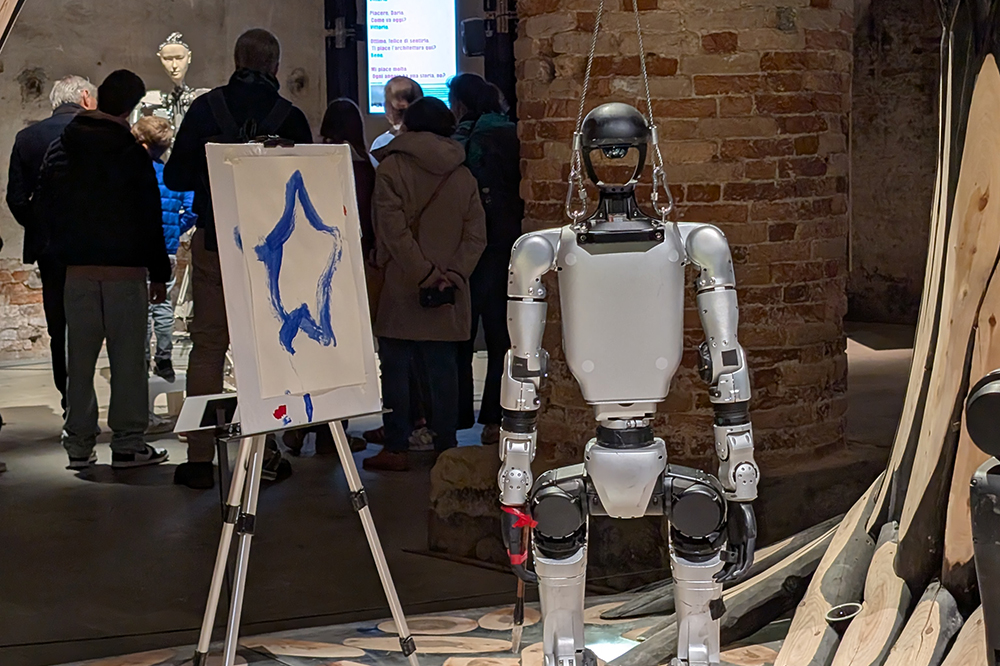
At the 19th Architecture Biennale in Venice (Biennale Architettura 2025) with the title “Intelligens. Natural. Artificial. Collective.”, robots play an important role. This is reported by several media, such as The Architect’s Newspaper. “Robots Falling from the Sky” is an installation in which robots appear to fall from the sky and interact with their surroundings. Another robot demonstrates its musical abilities by playing a handpan, a brass instrument. One is reminded of Henri-Louis Jaquet-Droz’s 18th century musician, who preferred a keyboard instrument. A robotic arm from ABB assists two Bhutanese craftsmen in working on a beam. For safety reasons, according to The Architect’s Newspaper, live carving with a drill was not permitted. The problem is not the two artisans, but the visitors. The Biennale is always dedicated to technical and futuristic themes. In 2021, the Architecture Biennale focused on cyborgs and transhumanists, among other things. In 2024, the art biennial featured a quasi-hologram and a spaceship-like installation. The Biennale runs from May 10 to November 23, 2025 at various venues in and near Venice, including the Giardini della Biennale, the Arsenale di Venezia, and the Forte Marghera in Mestre. Further information and the full program can be found at www.labiennale.org/en/architecture/2025 (Photo: Biennale Arte 2024).
Interpersonal Distance Preferences in Human-Robot Interactions
The paper “Robots at arm’s length: Unveiling the dynamics of interpersonal distance preferences in human-robot interactions” by Katharina Kühne, Laura M. Zimmer, Melina Jeglinski-Mende, Oliver Bendel, Yuefang Zhou, and Martin H. Fischer was published in February 2025 in the proceedings volume “Social Robots with AI: Prospects, Risks, and Responsible Methods” … From the abstract: “In social interactions, interpersonal distance is a vital factor influencing relationships, providing protection, and regulating arousal. Despite the intuitive nature of adopting specific distances, little is known about comfortable interpersonal distances with social robots. In our online study with 66 participants using a Go/No-Go task, we investigated perceptions of individuals standing face-to-face with a robot at different distances. In line with the negativity bias hypothesis, participants exhibited a preference for greater distances , as reflected in longer reaction times. Furthermore, the human-likeness of the robots moderated the link between distance and arousal. Finally, the most human-like robot was less liked and evoked higher arousal. These findings have implications for designing social robots and optimizing interactions, particularly in educational or medical contexts.” The proceedings volume comprises the papers presented at Robophilosophy 2024 in Aarhus. Leading philosophers, computer scientists, and roboticists met there in August. Like the ICSR, the conference is one of the world’s leading conferences on social robotics.