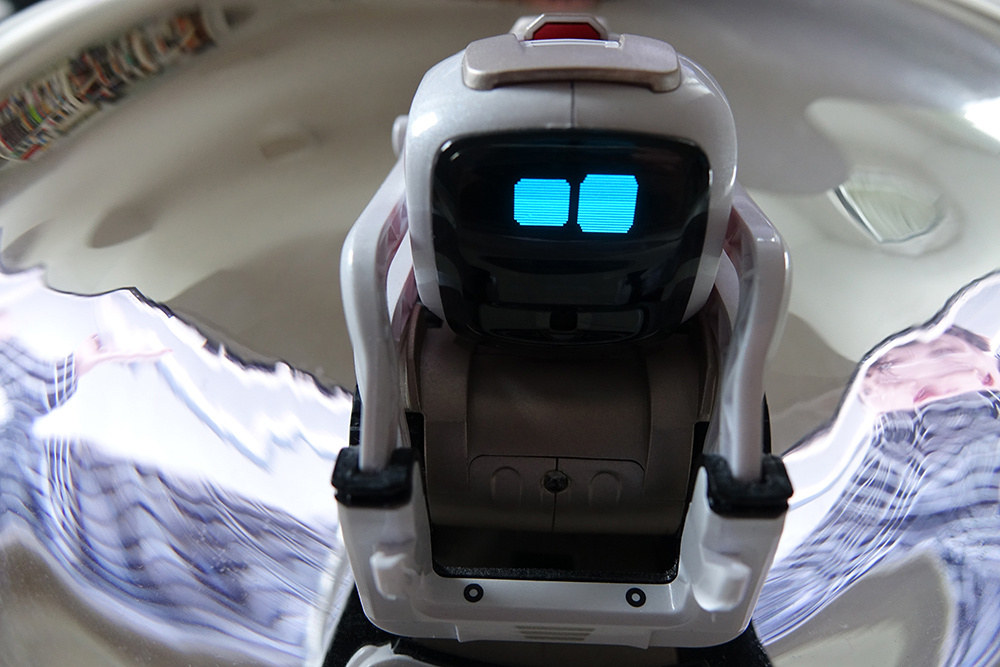
According to The Robot Report, Anki’s little robots might be making a comeback. Digital Dream Labs in Pittsburgh acquired the patents, trademarks, and domain. The start-up company “is planning to revive and manufacture more units of each product in the following order: Overdrive, Cozmo, Vector” (The Robot Report, 26 December 2019). Digital Dream Labs founder H. Jacob Hanchar told The Robot Report “the goal is to have all three products available for purchase for Christmas 2020” (The Robot Report, 26 December 2019). The small robots belong to the best that the industry has produced. What is special about Cozmo is the many emotions it can show (but of course doesn’t have). It also has face recognition and a night vision device. The future of it and its siblings is not yet clear, as Digital Dream Labs has not purchased “physical assets and inventory” (The Robot Report, 26 December 2019). Fans are waiting and hoping.
A Garbage Robot for Space
According to Tages-Anzeiger (9 December 2019), a consortium led by a Swiss start-up named Clearspace has won a ESA competition and was awarded the contract for a waste disposal mission in orbit. The so-called “chaser” of the EPFL spin-off has four robotic arms with which a remnant of the ESA launch vehicle Vega is to be captured and drawn. Chaser and the part of Vespa will then burn up together in the atmosphere. Later, the company wants to look for new targets. According to Luc Piguet, the issue of space debris is more urgent than ever. The founder and CEO of Clearspace says that there are currently almost 2,000 active and 3,000 inactive satellites. The problem is likely to worsen over the next few years. Where people roam, the mountains of rubbish grow and space fills with rubbish. This may sound literary, but above all, it’s terrible. Robots could be a solution both on Earth and in orbit.
The Interceptor in the Cengkareng Drain
Plastic in rivers and seas is one of the biggest problems of our time. Whether bottles or bags, whether macro or micro plastic – the flora and fauna is impaired and destroyed. Six projects against plastic waste have already been presented here. The focus was on the seas. One of the initiatives is now also active in the rivers. This is very important because what is fished out in the rivers no longer ends up in the oceans. The magazine Fast Company reported on 26 October 2019: “In the Cengkareng Drain, a river that runs through the megacity of Jakarta, Indonesia, tons of plastic trash flows to the ocean each year. But now a new solar-powered robot called the Interceptor is gobbling up the waste so that it can be recycled instead. The system was designed by the nonprofit The Ocean Cleanup, which spent the past four years secretly developing and testing the technology while it continued to work on its main project – a device that can capture plastic trash once it’s already in the ocean.” (Fast Company, 26 October 2019) This is good news. However, the most important thing is to avoid plastic waste. Otherwise, the destruction of the waters will continue unstoppably.
How to Improve Robot Hugs
Hugs are very important to many of us. We are embraced by familiar and strange people. When we hug ourselves, it does not have the same effect. And when a robot hugs us, it has no effect at all – or we don’t feel comfortable. But you can change that a bit. Alexis E. Block and Katherine J. Kuchenbecker from the Max Planck Institute for Intelligent Systems have published a paper on a research project in this field. The purpose of the project was to evaluate human responses to different robot physical characteristics and hugging behaviors. “Analysis of the results showed that people significantly prefer soft, warm hugs over hard, cold hugs. Furthermore, users prefer hugs that physically squeeze them and release immediately when they are ready for the hug to end. Taking part in the experiment also significantly increased positive user opinions of robots and robot use.” (Abstract) The paper “Softness, Warmth, and Responsiveness Improve Robot Hugs” was published in the International Journal of Social Robotics in January 2019 (First Online: 25 October 2018). It is available via link.springer.com/article/10.1007/s12369-018-0495-2.
The Girl with Robot Arms
Tilly Lockey was diagnosed with Meningococcal Septicaemia Strain B when she was 15 months old. Due to that disease, the doctors had to amputate both her arms and toes to give her a chance to survive. Since then, her mom has been fighting to ensure that she can do everything that children with hands can do. In the past years, they tried various myoelectric prosthesis, which Tilly describes as “very basic” as these were only capable of opening and closing. In January 2019 Tilly was surprised with Open Bionic Hero Arms for the Alita: Battle Angel film premiere. This medically certified prosthesis is custom 3D-printed and detects muscle movement thanks to special sensors. It works fully intuitively and provides its user with feedback through vibrations, lights and sounds. Thanks to 3D printing, an arm can be made within 40 hours and is quite affordable compared to other bionic hands (launching price of £5,000). The Hero Arms allow Tilly to be a “normal” teenager. She says she feels “more like everyone else”. Which is apparent in simple things such as doing thumbs up on a selfie or playing the Wii. Intelligent prostheses like the Hero Arms have a great impact on the quality of life for people like Tilly. It is that kind of transhuman achievements that increase independence and self-confidence tremendously for individuals. Here you can find more Hero Arm success stories (image source: Open Bionics Press Images).
An Autonomous Ship at Sea
The Mayflower Autonomous Ship (MAS) could be the first vessel to cross the Atlantic that is able to navigate around obstacles and hazards by itself. It will depart from Plymouth, UK on the fourth centenary of the original Mayflower voyage, on 6 September 2020, and will reach Plymouth, USA after an ecxiting tour, dedicated to science. “The project was put together by marine research and exploration company ProMare in an effort to expand the scope of marine research. The boat will carry three research pods equipped with scientific instruments to measure various phenomena such as ocean plastics, mammal behaviour or sea level changes.” (ZDnet, 16 October 2019) According to ZDnet, IBM has now joined the initiative to supply technical support for all navigation operations. It is important that the futuristic ship is not only careful with things, but also with animals. In this context, insights of animal-machine interaction and machine ethics might be useful. Ultimately, the excursion will help the marine mammals by obtaining data on their behaviour.
Towards Robots with Artificial Skin
“Sensitive synthetic skin enables robots to sense their own bodies and surroundings – a crucial capability if they are to be in close contact with people. Inspired by human skin, a team at the Technical University of Munich (TUM) has developed a system combining artificial skin with control algorithms and used it to create the first autonomous humanoid robot with full-body artificial skin.” (Press Release TUM, 10 October 2019) The robot skin consists of hexagonal cells which are about the size of a two-euro coin. Each of them is equipped with a microprocessor and sensors to detect contact, acceleration, proximity, and temperature. “Such artificial skin enables robots to perceive their surroundings in much greater detail and with more sensitivity. This not only helps them to move safely. It also makes them safer when operating near people and gives them the ability to anticipate and actively avoid accidents.” (Press Release TUM, 10 October 2019) The artificial skin could become important for service robots of all kinds, but also for certain industrial robots (Photo: Department of Electrical and Computer Engineering, Astrid Eckert).
Atlas Does a Handstand
In a new video, Boston Dynamics shows its humanoid Atlas performing various gymnastics exercises. This was reported by Heise on 26 September 2019 with reference to various sources. The well-known robot is 1.50 meters high and weighs 80 kilograms. It has two legs and two arms and the impression of a head. Among other things, it does a handstand and several somersaults, and it jumps with rotation around its own axis. Obviously, it can do complex physical movements typically only possible for humans. According to Heise, a new optimization algorithm, which translates certain maneuvers into executable reference movements, enables this progress in movements. Boston Dynamics is part of SoftBank. The Japanese company also manufactures Pepper and Nao, the well-known robots of the formerly independent French company Aldebaran Robotics.
Robots for Climate
On 20 September 2019 FridaysforFuture had called for worldwide climate strikes. Hundreds of thousands of people around the world took to the streets to protest for more sustainable industry and long-term climate policies to combat global warming. Technological progress and the protection of the environment do not necessarily have to contradict. Quite the opposite, we will present 3 robots which show that technology can be used to achieve climate goals. Planting trees is the most efficient strategy to recover biodiversity and stop climate change. However, this method requires lots of human power. The GrowBot automates this task resulting in a planting rate that is 10 times faster than trained human planters. Unique from planting drones, this small truck-like robot not only spreads seeds, but it plants small trees into the soil, giving them a better chance to survive and foster reforestation. The bio-inspired Row-bot converts organic matter into operating power just as the water boatman (a bug). The robot’s engine is based on a microbial fuel cell (MFC) which enables the robot to swim. Researchers from the Bristol Robotics Laboratory developed the 3D-printed Row-bot for environmental clean-up operations such as harmful algal bloom, oil spills or monitoring the impact of (natural or man-made) environmental catastrophes. Next-level-recycling like in the movie WALL·E can be expected with the sorting robot RoCycle which is developed at MIT. Other than classic recycling machines the robot is capable of distinguishing paper, plastic and metal carbage by using pressure sensors. This tactile solution is 85% accurate at detecting in stationary use and 63% when attached to an assembly line. Through cameras and magnets, the researchers aim to optimise recycling to help cleaning Earth.
Talk to the Shuttle
Olli 2.0 is born. Local Motors and IBM had presented an autonomous shuttle in 2016 that reminded of the Smart Shuttle operated by PostAuto AG in Sion, Valais. Unlike this one, however, Olli 1.0 could not only think but also speak, both at a high level and with the help of IBM Watson. Passengers’ wishes are accepted, for example with regard to destinations, and these are even suggested; when it is hot, the car drives to the nearest ice cream parlour. Olli could also reassure passengers or passers-by: “For citizens of Maryland, many of whom have never seen a self-driving car, Watson’s reassuring communications could be critical to making them more comfortable with the idea that there’s no human being at the wheel.” (Information IBM) Olli 2.0, launched in 2019, can not only access IBM Watson, but also Amazon’s deep learning chatbot service Lex. Something else is different from the predecessor: Olli is now 80% 3D-printed. This was reported by Techcrunch on August 31, 2019. The magazine contains more interesting information about the shuttle. By the way, it is intended for small areas, especially for trade fairs and university campuses. But like the Smart Shuttle, it has already been tested in small cities.