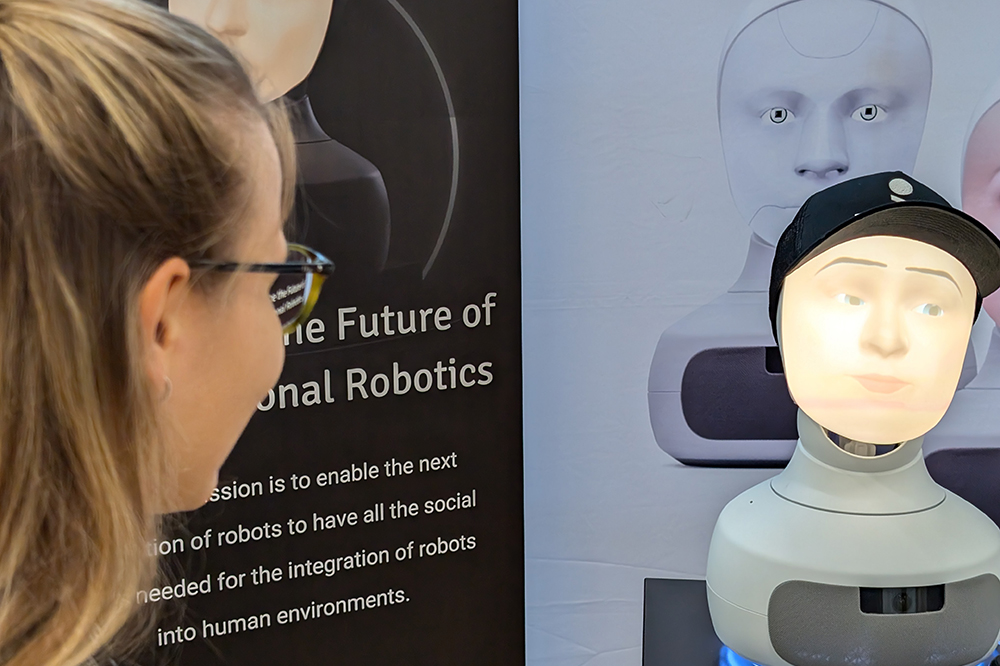
RealDollX and Realbotix have been known for years for Harmony, one of the most advanced sex robots in the world, known not least for the movie “Hi, AI”. Prof. Dr. Oliver Bendel was able to meet and talk to the robot head at a workshop in 2019. GPT was used, as explained by Kino Coursey from Realbotix, who was present and co-developed Harmony. Oliver Bendel was able to persuade him to write the article “Speaking with Harmony“, which was published in his book “Maschinenliebe” in 2020. Realbotix has since broadened its focus. The company develops social robots – mainly female androids, but also male models – for interactive presentations, among other things. Movable arms and hands are used for this. The company’s new flagship is Aria, which caused a stir at a trade fair in 2024. The movable arms and hands could also benefit Harmony, for example when hugging. Above all, however, it enables gestures that support the already convincing facial expressions. In future, the speech capabilities of the general models will be created using several speech models. Further developments will be discussed at a meeting in March 2025, for which the teams from Texas, Nevada, and California will come together in one place (Photo: Realbotix).
Interpersonal Distance Preferences in Human-Robot Interactions
The paper “Robots at arm’s length: Unveiling the dynamics of interpersonal distance preferences in human-robot interactions” by Katharina Kühne, Laura M. Zimmer, Melina Jeglinski-Mende, Oliver Bendel, Yuefang Zhou, and Martin H. Fischer was published in February 2025 in the proceedings volume “Social Robots with AI: Prospects, Risks, and Responsible Methods” … From the abstract: “In social interactions, interpersonal distance is a vital factor influencing relationships, providing protection, and regulating arousal. Despite the intuitive nature of adopting specific distances, little is known about comfortable interpersonal distances with social robots. In our online study with 66 participants using a Go/No-Go task, we investigated perceptions of individuals standing face-to-face with a robot at different distances. In line with the negativity bias hypothesis, participants exhibited a preference for greater distances , as reflected in longer reaction times. Furthermore, the human-likeness of the robots moderated the link between distance and arousal. Finally, the most human-like robot was less liked and evoked higher arousal. These findings have implications for designing social robots and optimizing interactions, particularly in educational or medical contexts.” The proceedings volume comprises the papers presented at Robophilosophy 2024 in Aarhus. Leading philosophers, computer scientists, and roboticists met there in August. Like the ICSR, the conference is one of the world’s leading conferences on social robotics.
A New Paper on Universal Robots
The paper “The Universal Robot of the 21st Century” by Oliver Bendel was published in February 2025 in the proceedings volume “Social Robots with AI: Prospects, Risks, and Responsible Methods” … From the abstract: “Developments in several areas of computer science, robotics, and social robotics make it seem likely that a universal robot will be available in the foreseeable future. Large language models for communication, perception, and control play a central role in this. This article briefly outlines the developments in the various areas and uses them to create the overall image of the universal robot. It then discusses the associated challenges from an ethical and social science perspective. It can be said that the universal robot will bring with it new possibilities and will perhaps be one of the most powerful human tools in physical space. At the same time, numerous problems are foreseeable, individual, social, and ecological.” The proceedings volume comprises the papers presented at Robophilosophy 2024 in Aarhus. Leading philosophers, computer scientists and roboticists met there in August. Like the ICSR, the conference is one of the world’s leading conferences on social robotics (Photo: Katharina Kühne).
A Video About the ICSR 2023
ICSR is one of the leading conferences for social robotics worldwide. The 17th edition will take place from 10 to 12 September 2025 in Naples, Italy. Participants will meet for two days at the Parthenope University of Naples and for the third day at the Città della Scienza conference center. In 2023, the conference took place in Doha, Qatar. A video on YouTube by Hooman Samani provides insights into the presentations and events: www.youtube.com/watch?v=MtgM8pTPw8c … It not only shows that numerous top-class presentations take place, but also that the members of the community are highly motivated and have a lot of fun. The high level of internationality and diversity of the conference should also be emphasized. The conference website of ICSR 2025 is online since January: icsr2025.eu.
A Video About the ICSR 2024
ICSR is one of the leading conferences for social robotics worldwide. The 17th edition will take place from 10 to 12 September 2025 in Naples, Italy. Participants will meet for two days at the Parthenope University of Naples and for the third day at the Città della Scienza conference center. In 2024, the conference took place in Odense, Denmark. A video on YouTube by Hooman Samani provides insights into the presentations and events: www.youtube.com/watch?v=Xj6p2yguYBk … It not only shows that numerous top-class presentations take place, but also that the members of the community are highly motivated and have a lot of fun. The high level of internationality and diversity of the conference should also be emphasized. The conference website of ICSR 2025 is online since January: icsr2025.eu.
Cute little AIBI
Prof. Dr. Oliver Bendel’s privately funded Social Robots Lab has been home to little AIBI since January 2025. It comes from the Chinese company LivingAI. Other robots and figures in the Social Robots Lab are Cupboo AI Robotic Pet aka Boo Boo, Unitree Go2, Alpha Mini, Cozmo, Vector, Furby, Tamagotchi, and Hugvie. HUGGIE was dismantled at the beginning of 2025 and given to a student project in which the robot laughs with a synthetic or natural voice. NAO and Pepper visit the lab and the elective module on social robots from time to time. AIBI has various sensors, a camera, and three microphones. It understands voice commands. For more complex questions, it connects to ChatGPT. The face consists of a display in which it can show animated eyes and animated scenes of all kinds. It stands on a platform that allows it to rotate 360 degrees. It can also turn its head freely. Similar to Cozmo, it emits numerous sounds and tries to attract the user’s attention in this and other ways. Thanks to its magnets, it can be attached to the fridge and other metal surfaces, as well as to an included necklace, transforming it into a wearable. It also transforms with accessories, for example into a cat. Robot enhancement is therefore included and supplied by the company.
The ICSR 2025 Website is Now Online
The ICSR is one of the leading conferences for social robotics worldwide. The 17th edition will take place from 10 to 12 September 2025 in Naples, Italy. The conference website is now online: icsr2025.eu. “The conference theme, ‘Emotivation at the Core: Empowering Social Robots to Inspire and Connect,’ highlights the essential role of ‘Emotivation’ in social robotics. Emotivation captures the synergy between emotion and motivation, where emotions trigger and sustain motivation during interactions. In social robotics, this concept is key to building trust, fostering empathy, and supporting decision-making by enabling robots to respond sensitively to human emotions, inspiring engagement and action.” (Website ICSR) The most important conferences dates are: Full Paper Submission: March 28th, 2025; Full Paper Notification: May 9th, 2025; Camera-ready: June 30th, 2025; Paper Presentation Days at ICSR’25: September 11th and 12th, 2025. All dates are also listed on the website. Participants will meet for two days at the Parthenope University of Naples and for the third day at the Città della Scienza conference center. All buildings and rooms are also listed on the website. Be part of this excellent conference (Photo: ICSR)!
First Human-Robot Marathon
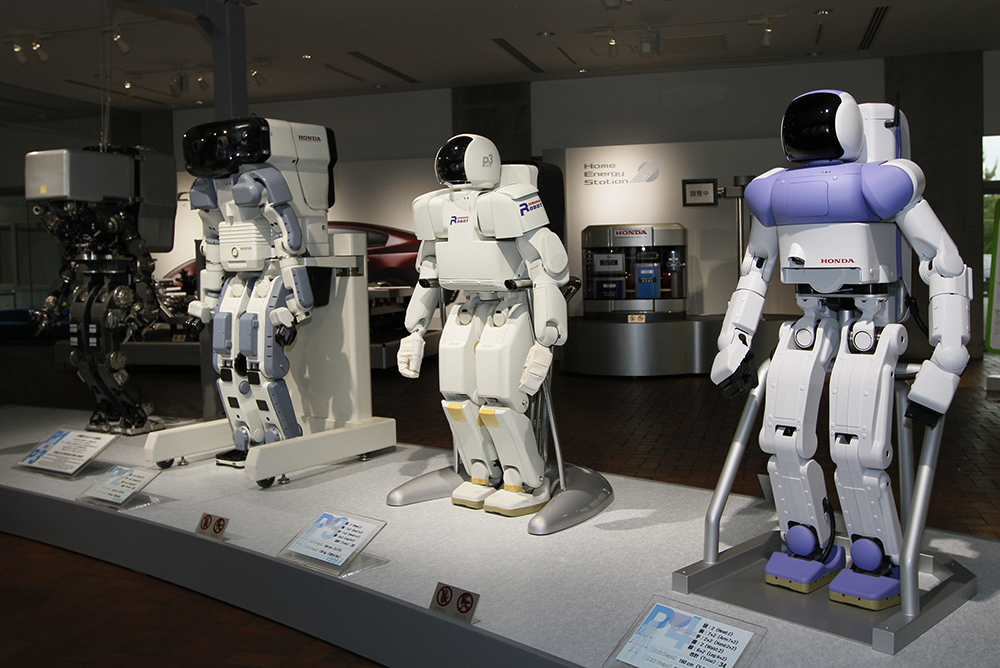
According to several media reports, humanoid robots will take part in a half marathon together with humans for the first time in Beijing in April 2025. Around 12,000 people will run the 21-kilometre course, accompanied by robots from more than 20 companies worldwide. The robots must look humanoid, be able to move on two legs, and be between 0.5 and 2 metres tall. The majority of the larger models are likely to be so-called all-purpose robots. Both remote-controlled and autonomous robots are permitted – with the option of changing batteries during the race. The premiere is part of a broader strategy by China to promote humanoid robots to achieve technological independence, boost the economy, and compete in the global technology race, especially with the US. Last year, the humanoid robot Galbot had already supported a marathon final, but this time the machines are running the full distance (Photo: Morio, CC BY-SA 3.0).
Trump is Guarded by Spot
Spot from Boston Dynamics is the latest tool in the arsenal of the US Secret Service. This was reported by the BBC on November 17, 2024. The robot was recently spotted patrolling the perimeter of President-elect Donald Trump’s Mar-a-Lago resort in Palm Beach, Florida. As the video on the website shows, they do not carry weapons; “and each can be controlled remotely or automatically – as long as its route is pre-programmed”. Passers-by are warned by a sign on each of Spot’s legs that reads, “DO NOT PET”. “I don’t know that anyone would be tempted to pet these robot dogs. They do not look cuddly,” Melissa Michelson, a political scientist at Menlo College, told the BBC. Oliver Bendel, an expert in social robotics at the FHNW School of Business, disagrees. He has been working with Unitree Go2, which is half the weight and smaller than SPOT but otherwise comparable, since 2023. “The students are initially amazed or shocked when they see it. After a minute or two, their doubts are dispelled and they try to lure it in and stroke it.” A robot like Spot is well suited to an estate like Mar-a-Lago. However, models such as K5 from Knightscope or RBwatcher from Robotnik/URG can also be used on the lawns.
Social Robots in Olten
The elective module “Social Robots” by Prof. Dr. Oliver Bendel took place from November 4 to 6, 2024 at the Olten Campus. Tamara Siegmann (with the online presentation of the paper “Social and Collaborative Robots in Prison”) was invited as a guest speaker. She made it clear to those present that every member of the university can make a contribution to research. On site were Pepper and NAO from the FHNW Robo Labs as well as Unitree Go2, Alpha Mini, Cozmo, Furby, and Booboo (aka Boo Boo) from Oliver Bendel’s privately funded Social Robots Lab. Unitree Go2 – also called Bao (Chinese for “treasure, darling”) by the lecturer – and Booboo were particularly well received. At the end of the elective module, the students designed social robots – also with the help of generative AI – that they found useful, meaningful or simply attractive. The elective modules have been offered since 2021 and are very popular.