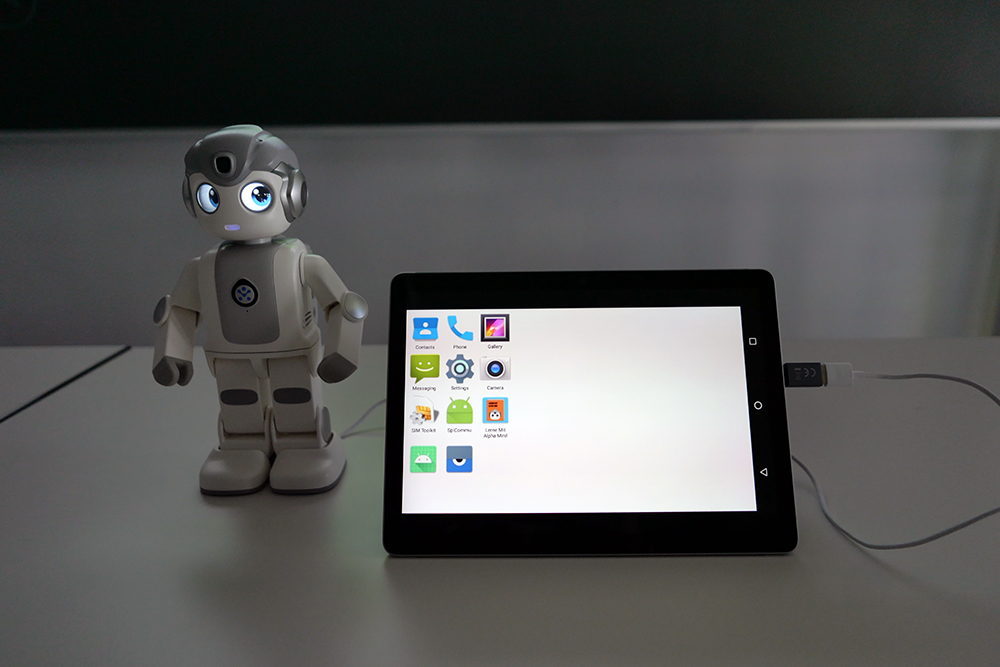
Robophilosophy 2022 at the University of Helsinki is the fifth event in the biennial Robophilosophy Conference Series. It “will explore the societal significance of social robots for the future of social institutions with its usual broad scope, embracing both theoretical and practical angles” (CfP Robophilosophy). It “is an invitation to philosophers and other SSH researchers, as well as researchers in social robotics and HRI, to investigate from interdisciplinarily informed perspectives whether and how social robotics as an interdisciplinary endeavour can contribute to the ability of our institutions to perform their functions in society” (CfP Robophilosophy). Social institutions include retirement and nursing homes, strip clubs and brothels, monasteries and seminaries, and police departments. Oliver Bendel (School of Business FHNW) will have the opportunity to present his paper entitled “Robots in Policing” in session 1, “Robots in Law and Policing”. Cindy Friedman (“Granting Negative Rights to Humanoid Robots”) and Jakob Stenseke (“The Use and Abuse of Normative Ethics for Moral Machines”) will speak after him. In addition, a poster by Katharina Kühne and Melinda Mende (University of Potsdam) as well als Oliver Bendel entitled “Tamagotchi on our couch: Are social robots perceived as pets?” was accepted. The full program is now available online.
Robots Dancing Like Bees
Robot-robot communication and interaction usually takes place via networks. Spoken language can also be used. In certain situations, however, these methods reach their limits. For example, during a rescue operation in disaster areas, communication via radio signals might not be possible. With this in mind, Kaustubh Joshi from the University of Maryland and Abhra Roy Chowdhury from the Indian Institute of Science (IISc) have developed an alternative approach. Their paper states: “This research presents a novel bio-inspired framework for two robots interacting together for a cooperative package delivery task with a human-in the-loop. It contributes to eliminating the need for network-based robot-robot interaction in constrained environments. An individual robot is instructed to move in specific shapes with a particular orientation at a certain speed for the other robot to infer using object detection (custom YOLOv4) and depth perception. The shape is identified by calculating the area occupied by the detected polygonal route. A metric for the area’s extent is calculated and empirically used to assign regions for specific shapes and gives an overall accuracy of 93.3% in simulations and 90% in a physical setup. Additionally, gestures are analyzed for their accuracy of intended direction, distance, and the target coordinates in the map. The system gives an average positional RMSE of 0.349 in simulation and 0.461 in a physical experiment.” (Abstract) The way of interaction and communication is reminiscent of the bee dance – and indeed this served as a model. The paper can be accessed via www.frontiersin.org/articles/10.3389/frobt.2022.915884/full.
About Manipulative Robots in Retail
On June 30, 2022, the paper “Should Social Robots in Retail Manipulate Customers?” by Oliver Bendel and Liliana Margarida Dos Santos Alves was published on arxiv.org. It was presented at the AAAI 2022 Spring Symposium “How Fair is Fair? Achieving Wellbeing AI” at Stanford University and came in third place in the Best Presentation Awards. From the abstract: “Against the backdrop of structural changes in the retail trade, social robots have found their way into retail stores and shopping malls in order to attract, welcome, and greet customers; to inform them, advise them, and persuade them to make a purchase. Salespeople often have a broad knowledge of their product and rely on offering competent and honest advice, whether it be on shoes, clothing, or kitchen appliances. However, some frequently use sales tricks to secure purchases. The question arises of how consulting and sales robots should “behave”. Should they behave like human advisors and salespeople, i.e., occasionally manipulate customers? Or should they be more honest and reliable than us? This article tries to answer these questions. After explaining the basics, it evaluates a study in this context and gives recommendations for companies that want to use consulting and sales robots. Ultimately, fair, honest, and trustworthy robots in retail are a win-win situation for all concerned.” The paper will additionally be published in the proceedings volume of the symposium by the end of summer. It can be downloaded via arxiv.org/abs/2206.14571.
Speaking with SPACE THEA
In June 2022, the paper “The SPACE THEA Project” by Martin Spathelf and Oliver Bendel was published on arxiv.org. It was presented at the AAAI 2022 Spring Symposium “How Fair is Fair? Achieving Wellbeing AI” at Stanford University and came in 2nd place in the Best Presentation Awards. From the abstract: “In some situations, no professional human contact can be available. Accordingly, one remains alone with one’s problems and fears. A manned Mars flight is certainly such a situation. A voice assistant that shows empathy and assists the astronauts could be a solution. In the SPACE THEA project, a prototype with such capabilities was developed using Google Assistant and Dialogflow Essentials. The voice assistant has a personality based on characteristics such as functional intelligence, sincerity, creativity, and emotional intelligence. It proves itself in seven different scenarios designed to represent the daily lives of astronauts, addressing operational crises and human problems. The paper describes the seven scenarios in detail, and lists technical and conceptual foundations of the voice assistant. Finally, the most important results are stated and the chapters are summarized.” The paper will additionally be published in the proceedings volume of the symposium by the end of summer. It can be downloaded via arxiv.org/abs/2206.10390.
From WALL·E to DALL·E
DALL·E 2 is a new AI system that can create realistic images and art from a description in natural language. It was announced by OpenAI in April 2022. The name is a portmanteau of “WALL-E” and “Salvador Dalí”. The website openai.com says more about the program: “DALL·E 2 can create original, realistic images and art from a text description. It can combine concepts, attributes, and styles.” (Website openai.com) Moreover, it is able to “make realistic edits to existing images from a natural language caption” and to “add and remove elements while taking shadows, reflections, and textures into account” (Website openai.com). Last but not least, it “can take an image and create different variations of it inspired by the original” (Website openai.com). The latter form of use is shown by variations of the famous painting “Girl with a Pearl Earring” by Johannes Vermeer. The website says about the principle of the program: “DALL·E 2 has learned the relationship between images and the text used to describe them. It uses a process called ‘diffusion,’ which starts with a pattern of random dots and gradually alters that pattern towards an image when it recognizes specific aspects of that image.” (Website openai.com) DALL·E mini is a slimmed down version of the powerful program, with which you can gain a first insight. Overall, this is a fascinating and valuable project. From the perspective of information ethics and the philosophy of technology, many questions arise.
The Ukrainian President as a Hologram
“Leia in ‘Star Wars’, who as a hologram delivers a message, Darth Vader, who forges plans with the imperator even though they are far apart from each other, William Riker in ‘Star Trek’, who moves on the holodeck through artificial landscapes, Major in ‘Ghost in the Shell’, who walks through a city while fish are swimming in the air next to her, Officer K in ‘Blade Runner 2049’, who lives together with a holographic assistant and meets holographic dancers and singers (Frank Sinatra under glass and Elvis Presley on stage) – fictional holograms make an appearance in all these instances.” (Oliver Bendel, “Hologram Girl“, 2018) According to the Guardian, Volodymyr Zelenskiy referenced Star Wars and the second world war as he appeared as a hologram (or pseudo-hologram) at a conference in Paris to seek aid from big tech companies. “He told a crowd of hundreds at the VivaTech trade show that he was offering technology firms a unique chance to rebuild Ukraine as a fully digital democracy.” (Guardian, June 17, 2022) The British newspaper quotes him as saying: “It’s unusual for presidents or heads of government to use a hologram to address people but this is not the only aspect of Star Wars that we are putting into practice” (Guardian, June 17, 2022). The Ukrainian president is not only following in the footsteps of Leila, but also of ABBA, who are currently causing a sensation with their avatars at concerts in London.
First Geriatronics Summit
The goal of the First Geriatronics Summit is to highlight current and planned robotics solutions in the context of geriatronics and to raise awareness of the relevant technologies among policymakers. According to its website, the event, which will take place on June 20 and 21, 2022, in Garmisch-Partenkirchen (Germany), aims to answer the following questions: 1. How can geriatronics be used to address the growing shortage and geographic disparities in caregivers and overburdened healthcare? 2. How can robotics and AI promote independence, mobility, self-determination and health for older people for as long as possible? 3. What are the rules of autonomy and how can moral, ethical, cultural, and personal challenges and dilemmas be addressed for geriatrics? Invited scientists are Prof. Dr.-Ing. Tamim Asfour (KIT Karlsruhe), Dr. Sylvain Calinon (EPFL), Dr. Tadej Petrič (Jožef Stefan Institute), Dr. Matteo Laffranchi (Italian Institute of Technology – IIT), Prof. Adriana Tapus (Institut Polytechnique de Paris), Prof. Jim Tørresen (University of Oslo), Prof. Dr.- Ing. Sami Haddadin (TUM), Prof. Dr. med. Alena M. Buyx (TUM), Prof. Dr. oec. Oliver Bendel (Hochschule für Wirtschaft FHNW), Prof. Dr. Christian Djeffal (TUM), Prof. Vera Lúcia Raposo (University of Coimbra), Prof. Dr. Lee Bygrave (University of Oslo), and Prof. Dr. Martin Ebers (Humboldt-Universität zu Berlin/University of Tartu). The event is supported by the Munich Institute of Robotics and Machine Intelligence (MIRMI) of the Technical University of Munich (TUM) and the Volkswagen Foundation, among others.
No More Drone Transports over Lake Zurich?
Swiss Post and PostBus are pioneers in the operation of robotic vehicles, robots, and drones. Swiss Post now reports the withdrawal from an project in which drones were used to transport laboratory samples: “Swiss Post drones have flown across various Swiss cities as a service for hospitals since 2017. After five years of pioneering work, the company has now decided to hand over its drone project to the Californian drone systems developer Matternet. Although the autonomous drones have attracted global interest, the current regulatory environment for unmanned aerial vehicles in Switzerland means Swiss Post is unable to use the drones widely enough or operate them at a profit. With its new strategy, the company is focusing on logistics solutions in its core business and on continuing to finance the public service for Switzerland using its own resources. This strategic decision is a logical step as part of its strategy.” (Media release Swiss Post, June 1, 2022) There were repeated problems within the project. For example, a drone once crashed into Lake Zurich. Nevertheless, the approach was generally considered innovative. It will be interesting to see whether the drone transports will be resumed one day.
The ABBAtars in London
ABBA are currently performing in London – but the four band members are being represented by their avatars. The ABBAtars, as they are called, appear very perfect. They have the facial expressions, gestures, and movements of the originals. Knowing how they look today, you think they fell into the fountain of youth. They look like they did in the ’70s. You see every detail of the faces, bodies, and suits and dresses. And they appear three-dimensional. You could call them quasi- or pseudo-holograms. The band has been performing their songs for weeks. Systems captured their movements when they danced and their emotions when they sang. Most of all, motion capture was used. The four wore special full-body suits with markers attached to them. In addition, facial expressions were recorded, mainly to be able to show emotions. 160 cameras filmed Agnetha, Björn, Anni-Frid, and Benny from all sides. The faces were then digitally rejuvenated – and apparently also the bodies. ABBA is probably writing cultural history with this project. The avatars and their movements are unusually perfect. In addition, there are real people, a live band playing with the four ABBAtars. The show is very elaborate. It is a new business model – in principle, you can give several concerts a day, 365 days a year. At least if you leave out the live band. On Deutschlandfunk Kultur, early in the morning of May 27, 2022, moderator Dieter Kassel spoke with Prof. Dr. Oliver Bendel about the ABBA show Voyage in London and the ABBAtars. Oliver Bendel published the chapter “Hologram Girl” in the 2019 Springer book “AI Love You“.
Hold a Video Call Naked Without Trouble
A software developer has created a tool that retouches pants on lower body to protect from embarrassing situations. He presents his solution in his video channel Everything Is Hacked on YouTube, under the title “I made a Zoom filter to add pants when you forget to wear them”. Under the video the software developer writes: “Using Python, OpenCV, MediaPipe, and pyvirtualcam to create a Zoom (or Teams or Hangouts or whatever) video filter to blur out your lower half or add customizable pants. This should work on any platform + video call app, as well as on recordings.” (Everything Is Hacked, May 10, 2022) You can watch the video here. The code is available at https://github.com/everythingishacked/Pants …