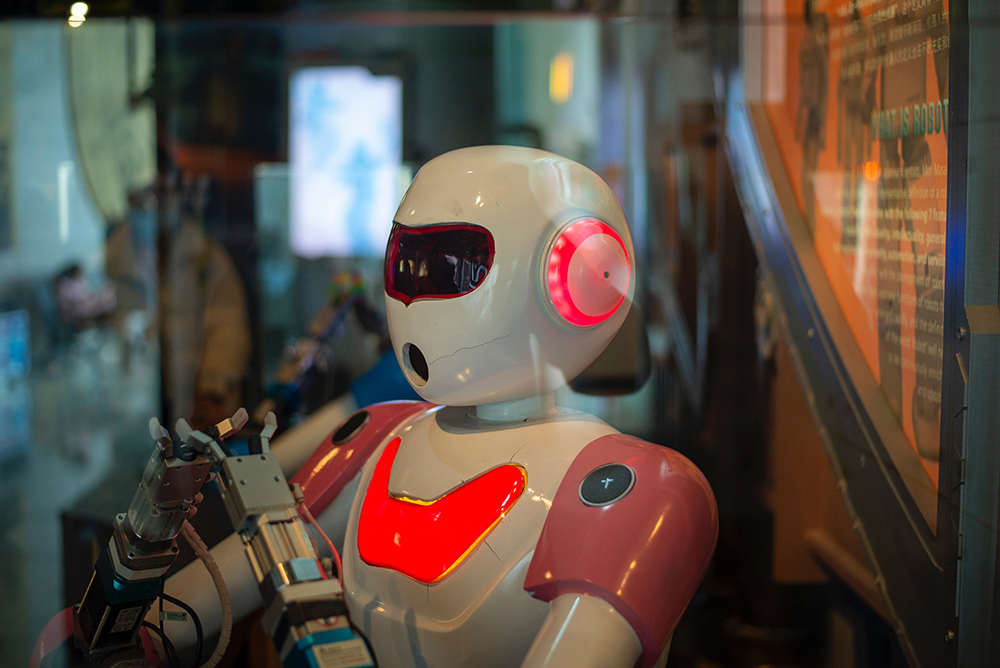
“Singapore’s Home Team Science and Technology Agency (HTX) roving robot has hit the streets of Toa Payoh Central as part of a trial to support public officers in enhancing public health and safety.” (ZDNet, 8 September 2021) This is reported by the magazine ZDNet. “The robot, named Xavier, was jointly developed by HTX and the Agency for Science, Technology and Research. It is fitted with sensors for autonomous navigation, a 360-degree video feed to the command and control centre, real-time sensing and analysis, and an interactive dashboard where public officers can receive real-time information from and be able to monitor and control multiple robots simultaneously.” (ZDNet, 8 September 2021) Xavier is one of many security robots deployed around the world. Widely known are K3 and K5 from Knightscope. REEM is also used as a policeman and even costumed like a policeman – a case of Robot Enhancement. Whether the people of Singapore will accept security robots remains to be seen.
Robots with Muscles
Robots may soon be equipped with muscles that develop considerable strength. The mechanical effort and weight are low because neither hydraulics nor electric motors are needed. The power comes from a new shape memory polymer developed by a team led by Zhenan Bao of Stanford University. This is reported by several media based on a press release from pressetext.com. ACS Central Science provides further information: “When stretched or deformed, shape memory polymers return to their original shapes after heat or light is applied. These materials show great promise for soft robotics, smart biomedical devices and deployable space structures, but until now they haven’t been able to store enough energy. Now, researchers reporting in ACS Central Science have developed a shape memory polymer that stores almost six times more energy than previous versions.” (ACS Central Science) Robots with muscles play an important role in the embodiment “movement”. It takes a lot of effort to build robots like Roboy. Perhaps the development of Stanford University will help in this area.
From Hugvie to Sylvie
Simple, soft shapes are everywhere. In our home environment you can find pillows, blankets, balls, bottles, clothes, etc. Robots are often expensive and complex. But couldn’t they be thought of in a completely different way? How could social robots emerge from simple, soft shapes? As part of their final thesis at the School of Business FHNW, Nhi Tran Hoang Yen and Thang Hoang Vu from Ho Chi Minh City have answered this question posed by their supervisor Prof. Oliver Bendel. They have submitted eleven proposals for novel robots. All are shown on informationsethik.net. The seventh proposal is Sylvie. The normal Hugvie is a communication and hugging device, whereby the communication is not with it, but with friends, partners and family members. Sylvie is a variant of it. You talk directly to her, and when you hug her, you mean her, not a human being. And there’s another difference: while in the classic Hugvie the smartphone is invisibly housed in a pocket on the head, in Sylvie it forms part of the face. A video is available here.
The Idea of a Tesla Bot
Elon Musk presented the idea of a humanoid robot that – according to Manager Magazin – could take on dangerous, repetitive or boring tasks in the future. The Tesla Bot will be about five feet eight inches (just under 1.73 meters) tall, weigh 57 kilograms, and be able to do numerous jobs, from putting screws on cars to picking up groceries at the store – this is what the German magazine reports. It will be equipped with eight cameras and a full self-driving computer, and will use the same tools Tesla uses in its cars (Manager Magazin, 20 August 2021). According to the announcement, the robot will be able to take over physical work. But that’s exactly what service robots are struggling with at the moment, especially humanoid models. The visualization hardly allows any conclusions to be drawn about the capabilities of the prototype, which is to be available as early as 2022. Eyes and mouths could appear on a large display in the head area and mimic abilities could be implemented. When it is turned off – as seen in the video – the robot appears creepy and unapproachable. Arms and feet are unlikely to be suitable for carrying the body in this form. Joints can also only be seen in rudimentary form. Overall, it is unclear why Tesla, of all companies, should close the gaps that are still present at Sony, SoftBank and Boston Dynamics even after many years.
Don’t Scan Our Phones
The U.S. civil liberties organization Electronic Frontier Foundation has launched a petition titled “Don’t Scan Our Phones”. The background is Apple’s plan to search users’ phones for photos that show child abuse or are the result of child abuse. In doing so, the company is going even further than Microsoft, which scours the cloud for such material. On its website, the organization writes: “Apple has abandoned its once-famous commitment to security and privacy. The next version of iOS will contain software that scans users’ photos and messages. Under pressure from U.S. law enforcement, Apple has put a backdoor into their encryption system. Sign our petition and tell Apple to stop its plan to scan our phones. Users need to speak up say this violation of our privacy is wrong.” (Website Electronic Frontier Foundation) More information via act.eff.org/action/tell-apple-don-t-scan-our-phones.
Conversational Agent as Trustworthy Autonomous System
The Dagstuhl seminar “Conversational Agent as Trustworthy Autonomous System (Trust-CA)” will take place from September 19 – 24, 2021. According to the website, Schloss Dagstuhl – Leibniz-Zentrum für Informatik “pursues its mission of furthering world class research in computer science by facilitating communication and interaction between researchers”. Organizers of this event are Asbjørn Følstad (SINTEF – Oslo), Jonathan Grudin (Microsoft – Redmond), Effie Lai-Chong Law (University of Leicester) and Björn Schuller (University of Augsburg). They outline the background as follows: “CA, like many other AI/ML-infused autonomous systems, need to gain the trust of their users in order to be deployed effectively. Nevertheless, in the first place, we need to ensure that such systems are trustworthy. Persuading users to trust a non-trustworthy CA is grossly unethical. Conversely, failing to convince users to trust a trustworthy CA that is beneficial to their wellbeing can be detrimental, given that a lack of trust leads to low adoption or total rejection of a system. A deep understanding of how trust is initially built and evolved in human-human interaction (HHI) can shed light on the trust journey in human-automation interaction (HAI). This calls forth a multidisciplinary analytical framework, which is lacking but much needed for informing the design of trustworthy autonomous systems like CA.” (Website Dagstuhl) Regarding the goal of the workshop, the organizers write: “The overall goal of this Dagstuhl Seminar is to bring together researchers and practitioners, who are currently engaged in diverse communities related to Conversational Agent (CA) to explore the three main challenges on maximising the trustworthiness of and trust in CA as AI/ML-driven autonomous systems – an issue deemed increasingly significant given the widespread uses of CA in every sector of life – and to chart a roadmap for the future research on CA.” (Website Dagstuhl) Oliver Bendel (School of Business FHNW) will talk about his chatbot and voice assistant projects. These emerge since 2013 from machine ethics and social robotics. Further information is available here (photo: Schloss Dagstuhl).
Meet SPACE THEA
SPACE THEA was developd by Martin Spathelf at the School of Business FHNW from April to August 2021. The client and supervisor was Prof. Dr. Oliver Bendel. The voice assistant is supposed to show empathy and emotions towards astronauts on a Mars flight. Technically, it is based on Google Assistant and Dialogflow. The programmer chose a female voice with Canadian English. SPACE THEA’s personality includes functional and emotional intelligence, honesty, and creativity. She follows a moral principle: to maximize the benefit of the passengers of the spacecraft. The prototype was implemented for the following scenarios: conduct general conversations; help the user find a light switch; assist the astronaut when a thruster fails; greet and cheer up in the morning; fend off an insult for no reason; stand by a lonely astronaut; learn about the voice assistant. A video on the latter scenario is available here. Oliver Bendel has been researching conversational agents for 20 years. With his teams, he has developed 20 concepts and artifacts of machine ethics and social robotics since 2012.
From AIBO to CyberDog
Xiaomi has unveiled CyberDog, a four-legged robot that could be a competitor to Sony’s AIBO. According to the Chinese company, it is calibrated with servo motors that translates into great speed, agility, and a wide range of motion. It is able to conduct complicated actions such as backflips. “To fully model biological organisms, CyberDog is equipped with 11 high-precision sensors which provide instant feedback to guide its movements. This includes touch sensors, cameras, ultrasonic sensors, GPS modules, and more, giving the CyberDog enhanced capability to sense, analyze, and interact with its environment.” (Mi Blog, 10 August 2021) Unlike AIBO, CyberDog looks rather frightening. This is because it does not have an actual head. In this it is comparable to Spot from Boston Dynamics. Nevertheless, it is intended to function as a pet substitute. “To add to its pet-like nature, users can use voice assistants to command and control CyberDog by setting a wake word, or simply use its accompanying remote and smartphone app. CyberDog can be called on for the most unique tasks, and the ways in which it can be interacted with holds unforetold possibilities.” (Mi Blog, 10 August 2021) The future will show whether users want to become friends with CyberDog.
AI and Society
The AAAI Spring Symposia at Stanford University are among the community’s most important get-togethers. The years 2016, 2017, and 2018 were memorable highlights for machine ethics, robot ethics, ethics by design, and AI ethics, with the symposia “Ethical and Moral Considerations in Non-Human Agents” (2016), “Artificial Intelligence for the Social Good” (2017), and “AI and Society: Ethics, Safety and Trustworthiness in Intelligent Agents” (2018) … As of 2019, the proceedings are no longer provided directly by the Association for the Advancement of Artificial Intelligence, but by the organizers of each symposium. As of summer 2021, the entire 2018 volume of the conference has been made available free of charge. It can be found via www.aaai.org/Library/Symposia/Spring/ss18.php or directly here. It includes contributions by Philip C. Jackson, Mark R. Waser, Barry M. Horowitz, John Licato, Stefania Costantini, Biplav Srivastava, and Oliver Bendel, among others.
Wildlife Conservation at a Garden Level
Sophie Lund Rasmussen and her co-authors published the interesting and enlightening article “Wildlife Conservation at a Garden Level: The Effect of Robotic Lawn Mowers on European Hedgehogs (Erinaceus europaeus)” in April 2021. In their “Simple Summary” they write: “Injured European hedgehogs are frequently admitted to hedgehog rehabilitation centres with different types of cuts and injuries. Although not rigorously quantified, a growing concern is that an increasing number of cases may have been caused by robotic lawn mowers. Research indicates that European hedgehogs are in decline. It is therefore important to identify and investigate the factors responsible for this decline to improve the conservation initiatives directed at this species. Because hedgehogs are increasingly associated with human habitation, it seems likely that numerous individuals will encounter several robotic lawn mowers during their lifetimes. Consequently, this study aimed to describe and quantify the effects of robotic lawn mowers on hedgehogs, and we tested 18 robotic lawn mowers in collision with dead hedgehogs. Some models caused extensive damage to the dead hedgehogs, but there were noteworthy differences in the degree of harm inflicted, with some consistently causing no damage. None of the robotic lawn mowers tested was able to detect the presence of dead, dependent juvenile hedgehogs, and no models could detect the hedgehog cadavers without physical interaction. We therefore encourage future collaboration with the manufacturers of robotic lawn mowers to improve the safety for hedgehogs and other garden wildlife species.” (Rasmussen et al. 2021) In 2019/2020, Oliver Bendel and his team developed the prototype HAPPY HEDGHEHOG. This robot lawnmower stops working as soon as it detects hedgehogs. A thermal recognition sensor and a camera with image recognition are used. The paper was presented at the AAAI Spring Symposia in March 2021.