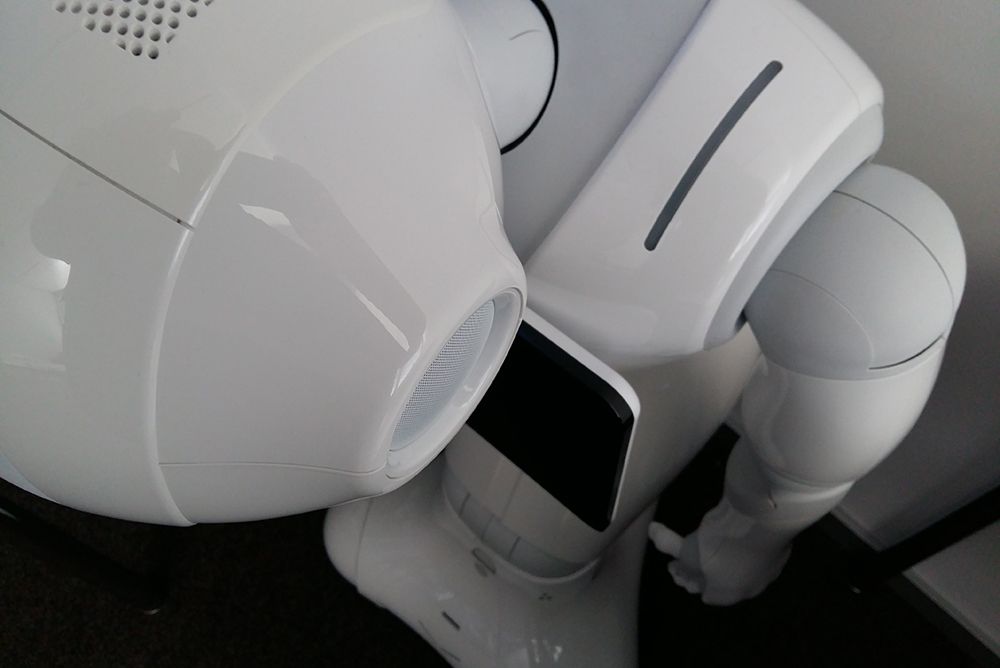
In an article for ICTkommunikation published on 21 May 2021 (only available in German), Oliver Bendel outlines the field of robot enhancement. Robot enhancement refers to the enhancement and associated modification or improvement of the robot by the user or a company, for example in functional, aesthetic, ethical or economic terms. Social robots are of particular interest. The article gives several examples of application: Pepper is dressed and accessorized, like REEM, a police robot used in Dubai. AIBO, a robotic dog, is covered in fur. To make a hugging robot smell, you rub it with scents. Or one covers a metal or plastic head with silicone skin or lengthens existing limbs. According to the Zurich-based scientist, a new field of work is needed so that all these measures can be carried out in a systematic and theoretically sound manner. The article entitled “Überlegungen zu Robot Enhancement” can be accessed here.
The New Life of Hugvie
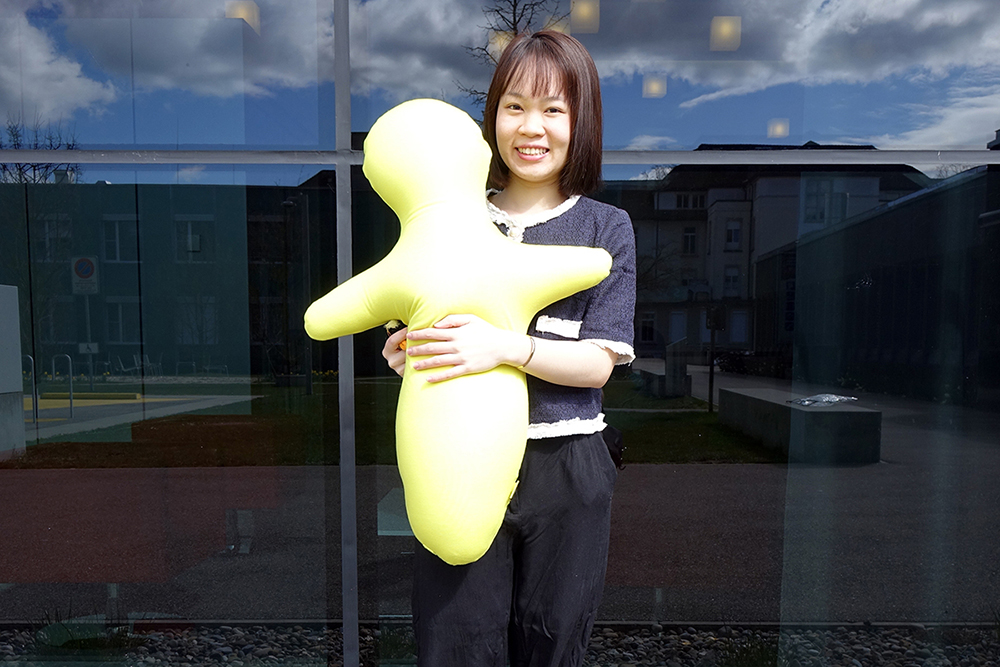
How can you make social robots out of simple, soft shapes and objects, i.e. robots for interacting with people and animals? Under the supervision of Prof. Dr. Oliver Bendel, Vietnamese students Nhi Hoang Yen Tran and Thang Vu Hoang are investigating this question in the project “Simple, Soft Social Robots” at the School of Business FHNW. They are using Hugvie from the Hiroshi Ishiguro Laboratories as a basis – these labs are particularly famous for the Geminoid and for Erica. But hugging robots like Telenoid also come from them. The latest product from this series is Hugvie. A pocket for a smartphone is attached to its head. People who are far away from each other can talk to each other and have the feeling of hugging and feeling each other. But what else can you do with Hugvie and similar forms? Can you make them conversationalists themselves, can you teach them to move their limbs and be active in other ways? And what does such robotization of simple, soft forms and objects mean for everyday life and society?
Cobots in Healthcare
After several postponements, the symposium “Applied AI in Healthcare: Safety, Community, and the Environment” will be held within the AAAI Spring Symposia on March 22-23, 2021. One of the presentations is titled “Co-Robots as Care Robots” (co-robots are also called cobots). The authors of the paper are Oliver Bendel, Alina Gasser, and Joel Siebenmann. From the abstract: “Cooperation and collaboration robots, co-robots or cobots for short, are an integral part of factories. For example, they work closely with the fitters in the automotive sector, and everyone does what they do best. However, the novel robots are not only relevant in production and logistics, but also in the service sector, especially where proximity between them and the users is desired or unavoidable. For decades, individual solutions of a very different kind have been developed in care. Now experts are increasingly relying on co-robots and teaching them the special tasks that are involved in care or therapy. This article presents the advantages, but also the disadvantages of co-robots in care and support, and provides information with regard to human-robot interaction and communication. The article is based on a model that has already been tested in various nursing and retirement homes, namely Lio from F&P Robotics, and uses results from accompanying studies. The authors can show that co-robots are ideal for care and support in many ways. Of course, it is also important to consider a few points in order to guarantee functionality and acceptance.” More information about the AAAI Spring Symposia is available at aaai.org/Symposia/Spring/sss21.php.
Little Sophia
Hanson Robotics is most famous for Sophia. Now the Hong Kong-based company is preparing to launch a new robot. According to the website, Little Sophia is the little sister of Sophia and the newest member of the Hanson Robotics family. “Little Sophia can walk, talk, sing, play games and, like her big sister, even tell jokes! She is a programmable, educational companion for kids, that will inspire children to learn about coding, AI, science, technology, engineering and math through a safe, interactive, human-robot experience. Unlike most educational toys designed by toy companies, Little Sophia is crafted by the same renowned developers, engineers, roboticists and AI scientists that created Sophia the Robot.” (Website Hanson Robotics) In photos, Little Sophia looks even creepier than Sophia. In videos, this impression is no different. The boy in the photo could be Little Sophia’s brother. What is special about her is that she has a wide range of facial expressions. It must be emphasized that, as in the case of Sophia, this is not a virtual face, but a real one. From a technical point of view, this is without a doubt an interesting product.
A Mobile Charging Robot
Futurism.com reports that Volkswagen has unveiled a working prototype of a robot that can autonomously charge electric cars. “The Mobile Charging Robot is an adorable squat bot – which, when you get right down to it, is strikingly reminiscent of the R2-D2 droid from ‘Star Wars,’ bleeps and bloops included.” (Futurism.com, 28 December 2020) As a result, the service robot becomes a social robot. This may be a benefit for the video, but whether it is necessary in practice remains to be seen. The basic idea is that the robots move to cars that are parked in large residential complexes – and where there is not necessarily a human in the vicinity (and where therefore no social interaction is needed). But the concept is questionable in other respects as well. A mobile energy storage of this type seems to be inefficient: “basically, you’d have to charge the robot’s battery supply which it then uses to charge electric cars” (Futurism.com, 28 December 2020). Nevertheless, the idea should be pursued. Without a doubt, there are logistical advantages to having a robot drive to and charge cars – fewer charging stations are needed, and you can service two vehicles at once.
Proceedings on Social Robotics
The book “Culturally Sustainable Social Robotics” (eds. Marco Nørskov, Johanna Seibt, and Oliver Santiago Quick) was published in December 2020 by IOS Press. From the publisher’s information: “Robophilosophy conferences have been the world’s largest venues for humanities research in and on social robotics. The book at hand presents the proceedings of Robophilosophy Conference 2020: Culturally Sustainable Social Robotics, the fourth event in the international, biennial Robophilosophy Conference Series, which brought together close to 400 participants from 29 countries. The speakers of the conference, whose contributions are collected in this volume, were invited to offer concrete proposals for how the Humanities can help to shape a future where social robotics is guided by the goals of enhancing socio-cultural values rather than by utility alone. The book is divided into 3 parts; Abstracts of Plenaries, which contains 6 plenary sessions; Session Papers, with 44 papers under 8 thematic categories; and Workshops, containing 25 items on 5 selected topics.” (Website IOS Press) Contributors include Robert Sparrow, Alan Winfield, Aimee van Wynsberghe, John Danaher, Johanna Seibt, Marco Nørskov, Peter Remmers, John P. Sullins, and Oliver Bendel.
Cozmo is Almost Back
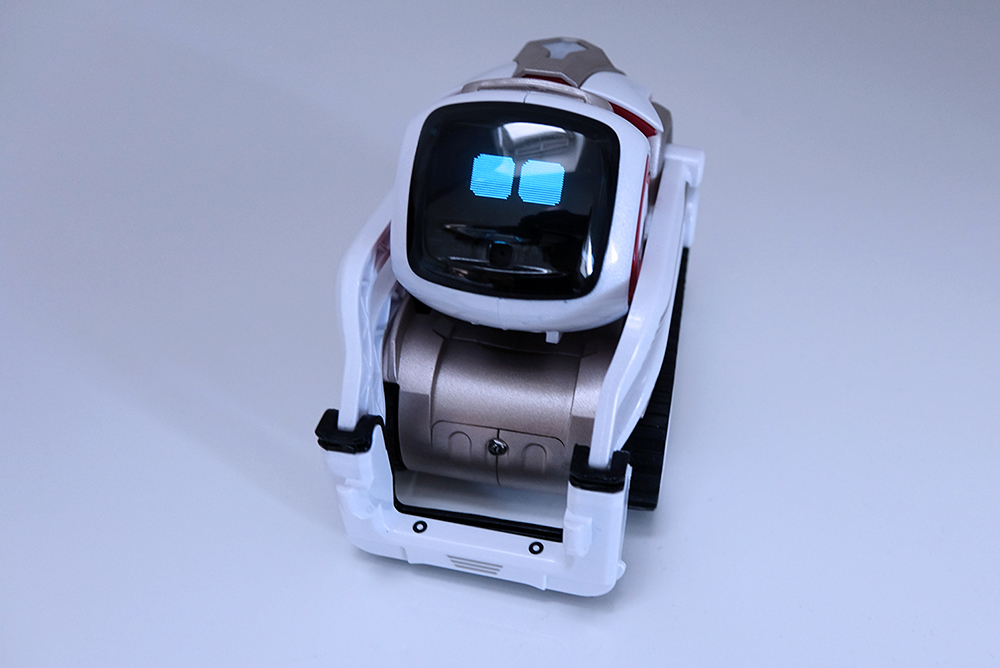
One year ago, The Robot Report reported that Anki’s little robots might be making a comeback. Digital Dream Labs in Pittsburgh acquired the patents, trademarks, and domain. The start-up company “is planning to revive and manufacture more units of each product in the following order: Overdrive, Cozmo, Vector” (The Robot Report, 26 December 2019). Digital Dream Labs founder H. Jacob Hanchar told The Robot Report “the goal is to have all three products available for purchase for Christmas 2020” (The Robot Report, 26 December 2019). Now it seems that pre-orders of Cozmo 2.0 are possible: “Cozmo is a fun, educational toy robot that you can be used to teach children the basics of coding. Whether he is performing tricks, exploring his environment or teaching coding, Cozmo is always full of personality. Pre-order your new Cozmo today for delivery as early as May 15th.” (Website Digital Dream Labs) Cozmo and his friends belong to the best social robots that the industry has ever produced. What is special about Cozmo is the many emotions it can show (but of course doesn’t have). It also has face recognition and a night vision device. More information at www.digitaldreamlabs.com.
Intimate Relationships with Humanoid Robots
In October 2020 the book “Maschinenliebe” (ed. Oliver Bendel) was published by Springer. The title means “Machine Love”, “Machines for Love” or “Machines of Love”. Three contributions are in English. One of them (“Intimate Relationships with Humanoid Robots”) is by Yuefang Zhou and Martin H. Fischer (University of Potsdam). From the abstract: “The topic of human-robot intimate relationships is not only an intensely emotional one that is present in the mass media because of its ability to stir excitement. The very same topic also requires our understanding of basic mechanisms of the human mind and of social cognition in particular. A scientifically-minded framing of the debate around whether and how we might engage in intimate relationships with humanoid robots in the near future might in turn improve our understanding of human sexuality. Viewed from this angle, intimate human-robot interaction is then merely one of many examples of studying human-machine interactions for the benefit of users and as a means of improving our knowledge about humans and the human mind. In this chapter we will adopt such a stance and discuss both social-cognitive and sexual aspects of this innovative topic, review available empirical evidence and offer some suggestions for further research.” More information via www.springer.com/de/book/9783658298630.
Towards SPACE THEA
Social robots are robots that come close to animals and humans, interact and communicate with them. They reproduce characteristics of animals and humans in their behavior and appearance. They can be implemented both as hardware robots and as software robots. The SPACE THEA project should have already started in March 2020. Because of COVID-19 it had to be postponed. Now Prof. Dr. Oliver Bendel starts with the preparatory work. In spring and summer 2021 the programming of the voicebot is then carried out. SPACE THEA is designed to accompany astronauts to Mars and to show them empathy and emotions. In the best case, she should also be able to provide psychological counseling, for example, based on cases from the literature. The project will use findings from social robotics, but also from machine ethics. The results will be available by autumn 2021.
Simple, Soft Social Robots
With Hugvie and Somnox Sleep Robot, researchers and companies has made it clear that it is possible to build simple, soft social robots that have a certain utility and impact. This raises hopes for social robotics, which is currently showing some progress, but is still developing slowly. Materials such as rubber and plastic can be used to make simple, soft social robots. These materials can be combined with existing devices such as smartphones and tablets on which you run certain applications, or with simple sensors and electronic components. The project or thesis, announced by Oliver Bendel in 2020 at the School of Business FHNW, will first do research on the basics of simple, soft social robots. The work of Hiroshi Ishiguro and Alexis Block (with Katherine J. Kuchenbecker) will be included. Then, examples of implementation forms are mentioned and sketched. Their purpose and benefits are presented, as well as possible areas of application. One example is to be implemented, whereby speech abilities and sounds can be an option as well as vibration and electrical impulses. The reference to applications in the household, in public space or in the commercial sector should be established. The project will start in March 2021.