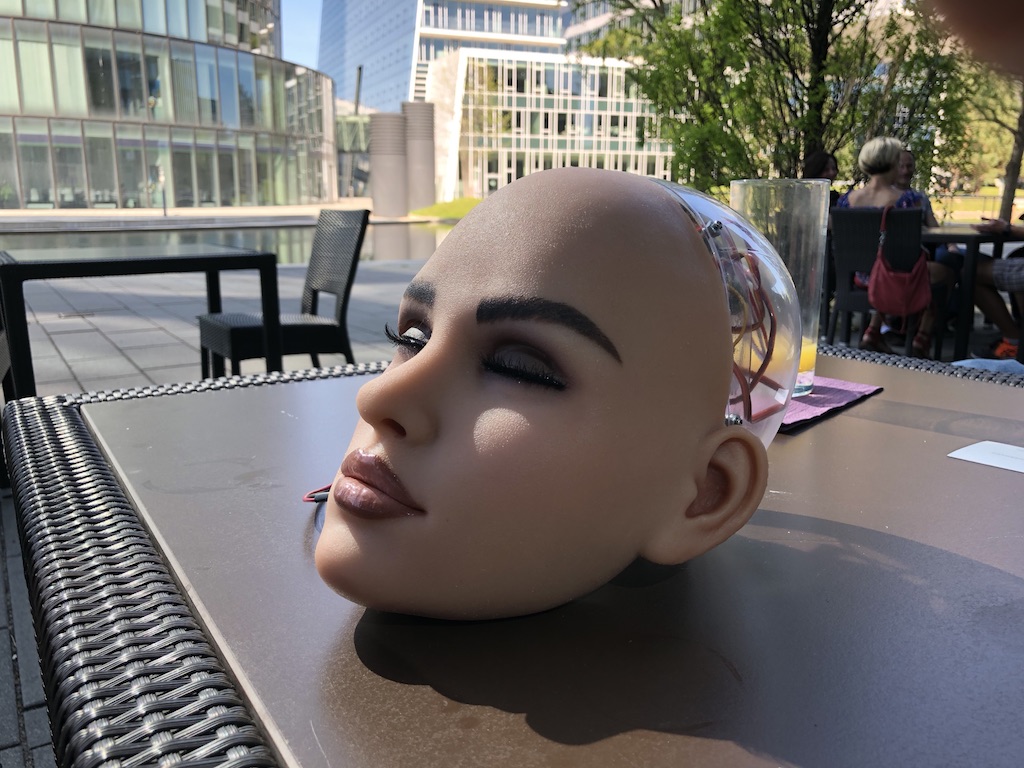
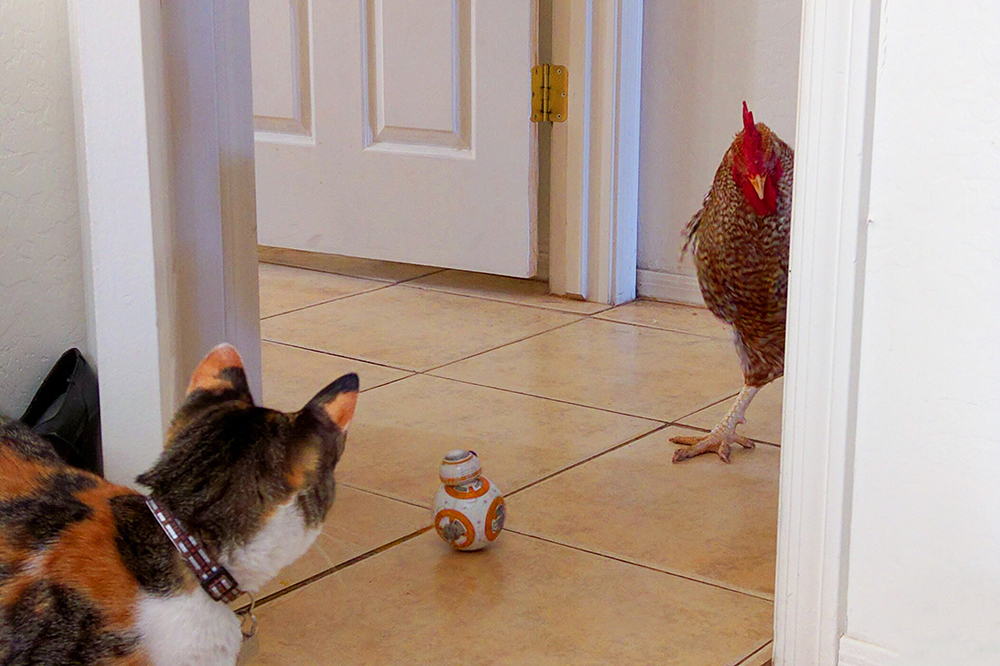
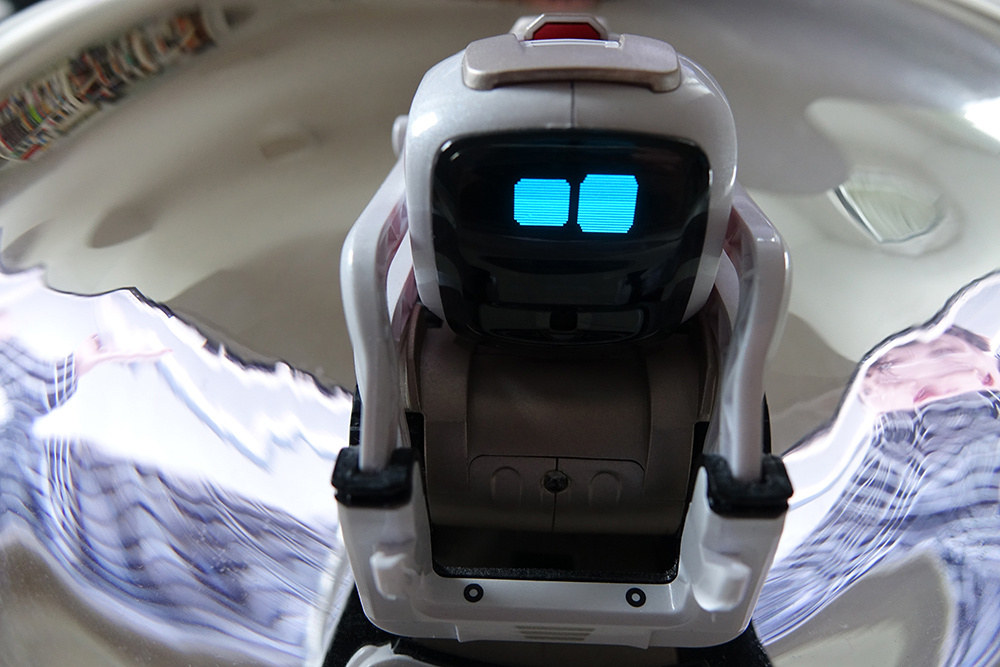
Social robots and service robots usually have a defined locomotor system, a defined appearance and defined mimic and gestural abilities. This leads, on the one hand, to a certain familiarization effect. On the other hand, the actions of the robots are thus limited, for example in the household or in a shopping mall. Robot enhancement is used to extend and improve social robots and service robots. It changes their appearance and expands their scope. It is possible to apply attachments to the hardware, extend limbs and exchange components. One can pull skin made of silicone over the face or head, making the robots look humanoid. One can also change the software and connect the robot to AI systems – this is already done many times. The project or thesis, announced by Oliver Bendel in August 2020 at the School of Business FHNW, should first present the principles and functional possibilities of robot enhancement. Second, concrete examples should be given and described. One of these examples, e.g., the skin made of silicone, has to be implemented. Robots like Pepper or Atlas would be completely changed by such a skin. They could look uncanny, but also appealing. The project will start in September 2020.
Findings on Robotic Hugging
In the first part of the HUGGIE project initiated by Oliver Bendel, two students of the School of Business FHNW conducted an online survey with almost 300 participants. In the management summary of their bachelor thesis Ümmühan Korucu and Leonie Stocker (formerly Leonie Brogle) write: “The results of the survey indicated that people have a positive attitude towards robots in general as robots are perceived as interesting and useful rather than unnecessary and disturbing. However, only a minority of the participants stated that they would accept a hug from a robot. A possible reason for this could be that for the majority of participants, a hug is an act of intimacy with a deeper meaning attached to it which is only being shared with selected persons. For a robot to be perceived as an attractive hugging partner, a human-like design including a face, eyes, a friendly look as well as the ability to communicate verbally and non-verbally is desired. However, an appearance being too realistic has a deterrent effect. Furthermore, an in-depth analysis of the data in relation to age and gender of the participants resulted in the discovery of interesting facts and differences. Overall, the findings contribute to a clearer picture about the appearance and the features Huggie should have in order to be accepted as a hugging counterpart.” The bachelor thesis will be publicly available in autumn 2020. There will also be a paper with the results next year.
Who can be My Companion?
Science-fiction regularly portrays deep friendship or even romantic relationships between a human and a machine, e.g., Dolores and William (Westworld, 2016), Joi and K (Bladerunner 2049, 2017) or Poe and Takeshi Kovacs (Altered Carbon, 2018 and 2020). In fact, for several years now, there has been a development approach aiming to create artificial companions. The so-called companion paradigm focuses on social abilities to create adaptive systems that adapt their behavior to the user and his/her environment [1]. This development approach creates a high degree of individualization and customization. The paradigm principally intends to reduce the complexity of innovative technology, which can go together with a lack of user-friendliness and frustrated users [2]. Ulm University hosted in 2015 the International Symposium of Companion Technology (ISCT). The ISCT conference paper gives a broad overview of the research issues in this field [3]. Some of the discussed research questions approached data input modalities for recognizing emotional states and the user’s current situation or dialog strategies of the artificial companions in order to create a trustworthy relationship. Although the paradigm is already approached quite interdisciplinary, Prof. Hepp (2020) has recently called on communication and media scientists to participate more influential in these discussions. Since in particular, the human-machine-communication was explored lacking pronounced participation of communication scholars [4]. In terms of perception, thrilling issues could consider e.g., possible gradations among different companion systems, and what effects these have on the interaction and communication with the technology? Such questions have to be discussed not only by computer scientists but also by psychology and philosophy scholars. Especially when it comes to the question of how human-machine-relationship will develop in the long run? Will companion systems drift into unemotional and function-centric routines as we have with other technologies, or can they become our forever friends?
References
[1] Wahl M., Krüger S., Frommer J. (2015). Well-intended, but not Well Perceived: Anger and Shame in Reaction to an Affect-oriented Intervention Applied in User-Companion Interaction. In: Biundo-Stephan S., Wendemuth A., & Rukzio E. (Eds.). (2015). Proceedings of the 1st International Symposium on Companion-Technology (ISCT 2015)—September 23rd-25th, Ulm University, Germany. p. 114-119. https://doi.org/10.18725/OPARU-3252
[2] Biundo S., Höller D., Schattenberg B., & Bercher P. (2016). Companion-Technology: An Overview. KI – Künstliche Intelligenz, 30(1), 11–20. https://doi.org/10.1007/s13218-015-0419-3
[3] Biundo-Stephan S., Wendemuth A., & Rukzio E. (Eds.). (2015). Proceedings of the 1st International Symposium on Companion-Technology (ISCT 2015)—September 23rd-25th, Ulm University, Germany. https://doi.org/10.18725/OPARU-3252
[4] Hepp A. (2020). Artificial companions, social bots and work bots: Communicative robots as research objects of media and communication studies. Media, Culture & Society, 016344372091641. https://doi.org/10.1177/0163443720916412
Chocolate Could Increase Acceptance
A multi-stage HUGGIE project is currently underway at the School of Business FHNW under the supervision of Prof. Dr. Oliver Bendel. Ümmühan Korucu and Leonie Stocker (formerly Leonie Brogle) started with an online survey. The aim was to gain insights into how people of all ages and sexes judge a hug by a robot. In crises and catastrophes involving prolonged isolation, such as the COVID 19 pandemic, proxy hugs of this kind could well play a role. Prisons and longer journeys through space are also possible fields of applications. Nearly 300 people took part in the online survey. The evaluation is almost complete and the results are remarkable. Among other things, it was found that women want to be hugged by a robot that is bigger than them, and men want to be hugged by a robot that is smaller than them. Not only the size is relevant for the acceptance of robotic hugging: “An interesting input given by one of the participants was that it could be more pleasant to hug a robot if it smelled nicely, for example like chocolate.” (Draft of Bachelor Thesis) Whether this is a typically Swiss view remains to be investigated. The results of the survey and the conclusions drawn from them for the design of HUGGIE will be compiled in a paper in the course of the year.
Talking to Harmony
At the end of June 2020, DIE WELT conducted an interview with Prof. Dr. Oliver Bendel about sex robots and love dolls. It was especially about their natural language skills. Particularly owners and users who want to have a relationship are interested in conversations of all kinds, about God and the world and in the sense of “dirty talk”. Companies like Realbotix go very far in this respect. Harmony for example can talk to her partners for hours in a quite convincing way. The engineers experiment with GPT-2, but also with other language models. Kino Coursey, AI boss of Realbotix, deals with this topic in his article “Speaking with Harmony” for the book “Maschinenliebe” (“Machine Love”) which will be released in October. The interview with Oliver Bendel was published on 11 July 2020 in the printed edition of DIE WELT, under the title “Intelligente Sexroboter sind begehrte Gesprächspartner” (already published the day before in the electronic edition, under the title “Was Sexpuppen können” …). In addition, an English version – “Intelligent sex robots are sought-after dialogue partners” – is available.
Machine Love
The book “Maschinenliebe” (“Machine Love”/”Machines of Love”/”Machines for Love”/”Love for Machines”), edited by Oliver Bendel, has gone into production. The subtitle is “Liebespuppen und Sexroboter aus technischer, psychologischer und philosophischer Perspektive” (“Love Dolls and Sex Robots from a Technical, Psychological and Philosophical Perspective”). The volume contains contributions by internationally renowned experts as well as interviews with a love doll brothel operator and a sex worker. It has about 200 pages and some color illustrations. Three of the 16 contributions are in English. They come from internationally renowned experts in this field, from Kate Devlin (King’s College London), Yuefang Zhou and Martin H. Fischer (University of Potsdam), and Kino Coursey (Realbotix; picture by courtesy of this company). The book will be published in autumn 2020. Further information is available at www.springer.com/de/book/9783658298630.
Towards Animal-machine Interaction
Animal-machine interaction (AMI) and animal-computer interaction (ACI) are increasingly important research areas. For years, semi-autonomous and autonomous machines have been multiplying all over the world, not only in factories, but also in outdoor areas and in households. Robots in agriculture and service robots, some with artificial intelligence, encounter wild animals, farm animals and pets. Jackie Snow, who writes for New York Times, National Geographic, and Wall Street Journal, talked to several people on the subject last year. In an article for Fast Company, she quoted the ethicists Oliver Bendel (“Handbuch Maschinenethik”) and Peter Singer (“Animal Liberation”). Clara Mancini (“Animal-computer interaction: A manifesto”) also expressed her point of view. The article with the title “AI’s next ethical challenge: how to treat animals” can be accessed here. Today, research is also devoted to social robots. One question is how animals react to them. Human-computer interaction (HCI) experts from Yale University recently looked into this topic. Another question is whether we can create social robots specifically for animals. The first beginnings were made with toys and automatic feeders for pets. Could a social robot replace a contact person for weeks on end? What features should it have? In this context, we must pay attention to animal welfare from the outset. Some animals will love the new freedom, others will hate it.
From Cozmo to Moxie
In 2016, the roboticist Maja Matarić founded Embodied, together with Paolo Pirjanian, former CTO of iRobot. In April 2020, the company started accepting preorders for Moxie, its first social robot. “Whereas other companion robots like the household assistant Jibo or Paro the robotic seal are designed for adults or the elderly, Moxie is built to foster social, cognitive, and emotional development in children. These are skills that are typically imparted to kids by their parents, teachers, and other adults, but Pirjanian noticed that many families want some extra help.” (Wired, 30 April 2020) According to the company, weekly themes and missions with Moxie explore human experiences, ideas, and life skills like kindness, empathy, and respect. Showing emotions is an important skill of social robots. SoftBank has created a model example with Pepper. Cozmo by Anki – currently not available – can also show emotions, even a multitude. And both Pepper and Cozmo create emotions in the user. Cozmo and Moxie have something in common, namely an effort of Pixar: “Taking a page from Anki’s Cozmo playbook, the company has enlisted the help of employees from Pixar and Jim Henson to flesh out the real-world robotic character. At first glance, the results are plenty impressive.” (TechCrunch, 4 May 2020)
Online Survey on Hugs by Robots
Embraces by robots are possible if they have two arms, such as Pepper and P-Care, restricted also with one arm. However, the hugs and touches feel different to those made by humans. When one uses warmth and softness, like in the HuggieBot project, the effect improves, but is still not the same. In hugs it is important that another person hugs us (hugging ourselves is totally different), and that this person is in a certain relationship to us. He or she may be strange to us, but there must be trust or desire. Whether this is the case with a robot must be assessed on a case-by-case basis. A multi-stage HUGGIE project is currently underway at the School of Business FHNW under the supervision of Prof. Dr. Oliver Bendel. Ümmühan Korucu and Leonie Brogle started with an online survey that targets the entire German-speaking world. The aim is to gain insights into how people of all ages and sexes judge a hug by a robot. In crises and catastrophes involving prolonged isolation, such as the COVID 19 pandemic, proxy hugs of this kind could well play a role. Prisons and longer journeys through space are also possible fields of applications. Click here for the survey (only in German): ww3.unipark.de/uc/HUGGIE/ …
Care Robots and Sex
The paper “Care Robots with Sexual Assistance Functions” by Oliver Bendel, accepted at the AAAI 2020 Spring Symposium “Applied AI in Healthcare: Safety, Community, and the Environment”, can be accessed via arxiv.org/abs/2004.04428. From the abstract: “Residents in retirement and nursing homes have sexual needs just like other people. However, the semi-public situation makes it difficult for them to satisfy these existential concerns. In addition, they may not be able to meet a suitable partner or find it difficult to have a relationship for mental or physical reasons. People who live or are cared for at home can also be affected by this problem. Perhaps they can host someone more easily and discreetly than the residents of a health facility, but some elderly and disabled people may be restricted in some ways. This article examines the opportunities and risks that arise with regard to care robots with sexual assistance functions. First of all, it deals with sexual well-being. Then it presents robotic systems ranging from sex robots to care robots. Finally, the focus is on care robots, with the author exploring technical and design issues. A brief ethical discussion completes the article. The result is that care robots with sexual assistance functions could be an enrichment of the everyday life of people in need of care, but that we also have to consider some technical, design and moral aspects.” Due to the outbreak of the COVID-19 pandemic, the physical meeting to be held at Stanford University was postponed. It will take place in November 2020 in Washington (AAAI 2020 Fall Symposium Series).