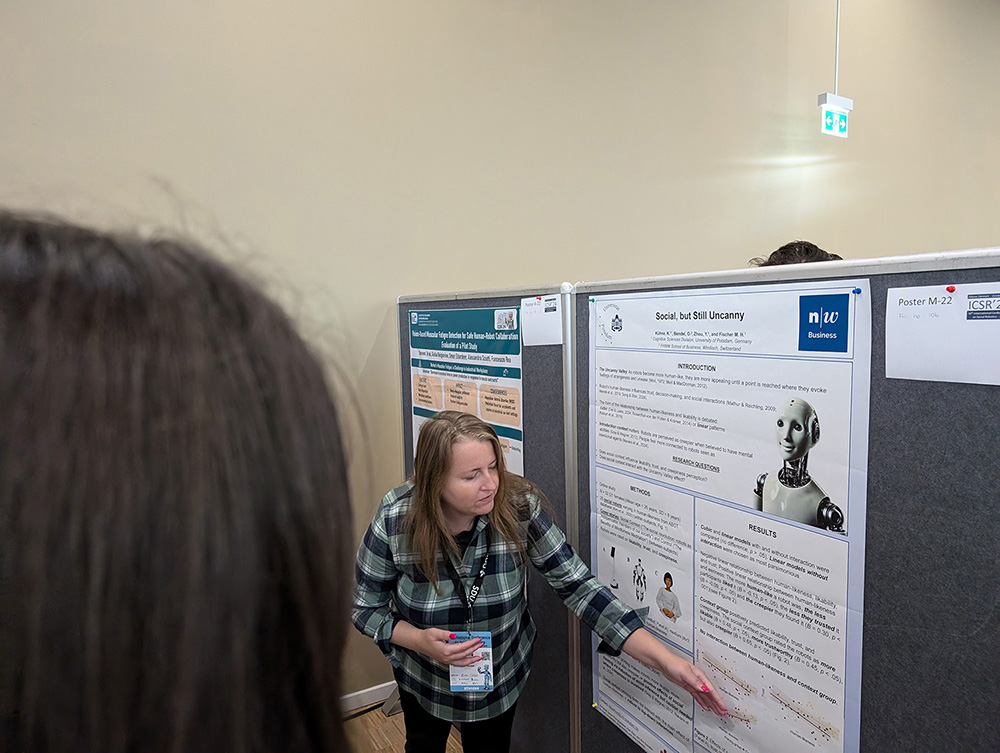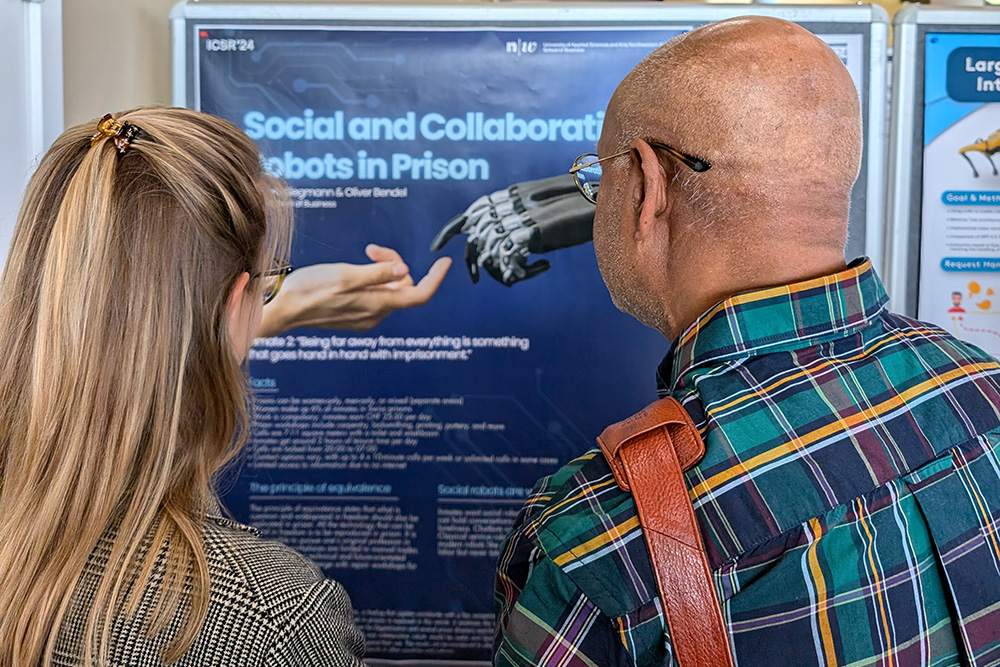
From February 12 to 14, 2024, the elective module “Social Robots” took place at the FHNW School of Business in Olten. This was the fifth time it had been held. This time, a GPT specialized in the topic was available for the first time. Prof. Dr. Oliver Bendel repeatedly had it explain the facts and then made additions. Social Robotics Girl, as she is called, was also used by the students in their group work. In this way, they benefited from the lecturer’s knowledge without having to search for the right text passages or call him in. Among the robots at the demo was Unitree Go2 for the first time. It stole the show from all the others, NAO, Pepper and even Alpha Mini. This was mainly due to its fast, fluid movements, its diverse forms of behavior and its surprising tricks. The robot comes from the Social Robots Lab privately funded by Prof. Dr. Oliver Bendel and is called Bao (Chinese for “treasure, jewel”) by him. As in 2023, image generators were used to design their own social robots, this time mainly with DALL-E 3 because some of the students had ChatGPT Plus access. The sixth edition will take place in Brugg-Windisch from February 15, 2024. It will mainly be attended by prospective business economists (Photo: Armend Nasufi).
Ick bin een Berlina
On January 29, 2024, the article “‘Ick bin een Berlina’: dialect proficiency impacts a robot’s trustworthiness and competence evaluation” was published in Frontiers in Robotics and AI. Authors are Katharina Kühne, Erika Herbold, Oliver Bendel, Yuefang Zhou, and Martin H. Fischer. With the exception of Oliver Bendel – who is a professor at the School of FHNW and an associated researcher in the PECoG group – all of them are members of the University of Potsdam. The paper says about the background: “Robots are increasingly used as interaction partners with humans. Social robots are designed to follow expected behavioral norms when engaging with humans and are available with different voices and even accents. Some studies suggest that people prefer robots to speak in the user’s dialect, while others indicate a preference for different dialects.” The following results are mentioned: “We found a positive relationship between participants’ self-reported Berlin dialect proficiency and trustworthiness in the dialect-speaking robot. Only when controlled for demographic factors, there was a positive association between participants’ dialect proficiency, dialect performance and their assessment of robot’s competence for the standard German-speaking robot. Participants’ age, gender, length of residency in Berlin, and device used to respond also influenced assessments. Finally, the robot’s competence positively predicted its trustworthiness.” The article can be accessed at www.frontiersin.org/articles/10.3389/frobt.2023.1241519/full.
Talking with Social Robotics Girl
On November 6, 2023, OpenAI made so-called GPTs available to ChatGPT Plus users. According to the US company, anyone can easily create his or her own GPT without any programming knowledge. Initial tests have shown the performance of the new function. ChatGPT suggests a name for the chatbot, creates the profile picture and accepts documents with text and reference lists to expand its knowledge of the topic. The function is ideal for creating your own learning companions, modern educational agents so to speak. But you can also benefit from chatbots from other users and providers. A GPT called Social Robotics Girl, which provides information about social robotics, has been available since November 12, 2023. It was created by Prof. Dr. Oliver Bendel and is based on a collection of his articles on this topic. It can therefore give his definition of social robots and make classifications based on his five-dimension model. ChatGPT Plus users can access Social Robotics Girl via chat.openai.com/g/g-TbhZSZaer-social-robotics-girl (Image: DALL-E 3).
Robophilosophy Conference 2024
The upcoming international Robophilosophy Conference 2024 in Aarhus is set to tackle the socio-cultural and ethical questions arising from the use of generative multimodal AIs in social robotics. The event will bring together global scholars from humanities, social sciences, social robotics, and computer science, aiming to produce actionable insights and responsibly address the socio-cultural transformations brought about by social robotics. It is part of the Robophilosophy Conference Series, known for its large scale events for humanities research in social robotics. RP2024 highlights the urgency of closer collaboration between tech experts and societal experts to establish research-based regulations. The conference will welcome 80-100 talks in plenaries, special workshops, and parallel sessions of reviewed research papers. Virtual attendance is made possible for those unable to attend in person. Interested parties are invited to submit their papers on the conference topics. Key dates to note: Deadline for workshop/panel proposal submissions is January 31, 2024. Deadline for short papers and posters is February 15, 2024. More information at cas.au.dk/en/robophilosophy/conferences/rpc2024.
Alpha Mini as a Learning Partner
The paper “Alpha Mini as a Learning Partner in the Classroom” by Prof. Dr. Oliver Bendel and Andrin Allemann was accepted at ICSR 2023. The philosopher of technology and information systems specialist has been researching conversational agents for a quarter of a century, and for many years specifically on embodied conversational agents and social robots. Andrin Allemann developed a learning application for children as part of his final thesis at the FHNW School of Business, supervised by Oliver Bendel. The goal was to create one with a low-cost social robot that has the same motor skills as NAO and the same knowledge transfer capabilities as Pepper (which is equipped with a display). The choice fell on the small Alpha Mini from Ubtech. It was possible, with some technical effort, to pair it with an external device, a Microsoft Surface. This runs an educational game suitable for primary school teaching. ICSR 2023 will take place in Qatar in December 2023. Along with Robophilosophy, it is one of the most important conferences for social robotics worldwide.
Pepper as a Learning Partner
The paper “Pepper as a Learning Partner in a Children’s Hospital” by Sara Zarubica and Prof. Dr. Oliver Bendel was accepted at ICSR 2023. The technology philosopher and information systems specialist has been researching conversational agents for a quarter of a century, and for many years specifically on embodied conversational agents and social robots. His projects often involve building prototypes, either in the context of machine ethics or with reference to buzzwords such as “AI for Good” or “AI for Well-being” (which he himself, however, views critically). Sara Zarubica developed a learning application for children with diabetes that runs on a social robot as part of her thesis at the FHNW School of Business, supervised by Oliver Bendel. According to the abstract, the goal was to make Pepper an interactive learning partner with which the children can “practise estimating carbohydrate amounts in meals and thus build a foundation for the daily management of type 1 diabetes mellitus” (abstract). The children complete the learning game on the social robot’s display and receive gestural and verbal feedback from it. In 2022, Oliver Bendel was at the ICSR 2022 in Florence together with Marc Heimann, where they presented the morality module. The ICSR 2023 will take place in Qatar in December 2023. Along with Robophilosophy, it is one of the most important conferences for social robotics worldwide.
15th International Conference on Social Robotics (ICSR 2023)
The International Conference on Social Robotics (ICSR 2023) is, next to Robophilosophy, the most important conference on social robotics. The deadline for paper submission is approaching. “The 15th International Conference on Social Robotics (ICSR 2023) will bring together researchers and practitioners working on the interaction between humans and intelligent robots and on the integration of social robots into our society. ICSR 2023 will take place in Doha as a face-to-face conference on December 4-7, 2023. This will be the first time that the conference will be hosted in Qatar and in the Middle East and North Africa region.” (Website ICSR) The theme of this year’s ICSR is “Human-Robot Collaboration: Sea, Air, Land, Space and Cyberspace”. According to the organizers, the theme emphasizes on all physical and cyber-physical domains where humans and robots collaborate. Papers can be submitted until August 21, 2023. Notifications will be made by September 18 of that year. More information via icsr23.qa.
Preprint on Bar Robots
From March 27-29, 2023, the AAAI 2023 Spring Symposia featured the symposium “Socially Responsible AI for Well-being” by Takashi Kido (Teikyo University, Japan) and Keiki Takadama (The University of Electro-Communications, Japan). This time the venue was exceptionally not Stanford University, but the Hyatt Regency SFO Airport. On March 28, Prof. Dr. Oliver Bendel and Lea Peier presented their paper “How Can Bar Robots Enhance the Well-being of Guests?”. The paper has now been published as a preprint and can be downloaded via arxiv.org/abs/2304.14410. From the abstract: “This paper addresses the question of how bar robots can contribute to the well-being of guests. It first develops the basics of service robots and social robots. It gives a brief overview of which gastronomy robots are on the market. It then presents examples of bar robots and describes two models used in Switzerland. A research project at the School of Business FHNW collected empirical data on them, which is used for this article. The authors then discuss how the robots could be improved to increase the well-being of customers and guests and better address their individual wishes and requirements. Artificial intelligence can play an important role in this. Finally, ethical and social problems in the use of bar robots are discussed and possible solutions are suggested to counter these.” More information on the conference via aaai.org/conference/spring-symposia/sss23/.
Preprint on Hugging Robots
From March 27-29, 2023, the AAAI 2023 Spring Symposia featured the symposium “Socially Responsible AI for Well-being” by Takashi Kido (Teikyo University, Japan) and Keiki Takadama (The University of Electro-Communications, Japan). This time the venue was exceptionally not Stanford University, but the Hyatt Regency SFO Airport. On March 28, Prof. Dr. Oliver Bendel presented the paper “Increasing Well-being through Robotic Hugs”, written by himself, Andrea Puljic, Robin Heiz, Furkan Tömen, and Ivan De Paola. The paper has now been published as a preprint and can be downloaded via arxiv.org/abs/2304.14409. From the abstract: “This paper addresses the question of how to increase the acceptability of a robot hug and whether such a hug contributes to well-being. It combines the lead author’s own research with pioneering research by Alexis E. Block and Katherine J. Kuchenbecker. First, the basics of this area are laid out with particular attention to the work of the two scientists. The authors then present HUGGIE Project I, which largely consisted of an online survey with nearly 300 participants, followed by HUGGIE Project II, which involved building a hugging robot and testing it on 136 people. At the end, the results are linked to current research by Block and Kuchenbecker, who have equipped their hugging robot with artificial intelligence to better respond to the needs of subjects.” More information on the conference via aaai.org/conference/spring-symposia/sss23/.
A “weak” Robot
How do social robots emerge from simple, soft shapes? As part of their final thesis in 2021 at the School of Business FHNW, 23-year-old students Nhi Tran Hoang Yen and Thang Hoang Vu from Ho Chi Minh City (Vietnam) have answered this question posed by their supervisor Prof. Dr. Oliver Bendel. They have submitted eleven proposals for novel robots. The first is a pillow to which a tail has been added. Its name is Petanion, a portmanteau of “pet” and “companion”. The tail could move like the tail of a cat or dog. In addition, the pillow could make certain sounds. It would be optimal if the tail movements were based on the behavior of the user. Thus, as desired, a social robot is created from a simple, soft form, in this case a pet substitute. Petanion is soft and cute and survives a long time. It can also be used if one has certain allergies or if there is not enough space or money in a household for a pet. Last but not least, the ecological balance is probably better – above all, the robot does not eat animals that come from factory farming. The inspiration may have been Qoobo, a pillow with a tail, designed to calm and to “heal the heart”. Panasonic also believes in robots that emerge from simple, soft forms. It promotes its new robot NICOBO as a “yowai robotto”, a “weak” robot that has hardly any functions or capabilities. The round, cute robot has two separate displays as eyes and a tail that it constantly moves. According to the company, it is aimed primarily at singles and the elderly. There could well be a high demand for it, even beyond the target groups (Photo: Panasonic).