China’s Brain Drain

“China’s AI talent base is growing, and then leaving” – this is what Joy Dantong Ma writes in an article with the same title. Artificial intelligence is promoted in the People’s Republic in various ways. Money is invested in technologies, institutions, and people. “China has been successful in producing AI talent, evidenced by the rapid growth of AI human capital over the last decade.” (MacroPolo, 30 July 2019) This seems to be good news for the country in the Far East. But the study to which the article refers comes to a different conclusion. While “Beijing has cultivated an army of top AI talent, well over half of that talent eventually ended up in America rather than getting hired by domestic companies and institutions”. “That’s because most of the government resources went into expanding the talent base rather than creating incentives and an environment in which they stay.” (MacroPolo, 30 July 2019) According to Joy Dantong Ma, Beijing seems to have recognized its failure in retaining talent. “The well-known New Generation Artificial Intelligence Development Plan, released in 2017, vowed to lure top-notch AI scientists in neural network, machine learning, self-driving cars, and intelligent robotics by opening up special channels and offering up competitive compensation packages. Still, it’s not clear that Beijing will be able to reverse the Chinese AI brains from draining to its biggest competitor, the United States.” (MacroPolo, 30 July 2019) Does the USA even want the talents? That is anything but clear in these times.

Unknown Links between Classic Artworks

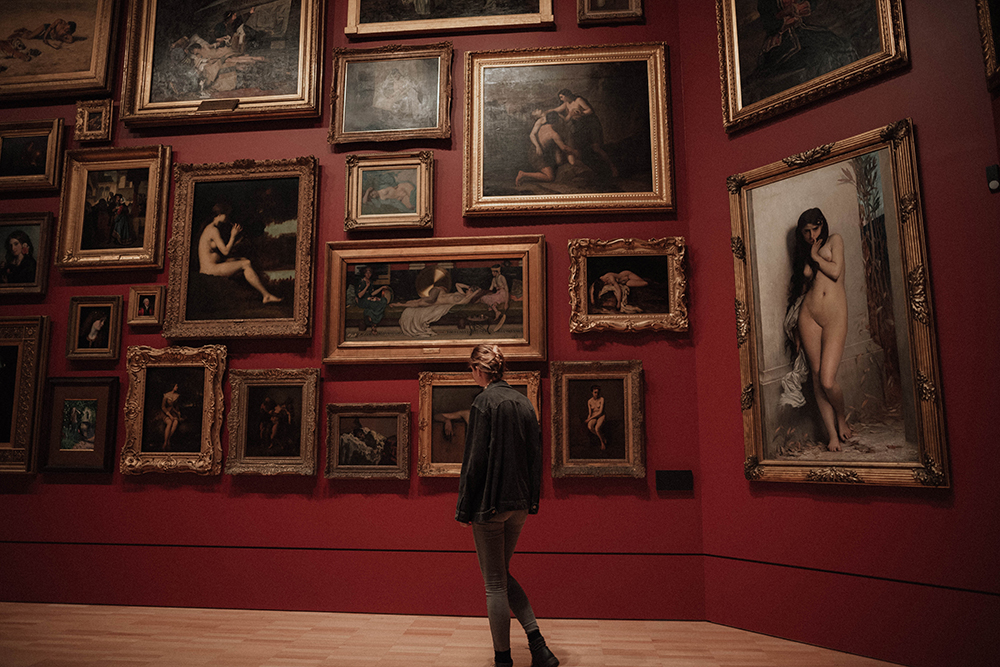
Can machine vision detect unknown connections between famous or classic artworks? This seems to be the case, as the work of Tomas Jenicek and Ondřej Chum shows. In their paper “Linking Art through Human Poses” they write: “We address the discovery of composition transfer in artworks based on their visual content. Automated analysis of large art collections, which are growing as a result of art digitization among museums and galleries, is an important tool for art history and assists cultural heritage preservation. Modern image retrieval systems offer good performance on visually similar artworks, but fail in the cases of more abstract composition transfer. The proposed approach links artworks through a pose similarity of human figures depicted in images.” (Abstract) Human figures are the subject of many paintings from the Middle Ages to the Modern Age and their unmistakable poses have often been a source of inspiration among artists. Think of “Sleeping Venus” by Giorgione, “Venus of Urbino” by Titian and “Olympia” by Édouard Manet – paintings with similarities and correlations. The method of the two scientists consists of fast pose matching and robust spatial verification. They “experimentally show that explicit human pose matching is superior to standard content-based image retrieval methods on a manually annotated art composition transfer dataset” (Abstract). The paper can be downloaded via arxiv.org/abs/1907.03537.

Could Artificial Intelligence Trigger Wars?

Deep fakes are a young phenomenon. Of course there have been fake videos for a long time. But that artificial intelligence makes the production possible, even in standard applications, is new. On August 1, an article dedicated to the phenomenon was published in the German newspaper Die Welt. It begins with the following words: “It is well known that a picture says more than a thousand words. And moving images, i.e. videos, are still regarded as unmistakable proof that something has taken place exactly as it can be seen in the film. … Powerful artificial intelligence (AI) processes now make it possible to produce such perfect counterfeits that it is no longer possible to tell with the naked eye whether a video is real or manipulated. In so-called deep fake videos, people say or do things they would never say or do.” Among others, the philosopher Oliver Bendel is quoted. The article with the title “Artificial intelligence could trigger wars” can be downloaded via www.welt.de.

About Robophilosophy

Robophilosophy or robot philosophy is a field of philosophy that deals with robots (hardware and software robots) as well as with enhancement options such as artificial intelligence. It is not only about the reality and history of development, but also the history of ideas, starting with the works of Homer and Ovid up to science fiction books and movies. Disciplines such as epistemology, ontology, aesthetics and ethics, including information and machine ethics, are involved. The website robophilosophy.com or robophilosophy.net is operated by Oliver Bendel, a robot philosopher who lives and works in Switzerland. Guest contributions are welcome. They should be exclusively scientific and should not advertise for companies.