Keynote by David Chalmers

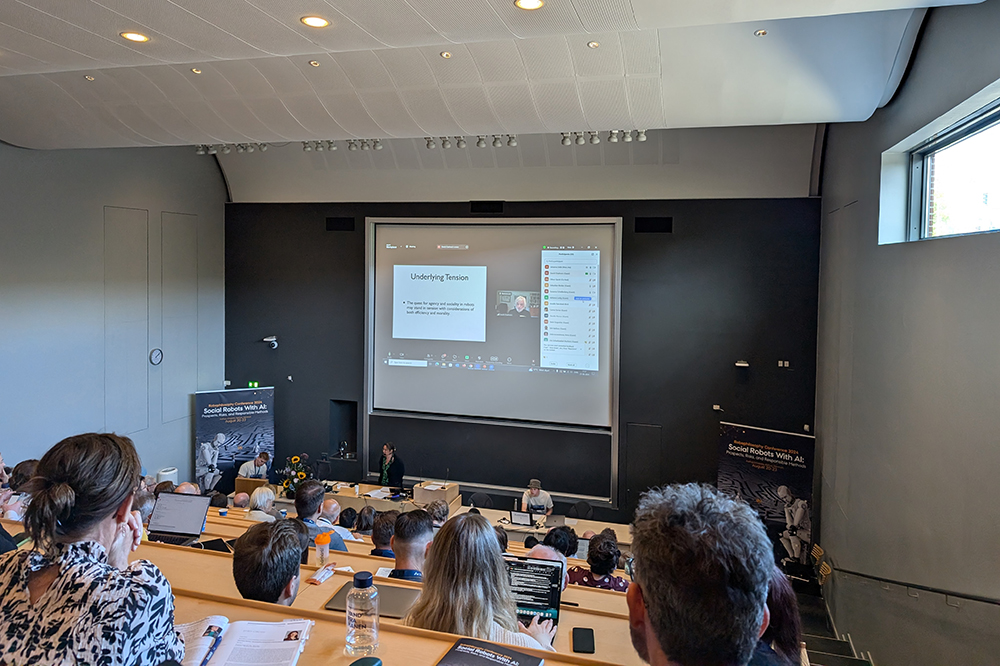
On the second day of Robophilosophy 2024, David Chalmers, an Australian philosopher and cognitive scientist, gave a keynote speech entitled “Does Generative AI Extend the Mind?”. From the website: “Prof. Chalmers is known worldwide, also outside of philosophy, for his contributions to consciousness research in ‘The Character of Consciousness’ (2010), and in particular for identifying more clearly than anyone the tasks for a philosophical account of consciousness (‘the hard problem’ of consciousness). Since recent advances in AI bring Chalmers’ thought experiment of ‘philosophical zombies’ closer to reality, in his current research he combines philosophy and a longstanding interest in AI for the exploration of the status of virtual reality … and the likelihood of creating artificial systems that fulfil the criteria of consciousness.” (Website Robophilosophy 2024) A key statement was: “As social AI systems become increasingly agent-like, they will decreasingly extend the mind …” The final statement was: “The quest for agency and sociality in robotsmay stand in tension with considerations of both efficiency and morality.” The audience applauded the witty and humorous talk.

Start of Robophilosophy 2024

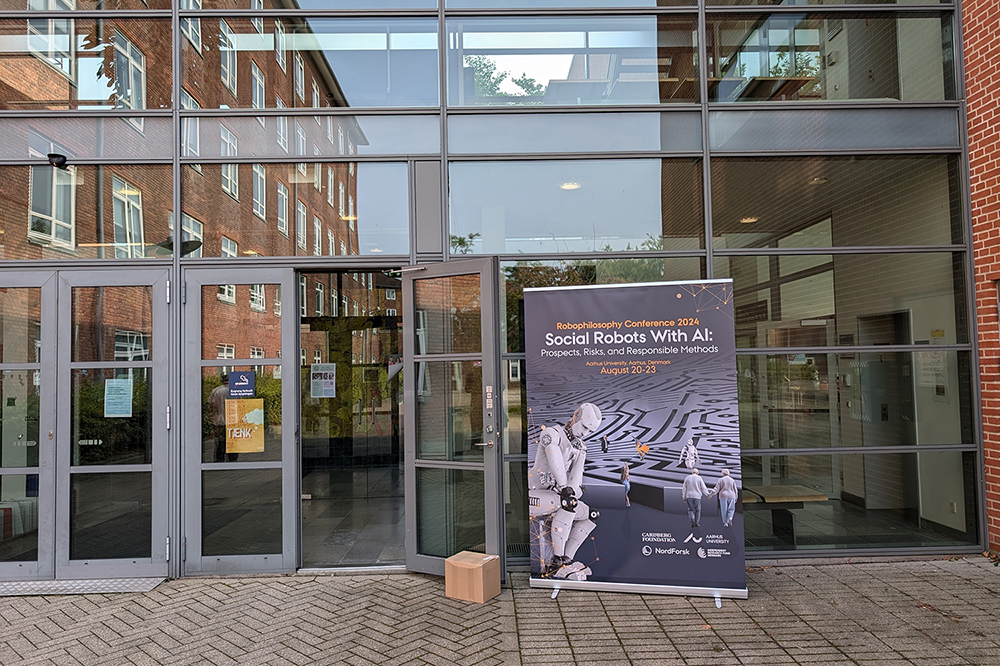
On August 20, 2024, Robophilosophy 2024 was opened with words of welcome from Maja Horst, Dean of the Faculty of Arts at Aarhus University, and Johanna Seibt, Professor of the School of Culture and Society at Aarhus University. The website says: “The international research conference RP2024 will discuss the questions that really matter in view of the new technological potential of social robotics. In over 100 research talks, RP2024 will address concrete and deep issues that reach far beyond safety and privacy concerns into the conceptual and normative fabric of our societies and individual self-comprehension.” (Website Robophilosophy 2024) The first keynote on the first day of the conference was given by Wendell Wallach, one of the world’s best-known machine ethicists. With his book “Moral Machines” (2009), he laid the foundation for a discipline that has been developing in science fiction and science for years and decades. This was followed in 2011 by “Machine Ethics” by Michael Anderson and Susan L.eigh Anderson. In addition to machine ethics, Robophilosophy is dedicated to robot ethics and other interesting perspectives on social robots.

Extended Deadline for ICSR 2024

The deadline for the International Conference on Social Robotics 2024 (ICSR 2024) has been extended. Experts in social robotics and related fields have until July 12 to submit their papers. The prestigious event was last held in Florence (2022) and Qatar (2023). Now it enters its next round. The 16th edition will bring together researchers and practitioners working on human-robot interaction and the integration of social robots into our society. The title of the conference includes the addition “AI”. This is a clarification and demarcation that has to do with the fact that there will be two further formats with the name ICSR in 2024. ICSR’24 (ICSR + AI) will take place as a face-to-face conference in Odense, Denmark, from 23 to 26 October 2024. The theme of this year’s conference is “Empowering Humanity: The role of social and collaborative robotics in shaping our future”. The topics of the Call for Papers include “collaborative robots in service applications (in construction, agriculture, etc.)”, “Human-robot interaction and collaboration”, “Affective and cognitive sciences for socially interactive robots”, and “Context awareness, expectation, and intention understanding”. The general chairs are Oskar Palinko, University of Southern Denmark, and Leon Bodenhagen, University of Southern Denmark. More information is available at icsr2024.dk.

Robophilosophy Conference 2024

The upcoming international Robophilosophy Conference 2024 in Aarhus is set to tackle the socio-cultural and ethical questions arising from the use of generative multimodal AIs in social robotics. The event will bring together global scholars from humanities, social sciences, social robotics, and computer science, aiming to produce actionable insights and responsibly address the socio-cultural transformations brought about by social robotics. It is part of the Robophilosophy Conference Series, known for its large scale events for humanities research in social robotics. RP2024 highlights the urgency of closer collaboration between tech experts and societal experts to establish research-based regulations. The conference will welcome 80-100 talks in plenaries, special workshops, and parallel sessions of reviewed research papers. Virtual attendance is made possible for those unable to attend in person. Interested parties are invited to submit their papers on the conference topics. Key dates to note: Deadline for workshop/panel proposal submissions is January 31, 2024. Deadline for short papers and posters is February 15, 2024. More information at cas.au.dk/en/robophilosophy/conferences/rpc2024.

LaborDigital Conference at the ZHdK

The LaborDigital conference at the Zurich University of the Arts (ZHdK) will take place on February 10, 2023 in English and German. It was initiated and organized by Charlotte Axelsson and others. The conference will open with a lecture by Prof. Dr. Johan Frederik Hartle, Rector of the Academy of Fine Arts Vienna. This will be followed by the keynote “Labor-Geschichte/s. On the Archaeology of a ‘Creative’ Space” by Prof. Dr. Oliver Ruf from the Bonn-Rhein-Sieg University of Applied Sciences. From 11:00 to 12:30, three Experimental Learning Labs will take place in parallel, namely “Artifacts of Machine Ethics” with Prof. Dr. Oliver Bendel (FHNW, Muttenz, Olten and Brugg-Windisch), “Dance Lab & Avatar” with Regina Bäck (Munich), and “Experimental Game Cultures Labs” with Prof. Dr. Margarete Jahrmann (University of Applied Arts Vienna). Lunch will be followed by ZHdK Lab Visits and more Experimental Learning Labs starting at 3:30 pm. At 4:30 p.m., Raphaële Bidault-Waddington, founder of the LIID Future Lab in Paris, will deliver the second keynote, titled “Designing Art-based Future Labs.” Johan Frederik Hartle will conclude the conference with further remarks. For more information, visit paul.zhdk.ch/course/view.php?id=2312.

Proceedings of Robophilosophy 2022

In January 2023, the proceedings of Robophilosophy 2022 were published, under the title “Social Robots in Social Institutions”. “This book presents the Proceedings of Robophilosophy 2022, the 5th event in the biennial Robophilosophy conference series, held in Helsinki, Finland, from 16 to 19 August 2022. The theme of this edition of the conference was Social Robots in Social Institutions, and it featured international multidisciplinary research from the humanities, social sciences, Human-Robot Interaction, and social robotics. The 63 papers, 41 workshop papers and 5 posters included in this book are divided into 4 sections: plenaries, sessions, workshops and posters, with the 41 papers in the ‘Sessions’ section grouped into 13 subdivisions including elderly care, healthcare, law, education and art, as well as ethics and religion. These papers explore the anticipated conceptual and practical changes which will come about in the course of introducing social robotics into public and private institutions, such as public services, legal systems, social and healthcare services, or educational institutions.” (Website IOS Press) The proceedings contain the paper “Robots in Policing” by Oliver Bendel and the poster “Tamagotchi on our couch: Are social robots perceived as pets?” by Katharina Kühne, Melinda A. Jeglinski-Mende, and Oliver Bendel. More information via www.iospress.com/catalog/books/social-robots-in-social-institutions.

CfP for Robophilosophy 2022

Robophilosophy 2022 is the fifth event in the biennial Robophilosophy Conference Series. The first call for papers (CfP) was published in November 2021, and the second at the end of 2021. The extended deadline for submissions of extended abstracts and full papers is February 28, 2022. The event “will explore the societal significance of social robots for the future of social institutions with its usual broad scope, embracing both theoretical and practical angles” (CfP Robophilosophy). It “is an invitation to philosophers and other SSH researchers, as well as researchers in social robotics and HRI, to investigate from interdisciplinarily informed perspectives whether and how social robotics as an interdisciplinary endeavour can contribute to the ability of our institutions to perform their functions in society” (CfP Robophilosophy). Topics of interest include robots and social institutions in general, robots in law and policing, robots in healthcare, and robots and social justice. The conference will be held at the University of Helsinki in Finland from August 16-19, 2022. More information via www.rp2022.org.

Next ROBOPHILOSOPHY in Helsinki

One of the world’s most important conferences for robot philosophy (aka robophilosophy) and social robotics, ROBOPHILOSOPHY, took place from 18 to 21 August 2020, not in Aarhus (Denmark) as originally planned, but – due to the COVID 19 pandemic – in virtual form. Organizers and presenters were Marco Nørskov and Johanna Seibt. A considerable number of the lectures were devoted to machine ethics, such as “Moral Machines” (Aleksandra Kornienko), “Permissibility-Under-a-Description Reasoning for Deontological Robots” (Felix Lindner) and “The Morality Menu Project” (Oliver Bendel). The keynotes were given by Selma Šabanović (Indiana University Bloomington), Robert Sparrow (Monash University), Shannon Vallor (The University of Edinburgh), Alan Winfield (University of the West of England), Aimee van Wynsberghe (Delft University of Technology) and John Danaher (National University of Ireland). In his outstanding presentation, Winfield was sceptical about moral machines, whereupon Bendel made it clear in the discussion that they are useful in some areas and dangerous in others, and emphasized the importance of machine ethics for the study of machine and human morality, a point with which Winfield again agreed. The last conference was held in Vienna in 2018. Keynote speakers at that time included Hiroshi Ishiguro, Joanna Bryson and Oliver Bendel. The next ROBOPHILOSOPHY will probably take place in 2022 at the University of Helsinki, as the organisers announced at the end of the event.