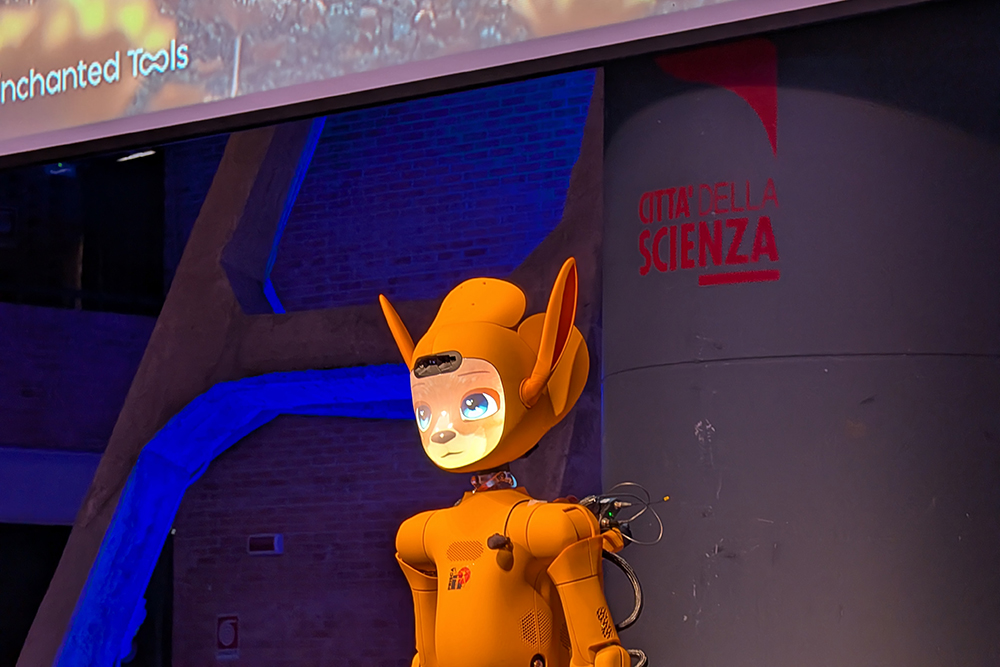
The article “It Does Not Always Have to Be a Humanoid Robot: Mythomorphic Design as an Option and a Perspective” by Oliver Bendel was published in Wiley Industry News on May 13, 2026. The philosopher of technology proposes the term “mythomorph” to expand upon the categories of “humanoid” and “animalid” (“zoomorph”). This allows robots such as Mirokaï, Furby, and Cozmo to be better categorized than before. From the abstract: “Social robots are often designed in a humanoid or zoomorphic manner. In addition, there are object-like designs that attempt to avoid imitation of living beings. Nevertheless, humanoid or zoomorphic features may still appear, such as human-like eyes or an animal-like tail. Less common, but clearly present, is a design perspective that can be described as mythomorphic. In this case, humans or animals do not serve, or do not directly serve, as models; instead, extraterrestrials, fantasy figures, or mythological beings are used as inspiration. This contribution first addresses what can be understood by mythomorphic design. It then collects, describes, and classifies examples of social robots that follow this approach. Subsequently, an ontological, aesthetic, and ethical discussion is conducted, with opportunities and risks identified in each case. It becomes apparent that mythomorphic design can be understood as a distinct perspective within the broader design space of social robotics.” The article can be accessed here.
Back to the Future
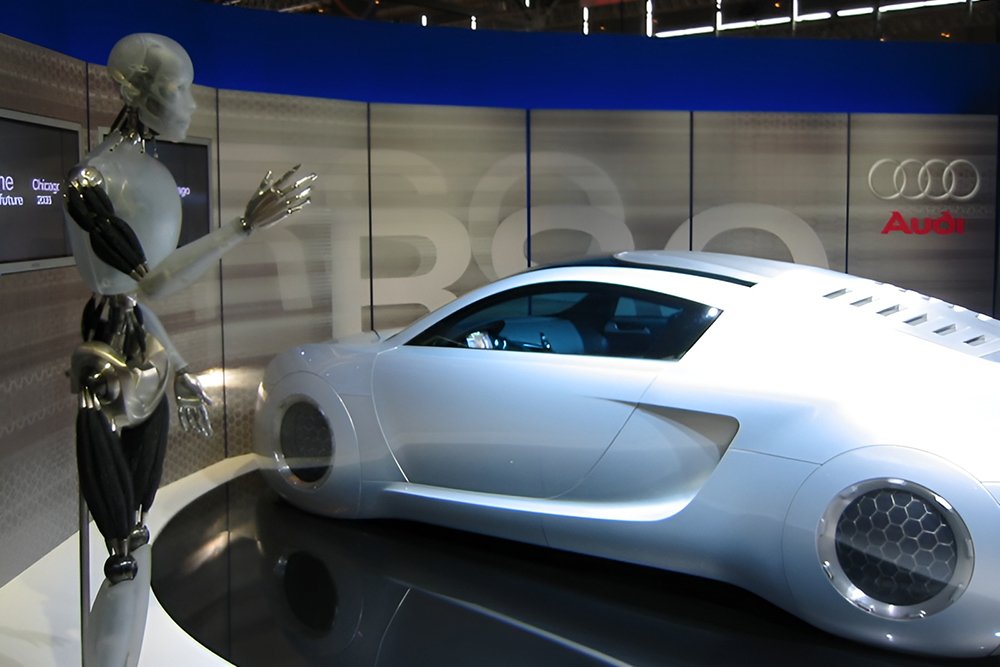
Elon Musk presented the prototypes of his new Cybercab and his new Robovan in October 2024. In this context, he once again said: “The future should look like the future.” (TechCrunch, 10 October 2024) This is an astonishing statement, because if you know a little about the history of robot and vehicle construction, you know that Elon Musk is orientating himself on ideas that were popular 20 to 80 years ago. Brass, copper, silver, gold, and large, matt or polished surfaces – reminiscent of Elektro (1939) and his animal companion Sparko (1940) as well as futuristic vehicles such as Gil Spear’s Chrysler two-seater (1941). Science fiction and fantasy are also likely to play a role in the design of Tesla and co – think of steampunk and cyberpunk in general, and think of movies like “Metropolis” (1927) and “I, Robot” (2004). Elon Musk generally likes to mix ideas from fiction in his developments, for example the large language model called Grok, which takes its name from “Stranger in a Strange Land” and is intended to fulfil claims formulated in “The Hitchhiker’s Guide to the Galaxy”. TechCrunch also points out the backward-looking nature of the Robovan: “The Robovan has a retro-futuristic look – somewhere between a bus from The Jetsons and a toaster from the 1950s. It features silver metallic sides with black details, and strips of light run-ning parallel to the ground along its sides, with doors that slide out from the middle.” (TechCrunch, 10 October 2024) Robots and robotic vehicles could look very different in the 2020s (Photo: Eirik Newth; cropped by Robophilosophy).