The book “Culturally Sustainable Social Robotics” (eds. Marco Nørskov, Johanna Seibt, and Oliver Santiago Quick) was published in December 2020 by IOS Press. From the publisher’s information: “Robophilosophy conferences have been the world’s largest venues for humanities research in and on social robotics. The book at hand presents the proceedings of Robophilosophy Conference 2020: Culturally Sustainable Social Robotics, the fourth event in the international, biennial Robophilosophy Conference Series, which brought together close to 400 participants from 29 countries. The speakers of the conference, whose contributions are collected in this volume, were invited to offer concrete proposals for how the Humanities can help to shape a future where social robotics is guided by the goals of enhancing socio-cultural values rather than by utility alone. The book is divided into 3 parts; Abstracts of Plenaries, which contains 6 plenary sessions; Session Papers, with 44 papers under 8 thematic categories; and Workshops, containing 25 items on 5 selected topics.” (Website IOS Press) Contributors include Robert Sparrow, Alan Winfield, Aimee van Wynsberghe, John Danaher, Johanna Seibt, Marco Nørskov, Peter Remmers, John P. Sullins, and Oliver Bendel.
A Digital Supermodel
Cameron-James Wilson, 31, founded an agency for digital models in London in 2019, The Diigitals. He is the creator of the digital supermodel Shudu. “Since baffling the fashion and modeling world at large, he’s added virtuals Galaxia, Brenn, Dagny, Koffi, Margot, and Zhi to the Gram family.” (Virtual Humans, 4 May 2020) Galaxia is an alien model and has long, pointed ears and a long neck. Koffi is a male virtual influencer with a muscle-rich body, which he likes to show in sparse clothing. Shudu is the most famous avatar of the agency. At this year’s digital fashion shows in Paris and Milan, a number of CGI (Computer Generated Imagery) models and avatars presented the new looks. Shudu was not there, which the creator explains in a SPIEGEL interview by the fact that it is still difficult to animate her to move like a real person. At the end Barbara Markert asks him what Shudu means to him. He answers: “It may sound crazy, but I feel a responsibility for this woman and the community she represents.” (SPIEGEL, 9 December 2020, own translation)
Love Dolls and Sex Robots in Prisons
On 24 October 2020 the article “Love Dolls and Sex Robots in Unproven and Unexplored Fields of Application” by Oliver Bendel was published in Paladyn, Journal of Behavioral Robotics. From the abstract: “Love dolls, the successors of blow-up dolls, are widespread. They can be ordered online or bought in sex shops and can be found in brothels and households. Sex robots are also on the rise. Research, however, has been slow to address this topic thoroughly. Often, it does not differentiate between users and areas of application, remaining vague, especially in the humanities and social sciences. The present contribution deals with the idea and history of love dolls and sex robots. Against this background, it identifies areas of application that have not been investigated or have hardly been investigated at all. These include prisons, the military, monasteries and seminaries, science, art and design as well as the gamer scene. There is, at least, some relevant research about the application of these artefacts in nursing and retirement homes and as such, these will be given priority. The use of love dolls and sex robots in all these fields is outlined, special features are discussed, and initial ethical, legal and pragmatic considerations are made. It becomes clear that artificial love servants can create added value, but that their use must be carefully considered and prepared. In some cases, their use may even be counterproductive.” The article is available here for free as an open access publication.
Investigating Robot Enhancement
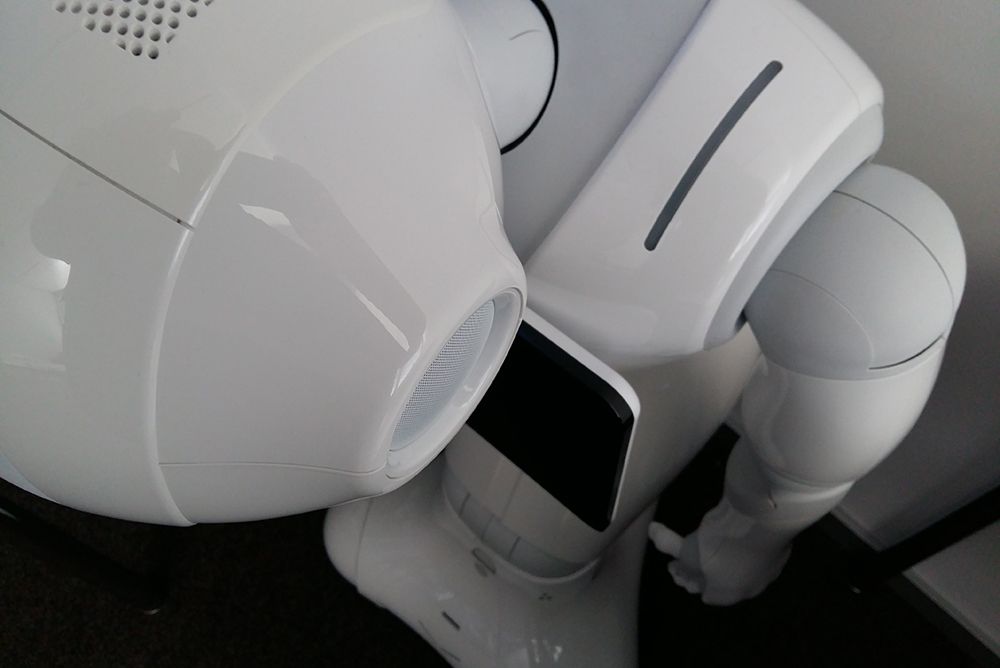
Social robots and service robots usually have a defined locomotor system, a defined appearance and defined mimic and gestural abilities. This leads, on the one hand, to a certain familiarization effect. On the other hand, the actions of the robots are thus limited, for example in the household or in a shopping mall. Robot enhancement is used to extend and improve social robots and service robots. It changes their appearance and expands their scope. It is possible to apply attachments to the hardware, extend limbs and exchange components. One can pull skin made of silicone over the face or head, making the robots look humanoid. One can also change the software and connect the robot to AI systems – this is already done many times. The project or thesis, announced by Oliver Bendel in August 2020 at the School of Business FHNW, should first present the principles and functional possibilities of robot enhancement. Second, concrete examples should be given and described. One of these examples, e.g., the skin made of silicone, has to be implemented. Robots like Pepper or Atlas would be completely changed by such a skin. They could look uncanny, but also appealing. The project will start in September 2020.
Launch of the Interactive AI Magazine
AAAI has announced the launch of the Interactive AI Magazine. According to the organization, the new platform provides online access to articles and columns from AI Magazine, as well as news and articles from AI Topics and other materials from AAAI. “Interactive AI Magazine is a work in progress. We plan to add lot more content on the ecosystem of AI beyond the technical progress represented by the AAAI conference, such as AI applications, AI industry, education in AI, AI ethics, and AI and society, as well as conference calendars and reports, honors and awards, classifieds, obituaries, etc. We also plan to add multimedia such as blogs and podcasts, and make the website more interactive, for example, by enabling commentary on posted articles. We hope that over time Interactive AI Magazine will become both an important source of information on AI and an online forum for conversations among the AI community.” (AAAI Press Release) More information via interactiveaimag.org.
Next ROBOPHILOSOPHY in Helsinki
One of the world’s most important conferences for robot philosophy (aka robophilosophy) and social robotics, ROBOPHILOSOPHY, took place from 18 to 21 August 2020, not in Aarhus (Denmark) as originally planned, but – due to the COVID 19 pandemic – in virtual form. Organizers and presenters were Marco Nørskov and Johanna Seibt. A considerable number of the lectures were devoted to machine ethics, such as “Moral Machines” (Aleksandra Kornienko), “Permissibility-Under-a-Description Reasoning for Deontological Robots” (Felix Lindner) and “The Morality Menu Project” (Oliver Bendel). The keynotes were given by Selma Šabanović (Indiana University Bloomington), Robert Sparrow (Monash University), Shannon Vallor (The University of Edinburgh), Alan Winfield (University of the West of England), Aimee van Wynsberghe (Delft University of Technology) and John Danaher (National University of Ireland). In his outstanding presentation, Winfield was sceptical about moral machines, whereupon Bendel made it clear in the discussion that they are useful in some areas and dangerous in others, and emphasized the importance of machine ethics for the study of machine and human morality, a point with which Winfield again agreed. The last conference was held in Vienna in 2018. Keynote speakers at that time included Hiroshi Ishiguro, Joanna Bryson and Oliver Bendel. The next ROBOPHILOSOPHY will probably take place in 2022 at the University of Helsinki, as the organisers announced at the end of the event.
Chocolate Could Increase Acceptance
A multi-stage HUGGIE project is currently underway at the School of Business FHNW under the supervision of Prof. Dr. Oliver Bendel. Ümmühan Korucu and Leonie Stocker (formerly Leonie Brogle) started with an online survey. The aim was to gain insights into how people of all ages and sexes judge a hug by a robot. In crises and catastrophes involving prolonged isolation, such as the COVID 19 pandemic, proxy hugs of this kind could well play a role. Prisons and longer journeys through space are also possible fields of applications. Nearly 300 people took part in the online survey. The evaluation is almost complete and the results are remarkable. Among other things, it was found that women want to be hugged by a robot that is bigger than them, and men want to be hugged by a robot that is smaller than them. Not only the size is relevant for the acceptance of robotic hugging: “An interesting input given by one of the participants was that it could be more pleasant to hug a robot if it smelled nicely, for example like chocolate.” (Draft of Bachelor Thesis) Whether this is a typically Swiss view remains to be investigated. The results of the survey and the conclusions drawn from them for the design of HUGGIE will be compiled in a paper in the course of the year.
Towards a Proxy Machine
“Once we place so-called ‘social robots’ into the social practices of our everyday lives and lifeworlds, we create complex, and possibly irreversible, interventions in the physical and semantic spaces of human culture and sociality. The long-term socio-cultural consequences of these interventions is currently impossible to gauge.” (Website Robophilosophy Conference) With these words the next Robophilosophy conference was announced. It would have taken place in Aarhus, Denmark, from 18 to 21 August 2019, but due to the COVID 19 pandemic it is being conducted online. One lecture will be given by Oliver Bendel. The abstract of the paper “The Morality Menu Project” states: “Machine ethics produces moral machines. The machine morality is usually fixed. Another approach is the morality menu (MOME). With this, owners or users transfer their own morality onto the machine, for example a social robot. The machine acts in the same way as they would act, in detail. A team at the School of Business FHNW implemented a MOME for the MOBO chatbot. In this article, the author introduces the idea of the MOME, presents the MOBO-MOME project and discusses advantages and disadvantages of such an approach. It turns out that a morality menu can be a valuable extension for certain moral machines.” In 2018 Hiroshi Ishiguro, Guy Standing, Catelijne Muller, Joanna Bryson, and Oliver Bendel had been keynote speakers. In 2020, Catrin Misselhorn, Selma Sabanovic, and Shannon Vallor will be presenting. More information via conferences.au.dk/robo-philosophy/.
Announcing AIhub.org
AAAI has announced the launch of a new website, which has the goal to connect the AI community with the public. “By providing free, high-quality technical and accessible information about AI, AIhub.org aims to improve public understanding so that everyone can have a meaningful discussion about the deployment of AI in society.” (Newsletter AAAI, 23 April 2020) According to the organization, AIhub.org hosts daily updates about the latest news, opinions, tutorials, and events in AI. “All information is produced by those working directly in the field, without filter or intermediary.” (Newsletter AAAI, 23 April 2020) This means that everyone in the AI community has the opportunity to participate in the website and address topics such as AI ethics and robot philosophy. More information via aihub.org.
Human, Medicine and Society
In his lecture “Service Robots in Health Care” at the Orient-Institut Istanbul on 18 December 2019, Prof. Dr. Oliver Bendel from Zurich, Switzerland is going to deal with care robots as well as therapy and surgery robots. He will present well-known and less known examples and clarify the goals, tasks and characteristics of these service robots in the healthcare sector. Afterwards he will investigate current and future functions of care robots, including sexual assistance functions. Against this background, the lecture is going to consider both the perspective of information ethics and machine ethics. In the end, it should become clear which robot types and prototypes or products are available in health care, which purposes they fulfil, which functions they assume, how the healthcare system changes through their use and which implications and consequences this has for the individual and society. The program of the series “Human, medicine and society: past, present and future encounters” can be downloaded here.