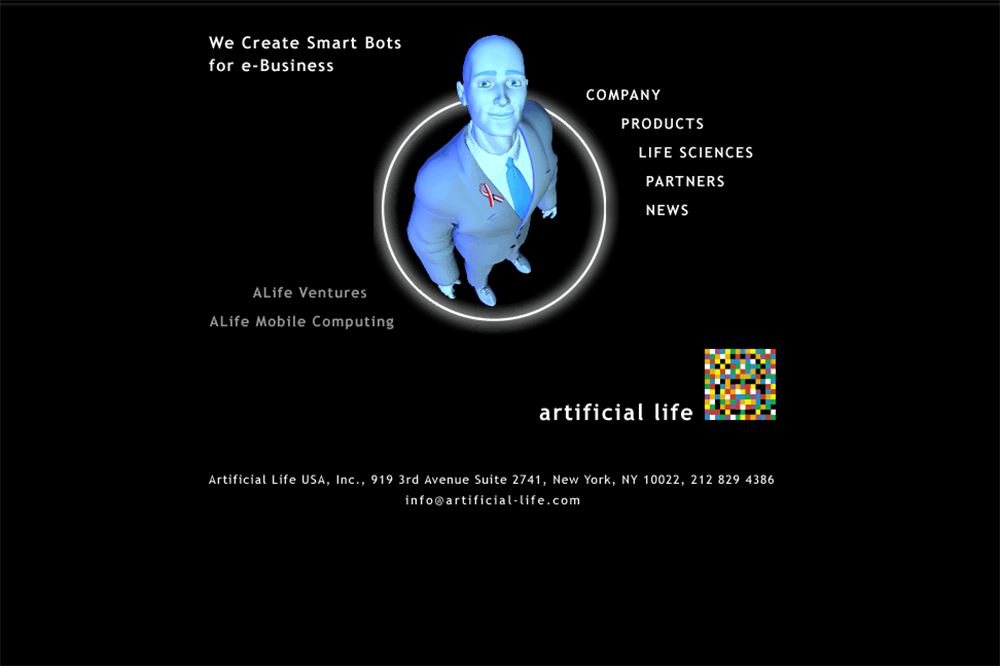
In 1999, Oliver Bendel moved from an institute in Trier to the University of St. Gallen, where he took a position as a project manager and doctoral researcher. At first, he planned to write his dissertation on learning and knowledge portals. However, he soon decided to pursue a different topic. From an early age, he had been fascinated by chatbots, voice assistants, and social robots. Some he knew from science fiction, while others he had encountered firsthand through observation and use. What fascinated him were not only the dialogue systems themselves, with which he had been experimenting since 1996, but also their visualizations and embodiments. He devoted his research to pedagogical agents – that is, chatbots, voice assistants, and AI agents in learning environments. He also examined emotion recognition systems and the earliest social robots. He devoted several pages to the company Artificial Life. Beginning in 1999, the company gained recognition with Einstein, an educational application distributed on CD-ROM. The chatbot was paired with a realistic-looking avatar that guided users through the life and work of the famous physicist from Ulm. At the beginning of the new millennium, the company made headlines again with another product: the Virtual Girlfriend for mobile phones designed for the then newly introduced 3G network. Users could care for her much like a Tamagotchi, which had been introduced a few years earlier, and they could buy her gifts – expensive ones, of course. For many years, she was available at v-girl.com. By that time, a number of companies had already discovered that users flirted with chatbots and their avatars, asking them how old they were, whether they had a boyfriend, and whether they were interested in a relationship. Artificial Life deliberately built on this phenomenon, creating an artifact that was as visionary as it was problematic, designed to foster profound emotional dependence within a one-sided relationship. Oliver Bendel later explored these issues in numerous journal articles and book chapters. In 2020, Springer Gabler published his book “Maschinenliebe (Machine Love)“. It summarized the state of research at the time on chatbots, love dolls, and sex robots.
Artificial Life and the Virtual Girlfriend