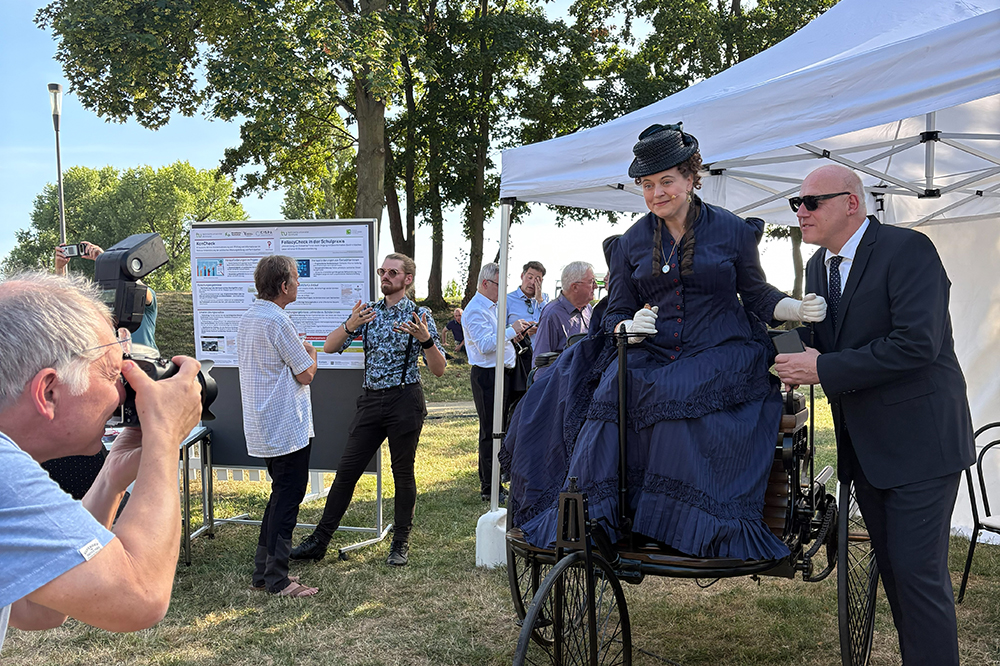
The Daimler and Benz Foundation celebrated its 40th anniversary on July 24, 2026, with a festive event at the Carl Benz House in Ladenburg. Guests were welcomed at the entrance by Managing Director Dr. Jörg Klein and Chairman of the Board Prof. Dr. Lutz Gade. Information booths and poster presentations provided insights into the Foundation’s work and research activities. Throughout the event, Patricia Piekenbrock, a physicist and the Foundation’s communications officer, ensured that everything ran smoothly. The event would not have been possible without the dedication of Marion Hartmann and Monika Stulberg, who were responsible for its organization and execution. One of the first highlights of the celebration came when the actress portraying Bertha Benz took her seat in the Benz Patent-Motorwagen No. 3. This was followed by speeches from Prof. Dr. Lutz Gade and Olaf Schick, Member of the Board of Management for Integrity, Governance and Sustainability at Mercedes-Benz Group AG. The chemist, who teaches and conducts research at Heidelberg University and is a member of both the Heidelberg Academy of Sciences and Humanities and the Academy of Sciences and Literature in Mainz, highlighted the Foundation’s support for research in areas including artificial intelligence, robot and machine ethics, as well as its funding of projects in Africa. Special recognition was given to the scientific members of the Foundation’s Board of Trustees: Prof. Dr. Oliver Bendel (FHNW School of Business), Prof. Dr. Hartmut Hillmer (University of Kassel), Prof. Dr. Ralf Poscher (Max Planck Institute for the Study of Crime, Security and Law), and Prof. Dr. Tereza Tykvová (University of St. Gallen). The keynote address was delivered by Prof. Dr. Dominika Wylezalek of Heidelberg University. Against the backdrop of academic freedom, she guided the audience through the millennia-long history of astronomy. Accompanied by a live band, the celebration continued well into the late evening (Photo: Stefanie Hauske).
Celebration of the Daimler and Benz Foundation’s 40th Anniversary