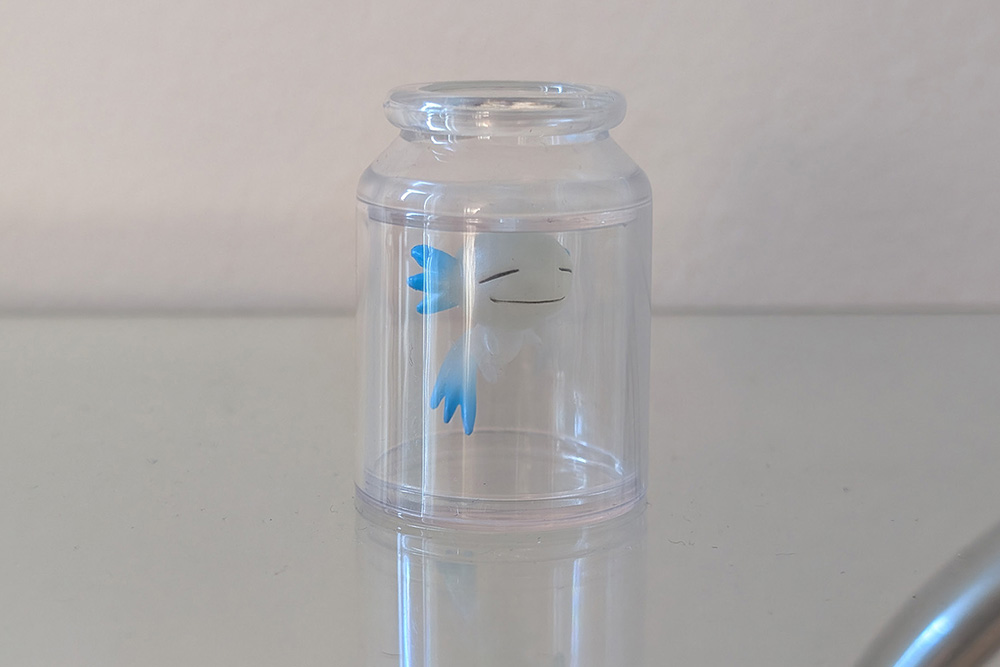
Most design is evaluated by how well it solves a problem. But some of the most memorable objects are not designed to maximize efficiency – they are designed to invite a relationship. Oliver Bendel believes this deserves its own name: Relational Object Design. Unlike Emotional Design, which focuses on how a product makes us feel, Relational Object Design focuses on the object itself as a potential relationship partner. Takashi Murakami’s Rumble-kun in a Jar is a beautiful example. The small axolotl-like creature sits quietly inside a transparent jar. It has no function, no movement, and no intelligence, yet it immediately feels alive. Its gentle expression and childlike proportions encourage us to care about it rather than simply look at it. The same philosophy can be found in the work of Yukai Engineering. Products such as Qoobo, Mirumi, and Nekojita FuFu are not primarily tools; they are companions with distinct personalities. Their value lies less in what they accomplish than in the emotional bond they encourage. This perspective also offers an interesting lens on social robotics. Robots such as AIBO, Eiliko, or Paro are often discussed in terms of artificial intelligence and social interaction, but perhaps the deeper question is simpler: what is the minimum amount of design required for a person to perceive an object as a companion? Murakami’s sculpture suggests that the answer may be surprisingly little. Sometimes a peaceful smile is enough.
BY OLIVER BENDEL