WhereIsIt, an object reminder assistant for blind and severely visually impaired people initiated by Prof. Dr. Oliver Bendel and implemented by Damian Huckele, reached its mid-term presentation on May 19, 2026. The inclusive AI project focuses on a lightweight speech-based system that allows users to store and retrieve object locations without continuous camera use. The work completed so far includes the literature review, problem analysis, requirements definition and the first system design concept. An important milestone was an expert interview with Steve Weidel, blind developer, founder of INKLUTEC and specialist in accessibility and assistive AI technologies. The interview confirmed the practical relevance of the project and highlighted key requirements such as simple voice interaction, portability, reminder functions and optional Bluetooth tags with acoustic tracking. The planned prototype architecture is Python-based and combines speech recognition, language processing, local object-location storage and text-to-speech output. The next project phases include prototype development, testing and the evaluation of Bluetooth integration.
WhereIsIt: An Object-Location Reminder
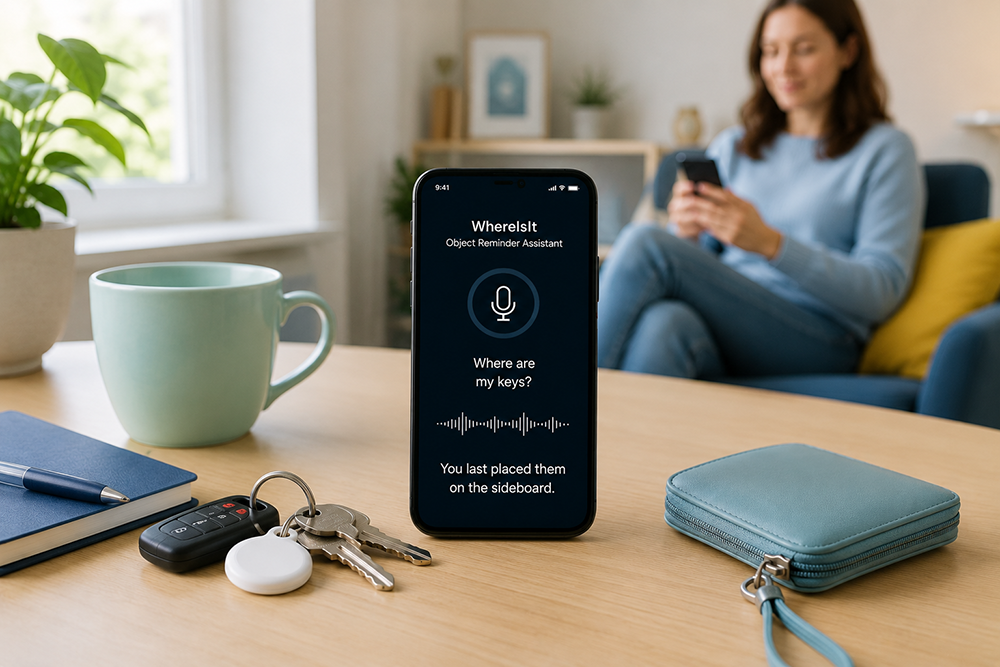
Blind and severely visually impaired people depend in everyday life on systematically placing objects or remembering their location. Because visual control is lacking, everyday items such as keys, medication, documents, or technical aids are often misplaced or must be searched for with considerable effort. This leads to loss of time, stress, and unnecessary dependence on other people. Existing solutions such as Microsoft’s “Find My Things” often rely on visual object recognition or complex assistance systems. These are technically demanding, prone to errors, energy-intensive, and not always acceptable from a privacy perspective. What is needed is a simple, robust, and practical solution for everyday use that does not require continuous camera usage and can be operated intuitively. A speech-based object reminder assistant called WhereIsIt is being developed on the initiative of Prof. Dr. Oliver Bendel. The user can use voice input to record which object has been placed where (e.g., “I put my medication on the kitchen table”). The information is stored locally and provided with a timestamp. When asked later (“Where is my medication?”), the system outputs the last known location via speech. Optionally, inexpensive Bluetooth tags can be used that emit an additional acoustic signal to make the object physically easier to locate. The focus is on ease of use, low technical complexity, and high reliability. Possible technical components include: voice capture and speech recognition; extraction of object and location information; local data storage with time reference; voice-based feedback; optional integration of BLE tags. When AI components are used, it is a project within Inclusive AI. The kick-off meeting will take place on March 17, 2026 at the FHNW School of Business. Damian Huckele has been recruited to implement the project.
Quo Vadis, CYBATHLON?
Ten years ago, the CYBATHLON was held for the first time. It marked the beginning of a fascinating and inspiring project centered on inclusive AI and inclusive robotics. The competition – bringing together people with disabilities and impairments to compete with and against one another – was founded by Prof. Dr. Robert Riener of ETH Zurich. At the 2016 CYBATHLON, SRF host Tobias Müller spoke five times with Prof. Dr. Oliver Bendel, a technology philosopher from Zurich, who provided context and evaluation regarding the use of implants, prosthetics, and robots. On one occasion, Prof. Dr. Lino Guzzella, then President of ETH Zurich, also took part; on another, Robert Riener joined the discussion. The most recent edition of the CYBATHLON took place in 2024. A total of 67 teams from 24 nations competed across eight disciplines at the SWISS Arena in Kloten near Zurich, as well as at seven interconnected hubs in the United States, Canada, South Africa, Hungary, Thailand, and South Korea. The website currently states: “While CYBATHLON’s journey at ETH Zürich ends here, the story is far from over. The next edition of the event may take place in Asia in 2028, marking an exciting new chapter for this unique global competition.” (CYBATHLON website) This would allow a success story to continue – once again not in Europe, but in Asia (Photo: ETH Zürich, CYBATHLON/Alessandro della Bella).
Inclusive AI and Inclusive Robotics are Highly Valued
At CES 2026, some of the most compelling examples of Inclusive AI and Inclusive Robotics came not from consumer gadgets, but from European assistive technologies designed to expand human autonomy. This was reported by FAZ and other media outlets in January 2026. These innovations show how AI-driven perception and robotics can be centered on accessibility – and still scale beyond niche use cases. Romanian startup Dotlumen exemplifies Inclusive AI through its “.lumen Glasses for the Blind,” a wearable system that replaces a guide dog with real-time, on-device intelligence. Using multiple cameras, sensors, and GPU-based computer vision, the glasses interpret sidewalks, obstacles, and spatial structures and translate them into intuitive haptic signals. The company calls this approach “Pedestrian Autonomous Driving” – a concept that directly bridges human navigation and mobile robotics. Notably, the same algorithms are now being adapted for autonomous delivery robots, underscoring the overlap between assistive AI and broader robotic autonomy. A complementary approach comes from France-based Artha (Seehaptic), whose haptic belt uses AI-powered scene understanding to convert visual space into tactile feedback. By shifting navigation cues from sound to touch, the system reduces cognitive load and leverages sensory substitution – an inclusive design principle with implications for human-machine interfaces in robotics. Together, these technologies illustrate a European model of Inclusive AI: privacy-preserving, embodied, and focused on real-world autonomy. What begins as assistive tech increasingly becomes a foundation for the next generation of intelligent, human-centered robotics (Photo: ETH Zürich, CYBATHLON/Alessandro della Bella).
Towards Inclusive AI and Inclusive Robotics
The article “Wearable Social Robots for the Disabled and Impaired” by Oliver Bendel was published on December 23, 2025. It is part of the volume “Social Robotics + AI: 17th International Conference, ICSR+AI 2025, Naples, Italy, September 10–12, 2025, Proceedings, Part III.” From the abstract: “Wearable social robots can be found on a chain around the neck, on clothing, or in a shirt or jacket pocket. Due to their constant availability and responsiveness, they can support the disabled and impaired in a variety of ways and improve their lives. This article first identifies and summarizes robotic and artificial intelligence functions of wearable social robots. It then derives and categorizes areas of application. Following this, the opportunities and risks, such as those relating to privacy and intimacy, are highlighted. Overall, it emerges that wearable social robots can be useful for this group, for example, by providing care and information anywhere and at any time. However, significant improvements are still needed to overcome existing shortcomings.” The technology philosopher presented the paper on September 12, 2025, in Naples. It can be downloaded from link.springer.com/chapter/10.1007/978-981-95-2398-6_8.
The Hippo in the Mud
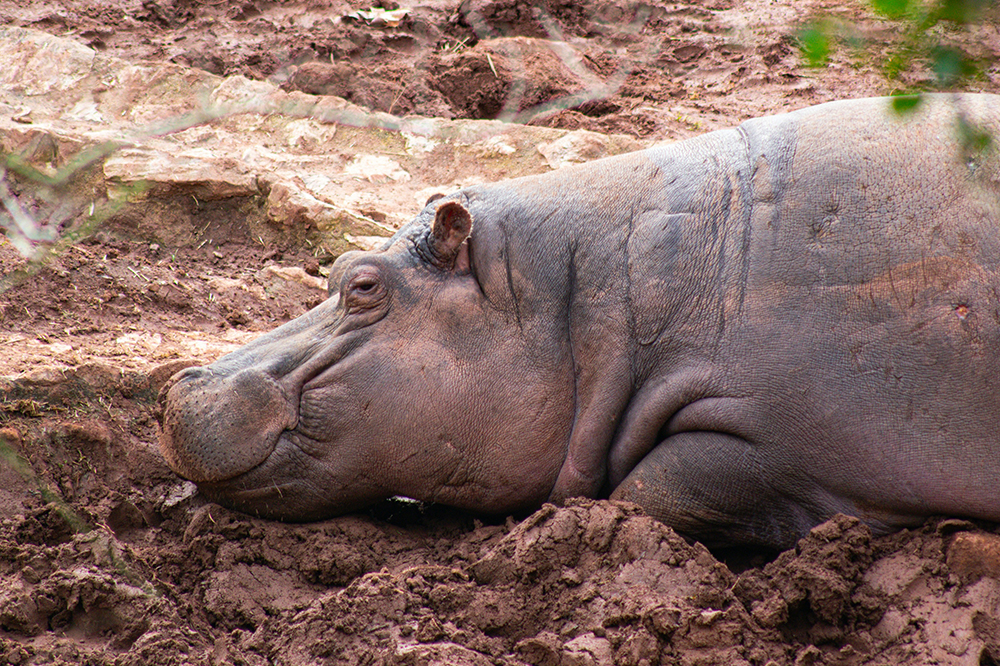
On November 10, 2025, the article “There’s a Large Hippo Resting in the Mud” by Oliver Bendel and Doris Jovic was published introducing the VISUAL project. “VISUAL” stands for “Virtual Inclusive Safaris for Unique Adventures and Learning”. All over the world, there are webcams showing wild animals. Sighted people can use them to go on photo and video safaris comfortably from their sofas. Blind and visually impaired people are at a disadvantage here. As part of Inclusive AI, the project developed a prototype specifically for them. Public webcams around the world that are directed at wild animals are tapped. Users can choose between several habitats on land or in water. They can also select “Adult” or “Child” as a profile and choose a role (“Safari Adventurer”, “Field Scientist”, “Calm Observer”). When the live video is accessed, three screenshots are taken and combined into a bundle. This bundle is analyzed and evaluated by GPT-4o, an MLLM. The user then hears a spoken description of the scene and the activities. The project is likely one of the first to combine Inclusive AI with new approaches in Animal-Computer Interaction (ACI). The article was published in Wiley Industry News and can be accessed at: wileyindustrynews.com/en/contributions/theres-a-large-hippo-resting-in-the-mud. It should be noted that it is also available in German.
Completion of the VISUAL Project
On July 31, 2025, the final presentation of the VISUAL project took place. The initiative was launched by Prof. Dr. Oliver Bendel from the University of Applied Sciences and Arts Northwestern Switzerland (FHNW). It was carried out by Doris Jovic, who is completing her Bachelor’s degree in Business Information Technology (BIT) in Basel. “VISUAL” stands for “Virtual Inclusive Safaris for Unique Adventures and Learning”. All over the world, there are webcams showing wild animals. Sighted individuals can use them to go on photo or video safaris from the comfort of their couches. However, blind and visually impaired people are at a disadvantage. As part of Inclusive AI, a prototype was developed specifically for them in this project. Public webcams around the world that are focused on wildlife are accessed. Users can choose between various habitats on land or in water. Additionally, they can select a profile – either “Adult” or “Child” – and a role such as “Safari Adventurer,” “Field Scientist”, or “Calm Observer”. When a live video is launched, three screenshots are taken and compiled into a bundle. This bundle is then analyzed and evaluated by GPT-4o, a multimodal large language model (MLLM). The user receives a spoken description of the scene and the activities. The needs of blind and visually impaired users were gathered through an accessible online survey, supported by FHNW staff member Artan Llugaxhija. The project is likely one of the first to combine Inclusive AI with new approaches from the field of Animal-Computer Interaction (ACI).
Start of the VISUAL Project
The kick-off meeting for the VISUAL project took place on March 20, 2025. It was initiated by Prof. Dr. Oliver Bendel from the FHNW School of Business. “VISUAL” stands for “Virtual Inclusive Safaris for Unique Adventures and Learning”. There are webcams all over the world that show wild animals. Sighted people can use them to go on a photo safari from the comfort of their sofa. Blind and visually impaired people are at a disadvantage. As part of Inclusive AI – an approach and a movement that also includes apps such as Be My Eyes with the Be My AI function – a solution is to be found for them. The aim of the project is to develop a prototype by August 2025 that enables blind and visually impaired people to have webcam images or videos of wild animals described to them. The system analyzes and evaluates them with the help of a multimodal LLM. It presents the results in spoken language via an integrated text-to-speech engine. As a by-product, poaching, bush and forest fires and other events can be detected. The project is likely to be one of the first to combine inclusive AI with new approaches to animal-computer interaction (ACI). Doris Jovic, who is completing her degree in BIT, has been recruited to work on the project.
About Inclusive AI
The Gabler Wirtschaftslexikon is the largest economics encyclopedia in the German-speaking world. In March 2025, Oliver Bendel published an article on inclusive AI in this reference work. The first part reads as follows: “Inclusive AI aims, on the one hand, to combat phenomena in artificial intelligence (AI) that have an exclusionary character – such as bias, hallucination, hate speech, and deepfakes – and, on the other hand, to strengthen applications with an inclusionary character in order to support those affected. One meaning is associated with terms like “responsible AI”, “explainable AI”, and “trustworthy AI”, while the other aligns with concepts such as “AI for good” or “AI for wellbeing”. Overall, this falls under the umbrella of “ethical AI”, though this term is also used in marketing contexts. In 2025, the World Economic Forum (WEF) pointed to the digital divide, asking: “How do we ensure that the growth of AI doesn’t leave people behind and is truly inclusive?” Inclusive AI can be associated with generative AI as well as with other forms of artificial intelligence.” The full article is available at:
wirtschaftslexikon.gabler.de/definition/inclusive-ai-171870.
The VISUAL Project
The VISUAL project will be launched in March 2025 at the FHNW School of Business. It was initiated by Prof. Dr. Oliver Bendel. VISUAL stands for “Virtual Inclusive Safaris for Unique Adventures and Learning”. There are webcams all over the world showing wild animals. Sighted people can use them to go on photo safaris from the comfort of their sofa. Blind and visually impaired people are at a disadvantage. As part of inclusive AI – a movement that includes apps like Be My Eyes with the Be My AI feature – a solution is to be found for them. The project aims to develop a prototype by August 2025 that will allow blind and visually impaired people to have webcam images of wildlife described to them. The system takes regular snapshots of the videos and analyzes and evaluates them using a multimodal LLM. It presents the results ini spoken language via an integrated text-to-speech engine. As a byproduct, poaching, bush and forest fires, and other events can be detected. The project is likely to be one of the first to combine inclusive AI with new approaches of animal-computer interaction (ACI).