Wearable Social Robots for Space Missions

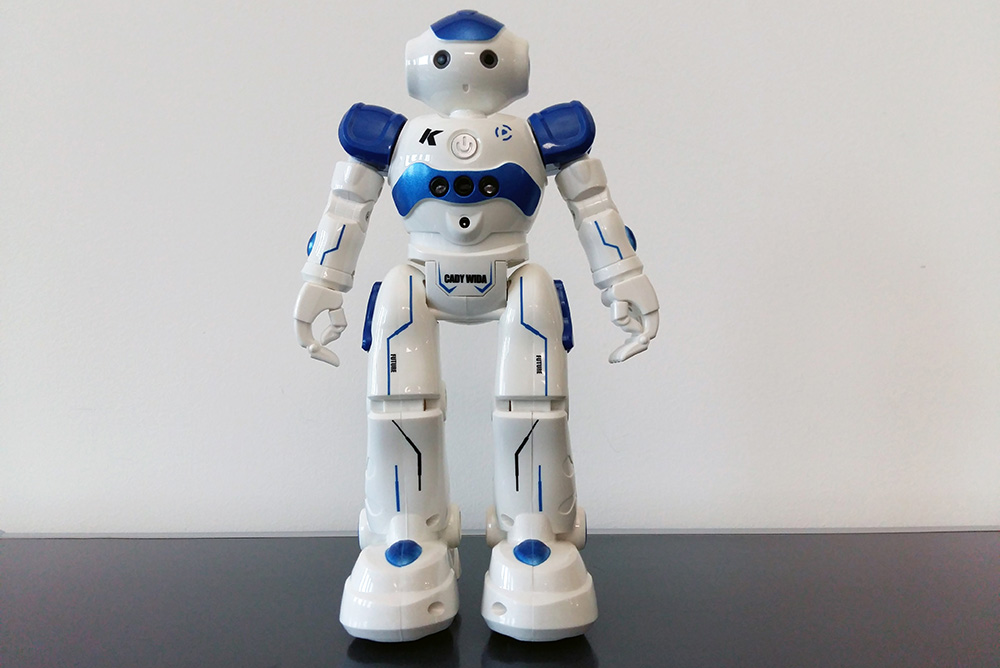
The short paper “Wearable Social Robots in Space” by Tamara Siegmann and Oliver Bendel (FHNW School of Business) has been accepted for presentation at the International Conference on Social Robotics (ICSR). The conference will take place from September 10 to 12, 2025, in Naples, Italy. Social robots have been explored on Earth since the 1990s, but this study considers their application beyond our planet – specifically, on manned missions to Mars. The focus lies on wearable social robots, a promising form factor due to their compact size and light weight. Using AIBI as a case study, the short paper examines how such a robot could support astronauts under the unique psychological and environmental conditions of deep space travel. The authors discuss the little robot’s potential roles and highlight directions for future development, particularly in improving human-robot interaction and communication. The findings suggest that wearable social robots like AIBI could offer valuable support on long-duration space missions.

Suzuki Presents its Moqba

“On June 5, 2025, Suzuki made headlines in the robotics and mobility sector by launching the Moqba, a $3,000 four-legged transport robot designed to revolutionize urban commuting, accessibility, and logistics.” (The Jurnals, 6 June 2025) This was reported by The Jurnals in the article “Suzuki’s Moqba Unleashed: A $3,000 Robot Dog Redefining Urban Mobility” on June 6, 2025. “The Moqba’s sleek design features a white-and-black color scheme, a futuristic aesthetic, and a saddle-like seat for riders, blending practicality with a forward-thinking vision. Its four-legged structure, inspired by robots like Spot, allows it to navigate varied terrain, making it a versatile tool for both individual transport and commercial applications. With a top speed of 20 mph (32 km/h) and a range of up to 50 miles (80 km) on a single charge, the Moqba is well-suited for urban environments, where short, efficient trips are the norm.” (The Jurnals, 6 June 2025) The device looks solid and ready for use. However, it is probably not suitable for people taller than 180 cm. It is also unlikely to be suitable for physically disabled people. For everyone else, it could be an interesting way to get around (Image: ChatGPT/4o Image).

Intelligens. Natural. Artificial. Collective.

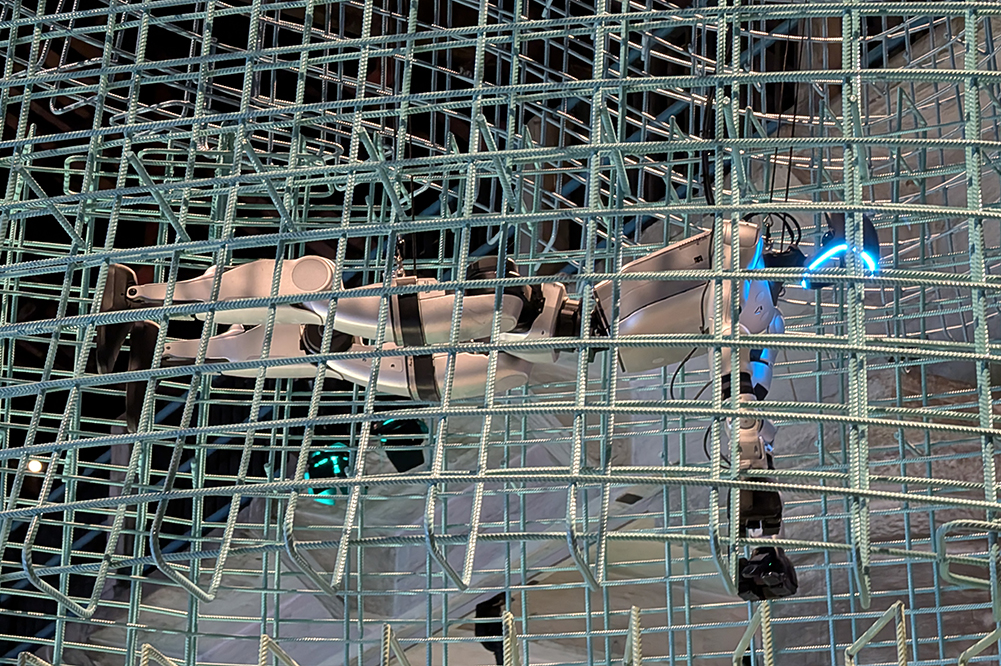
At the 19th Architecture Biennale in Venice (Biennale Architettura 2025) with the title “Intelligens. Natural. Artificial. Collective.”, robots play an important role. This is reported by several media, such as The Architect’s Newspaper. “Robots Falling from the Sky” is an installation in which robots appear to fall from the sky and interact with their surroundings. Another robot demonstrates its musical abilities by playing a handpan, a brass instrument. One is reminded of Henri-Louis Jaquet-Droz’s 18th century musician, who preferred a keyboard instrument. A robotic arm from ABB assists two Bhutanese craftsmen in working on a beam. For safety reasons, according to The Architect’s Newspaper, live carving with a drill was not permitted. The problem is not the two artisans, but the visitors. The Biennale is always dedicated to technical and futuristic themes. In 2021, the Architecture Biennale focused on cyborgs and transhumanists, among other things. In 2024, the art biennial featured a quasi-hologram and a spaceship-like installation. The Biennale runs from May 10 to November 23, 2025 at various venues in and near Venice, including the Giardini della Biennale, the Arsenale di Venezia, and the Forte Marghera in Mestre. Further information and the full program can be found at www.labiennale.org/en/architecture/2025 (Photo: Biennale Arte 2024).

ICSR Deadlines Extended One Last Time

The ICSR is one of the leading conferences for social robotics worldwide. The 17th edition will take place from 10 to 12 September 2025 in Naples, Italy. The deadline for submissions has been extended one last time. Full papers should consist of 11 pages of body text plus references as appropriate. The most important conferences dates are: Full Paper Submission: May 9th, 2025; Full Paper Notification: June 13th, 2025; Camera-ready: June 30th, 2025; Paper Presentation Days at ICSR’25: September 11th and 12th, 2025. All dates – including the deadlines for the submission of short papers and special session papers – are listed on the website. “The conference theme, ‘Emotivation at the Core: Empowering Social Robots to Inspire and Connect,’ highlights the essential role of ‘Emotivation’ in social robotics. Emotivation captures the synergy between emotion and motivation, where emotions trigger and sustain motivation during interactions. In social robotics, this concept is key to building trust, fostering empathy, and supporting decision-making by enabling robots to respond sensitively to human emotions, inspiring engagement and action.” (Website ICSR) Participants will meet for two days at the Parthenope University of Naples and for the third day at the Città della Scienza conference center. All buildings and rooms are also listed on the website. The PDF of the CfP can be downloaded here.

A Martian Landscape on the Brugg-Windisch Campus

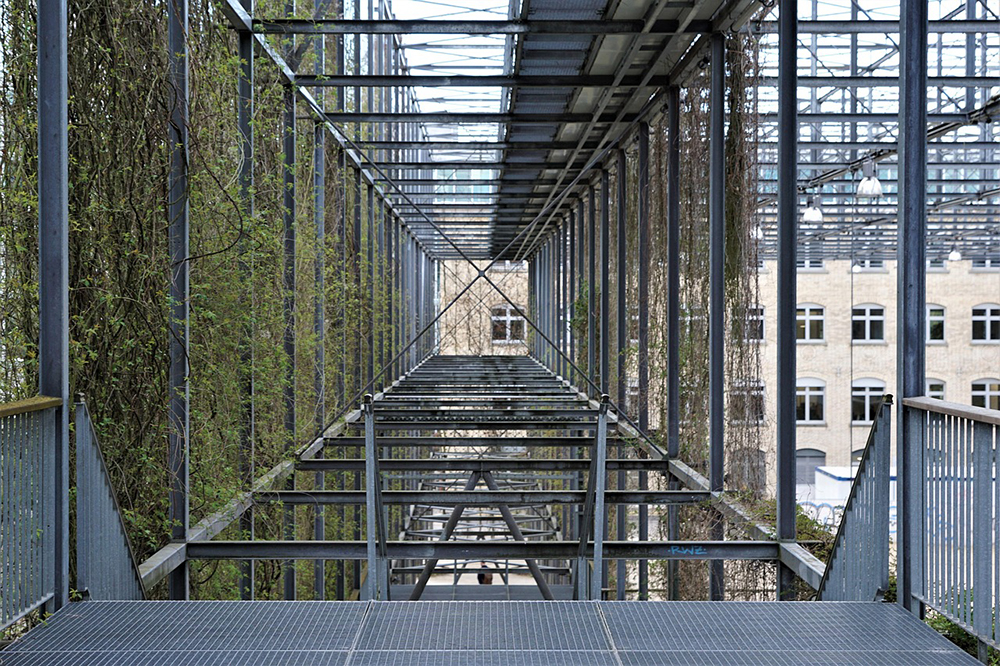
Students from the Eastern Switzerland University of Applied Sciences (Campus Rapperswil) have created a Martian landscape in front of the Hallerbau on the Brugg-Windisch campus in collaboration with the FHNW. This will serve as a training ground for the FHNW Mars rover and promote “interest in space travel and technology” (information sign on the construction site, own translation). According to the website, the FHNW rover team consists of “an interdisciplinary group of students from the School of Engineering and Environment and the School of Computer Science”. The so-called “Umwäldchen” with new plantings offers a place for relaxation and encounters and makes a “positive contribution to the environment” (information sign on the construction site). According to its website, the FHNW is “active in the development of observation instruments, components and manufacturing processes for the aerospace sector”. In addition to the aforementioned universities, the FHNW School of Business is also active in this field. In 2021, SPACE THEA was developed, a voice assistant for Mars flights, which was presented at the AAAI Spring Symposia at Stanford University in 2022 and attracted the attention of NASA. In 2025, the focus will be on social robots for Mars flights with a view to ICSR 2025.

This Robot Could Spy on You

As reported by the CyberInsider platform on March 24, 2025, security experts have discovered a pre-installed, undocumented remote access tunnel in the Unitree Go1 robot dogs that enables remote control and network access. The Unitree Go1 can be found in numerous companies and universities. During their tests, the researchers were able to list all connected devices and their IP addresses and access these devices. They were also able to use the robotic quadruped’s cameras for live monitoring. The article states: “Perhaps most concerning is the implication of deliberate design. The tunnel is not merely an over-looked debug utility; it appears fully integrated into the boot process and enabled by default.” (CyberInsider, 24 March 2025) Users should immediately isolate their devices from critical internal networks, change SSH credentials, and disable the tunnel service. More information is available on the platform.

The Next Social Robots Module

The elective module “Soziale Roboter” (“Social Robots”) by Prof. Dr. Oliver Bendel will be held again from April 15 to 17, 2025 at the FHNW in Olten. It is primarily aimed at prospective information systems specialists, but prospective business economists can also take part. Dr. Amol Deshmukh has been invited as a guest speaker. He previously worked for the University of Glasgow and now conducts research at ETH Zurich. In his lecture, he will present the findings from his paper “Leveraging Social Robots to Promote Hand Hygiene: A Cross-Cultural and Socio-Economic Study of Children in Diverse School Settings”. Unitree Go2, Alpha Mini, Cozmo, Vector, Aibi, Furby and Booboo from Oliver Bendel’s private Social Robots Lab will also be on site. Social Robotics Girl, a so-called GPT who specializes in this topic, will be available as a tutor throughout the event. Basic works are “Soziale Roboter” (2021) and “300 Keywords Soziale Robotik” (2021). At the end of the elective module, students design social robots – also with the help of generative AI – that they find useful, meaningful, or simply attractive. The elective modules have been offered since 2021 and are very popular.

About Inclusive Robotics

The Gabler Wirtschaftslexikon is the largest economics encyclopedia in the German-speaking world. In March 2025, Oliver Bendel published an article on inclusive robotics in this reference work. The first part reads as follows: “Inclusive robotics designs, develops, controls, manufactures, and operates robotic solutions for individuals with disabilities or impairments. The goal is to enable them to fully participate in social life and to engage in education, culture, and sports. This can involve the replacement or enhancement of a body part, as well as the use of a robot that provides assistance (an assistive robot or companion robot) or is worn on or with the body (a wearable robot). Robotic quadrupeds and bipedal general-purpose robots are becoming increasingly relevant. In the future, these will function as universal robots – true generalists. Inclusive Robotics addresses not only physical aspects but also psychological ones. It is closely related to inclusive AI.” The full article is available at: wirtschaftslexikon.gabler.de/definition/inclusive-robotics-172663 (Photo; ETH Zurich, Cybathlon/Alessandro Della Bella).

ICSR 2025 at the Parthenope University of Naples

The first two days of ICSR 2025 will be held “on the industrial side of Naples”. This has been announced by the General Chairs, Mariacarla Staffa (University of Naples Parthenope, Italy) and John-John Cabibihan (Qatar University, Qatar). The Honorary Chair is Bruno Siciliano (University of Naples Federico II, Italy). “The University of Naples Parthenope will host the social robotics conference and showcase the technological advancements of this innovative city. Since 1919, the University of Naples Parthenope has been dedicated to fostering young talent, offering internationally oriented education and cutting-edge research. With 15,000 students, 320 faculty, and 250 staff, it combines a strong maritime tradition with excellence in economics, law, engineering, technology, and sports sciences. Innovation and real-world impact are at the core of its mission.” (Announcement General Chairs) On the third day, the participants will meet at the Città della Scienza conference center. The conference website of ICSR 2025 is online since January: icsr2025.eu (Photo: Parthenope).

First Human-Robot Marathon

According to several media reports, humanoid robots will take part in a half marathon together with humans for the first time in Beijing in April 2025. Around 12,000 people will run the 21-kilometre course, accompanied by robots from more than 20 companies worldwide. The robots must look humanoid, be able to move on two legs, and be between 0.5 and 2 metres tall. The majority of the larger models are likely to be so-called all-purpose robots. Both remote-controlled and autonomous robots are permitted – with the option of changing batteries during the race. The premiere is part of a broader strategy by China to promote humanoid robots to achieve technological independence, boost the economy, and compete in the global technology race, especially with the US. Last year, the humanoid robot Galbot had already supported a marathon final, but this time the machines are running the full distance (Photo: Morio, CC BY-SA 3.0).