Japanese technology giant Kawasaki Heavy Industries has unveiled Home Leo, a dog-like robot designed to assist older adults in their daily lives. The Japan Times reported on the development on October 7, 2026. The prototype, presented in Tokyo on October 6, 2026, uses artificial intelligence to communicate with people, perceive its surroundings, make decisions based on the situation, and act autonomously. Home Leo is designed to provide companionship, help its owners with everyday tasks, and watch for potential hazards. By continuously learning individual preferences and habits, the robot is expected to adapt to each user’s needs. In the future, it could also detect falls, changes in health conditions, or fire hazards and alert family members or caregivers. According to the Japan Times, Kawasaki President Yasuhiko Hashimoto demonstrated the robot’s capabilities during the presentation by asking it where his smartphone was. Home Leo replied that the device was on the table, retrieved it, and handed it to its owner. Kawasaki plans to launch the robot in the Japanese fiscal year 2028 and is collaborating with government agencies, medical institutions, nursing care organizations, and AI companies on its further development. The goal is to enable older adults to live independently and safely in their familiar surroundings for as long as possible.
Can Robots and AI Systems Be Creative?
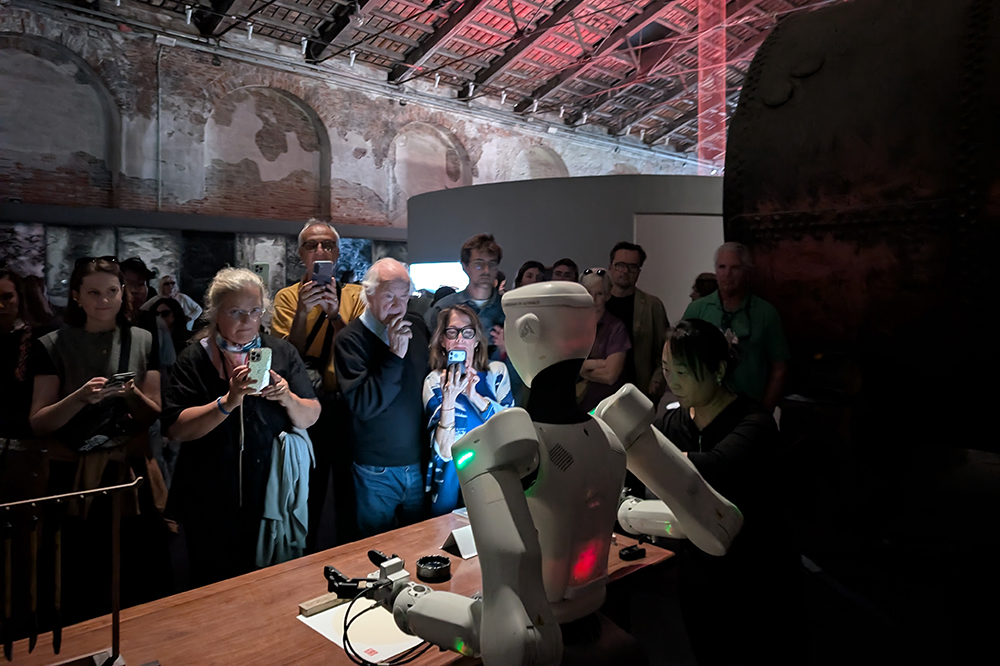
Can robots and AI systems be creative? Since the rise of generative AI, this question has been the subject of intense debate. The issue is not merely whether machines can produce images, texts, or music. It is also about what we understand by creativity and art in the first place, and whether they are necessarily tied to human beings. The Biennale Arte 2026 could have been an excellent place to engage in this debate. In fact, it does so only occasionally. In the Chinese Pavilion, the humanoid robot Astribot S1 writes in the style of calligraphy master Wang Dongling. Visitors can take the works of art, if that is what they are, home with them. Zhang Zhoujie, meanwhile, has computers develop forms for his “digital chairs” based on predefined rules. The designer tries to exercise as little control as possible, giving the computer a degree of creative freedom of its own. In the Venice Pavilion, “Echo/SommersiVo” uses artificial intelligence to translate visitors’ memories and impressions into a constantly changing world of sound and images. Those involved explicitly describe the process as a collaboration between humans and AI in the creative process. These are interesting approaches, but they remain exceptions. At a time when generative AI is challenging our understanding of authorship, originality, and creativity, the world’s most important international exhibition of contemporary art barely addresses this development. The Biennale Arte 2026 did not have to answer the question of whether machines can be creative. But it should have asked it.
Robotaxis in Switzerland
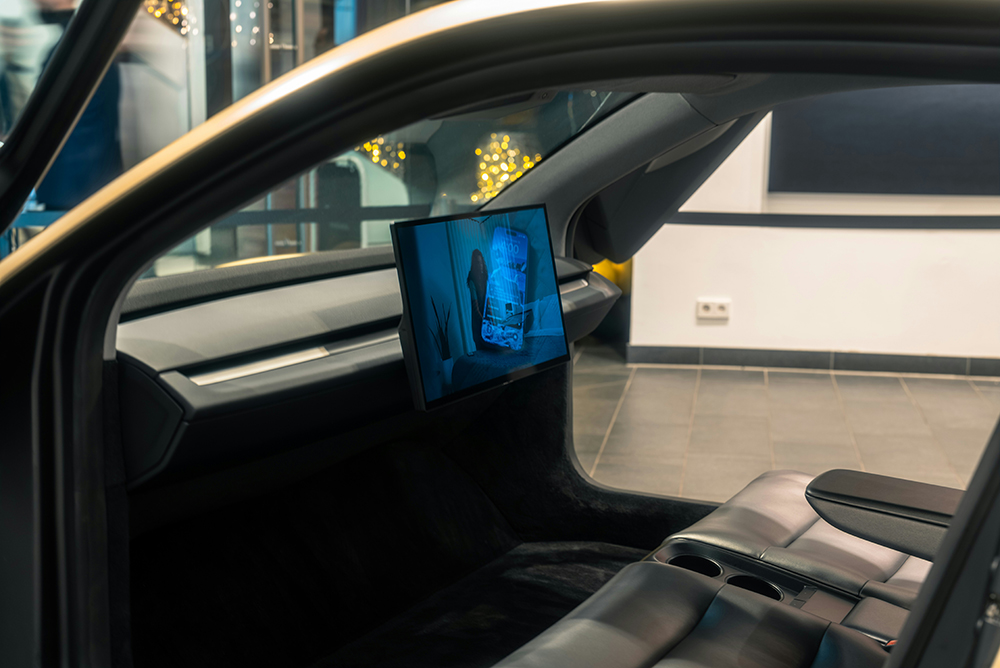
Robotaxis have made their way to Switzerland. Since September 28, 2026, self-driving cars have been available for booking through the iamo app in Zurich’s Furttal region. Three electric Nissan Ariyas are operating in Otelfingen, Dänikon, Hüttikon, and Boppelsen. They are equipped with technology from automation specialist WeRide. The vehicles feature six LiDAR sensors, eleven cameras, and eight additional sensors that provide a 360-degree view of their surroundings. The service includes nearly 100 digitally designated pickup and drop-off points. A ride costs a base fare of CHF 4.70 plus CHF 0.38 per kilometer; Swiss Half Fare Cards and GA Travelcards are not accepted. The service operates daily from 1 to 5 p.m. Up to three passengers can ride at a time, accompanied by a safety driver who can intervene in an emergency. Autonomous driving is not entirely new to Switzerland. As early as 2016, PostAuto’s SmartShuttles were operating in Sion in the canton of Valais. The vehicles used at the time, however, operated under very different conditions. Depending on the area, their speed was limited to between 5 and 20 km/h (3 and 12 mph), and they traveled along virtual tracks. The Furttal project now takes a crucial step further: The Nissan Ariyas operate in regular traffic and have to handle far more complex situations than a bus traveling along a predefined route. That is precisely where the pilot project stands to provide valuable insights. And those insights are unlikely to come without incidents. In a real-world trial of this kind, accidents should be expected. It remains to be seen how the public will react.