When Animals Meet Machines

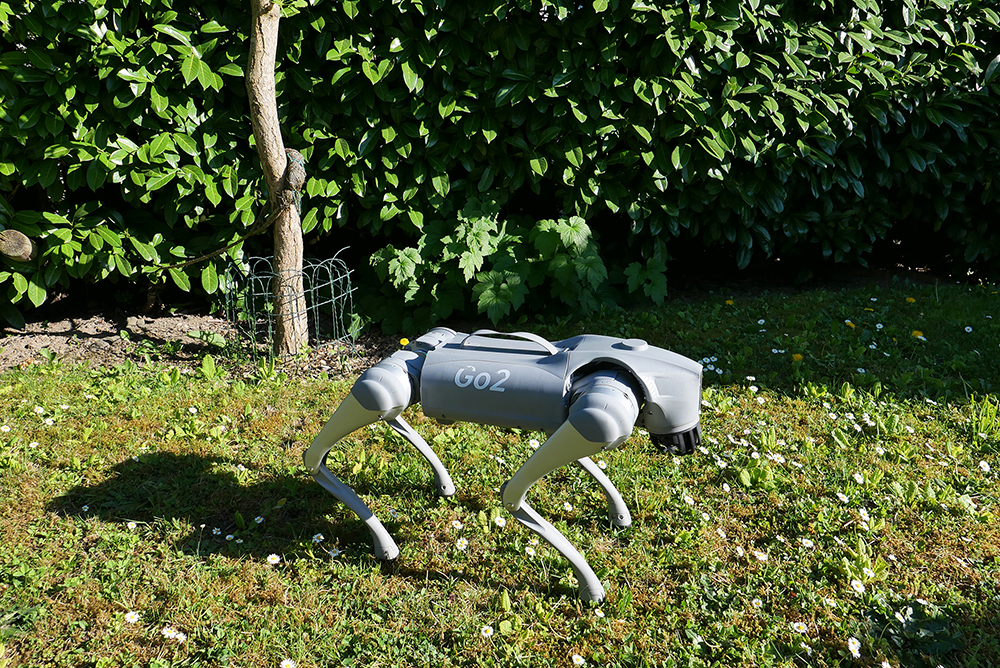
The manuscript of the book “Non-Human Animals, Ethics and Engineering” (alternative title “Animals, Ethics and Engineering”) was sent to the publisher Jenny Stanford in May 2024. It contains 16 chapters on this topic, including by Clara Mancini (“Animal-Centered Technology and Sustainable Development”), Fiona French (“Designing and Crafting Systems for Non-Human Animals”), and Leonie Bossert together with Thilo Hagendorff (“Animals and AI: The Role of Animals in AI Research and Application”). In “An Investigation into the Encounter Between Social Robots and Animals” (Chapter 12), Oliver Bendel “delves into the evolving landscape of social robots designed to interact with animals, dissecting the intricate dynamics of these interactions and their ethical ramifications” (Information from the editors). The philosopher of technology also presents his own projects, such as concepts and prototypes of animal-friendly machines, developed in the context of machine ethics, animal-machine interaction, and social robotics. The editors are Rosalyn W. Berne and Madeline A. Kibler from the University of Virginia. The book is scheduled for publication in late summer or fall 2024.

ACI 2023 in North Carolina

The Tenth International Conference on Animal-Computer Interaction will be held December 4-8, 2023, in Raleigh, North Carolina, hosted by North Carolina State University. “ACI is the leading International Conference on Animal-Computer Interaction. It is a highly multidisciplinary event drawing researchers and practitioners from diverse backgrounds to share and discuss work and topics related to the research and design of computing-enabled and interactive technology for and with animals.” (Website ACI) The Ninth International Conference on Animal-Computer Interaction was held in Newcastle upon Tyne at the end of 2022. Also this year the organizers are interested in a variety of topics in animal-computer interaction and animal-machine interaction, as the call for papers (CfP) reveals: “Submissions might address topics such as: the role of technology in shaping human-animal relationships; studies and/or analysis of large-scale technology for animal deployments; considerations on the wider context of technology for animal use; methods and reflections on studying the next generation of technology for animals; or how to conduct ACI research in a world where commercial design and deployment of technology for animals outpaces academic thought.” (Website ACI) The CfP can be accessed at www.aciconf.org/aci2023.

ACI 2022 Proccedings

The ACI took place from 5 to 8 December 2022 in Newcastle upon Tyne. It is the world’s leading conference on animal-computer interaction. The proceedings were published in the ACM Library on March 30, 2023. They include the paper “A Face Recognition System for Bears: Protection for Animals and Humans in the Alps” by Oliver Bendel and Ali Yürekkirmaz. From the abstract: “Face recognition, in the sense of identifying people, is controversial from a legal, social, and ethical perspective. In particular, opposition has been expressed to its use in public spaces for mass surveillance purposes. Face recognition in animals, by contrast, seems to be uncontroversial from a social and ethical point of view and could even have potential for animal welfare and protection. This paper explores how face recognition for bears (understood here as brown bears) in the Alps could be implemented within a system that would help animals as well as humans. It sets out the advantages and disadvantages of wildlife cameras, ground robots, and camera drones that would be linked to artificial intelligence. Based on this, the authors make a proposal for deployment. They favour a three-stage plan that first deploys fixed cameras and then incorporates camera drones and ground robots. These are all connected to a control centre that assesses images and developments and intervenes as needed. The paper then discusses social and ethical, technical and scientific, and economic and structural perspectives. In conclusion, it considers what could happen in the future in this context.” The proceedings can be accessed via dl.acm.org/doi/proceedings/10.1145/3565995.

Face Recognition for Bears in the Alps

At the end of the ACI conference, the “Paper Session 6” was held, which was titled “Investigating Human-Animal Relations”. Sarah Webber (University of Melbourne) gave a talk on “Watching Animal-Computer Interaction: Effects on Perceptions of Animal Intellect”. In the experiment, people observed orangutans interacting with computer applications. It was examined how they changed their judgments regarding the animals’ intelligence and behavior. The talk that followed came from Alexandra Morgan (Northumbria University) and was titled “Blind dogs need guides too: towards technological support for blind dog caregiving”. She addressed the needs of blind dogs and showed what gadgets are on the market to assist them. Her team developed an app called “My Blind Dogo” that could help owners of blind dogs. The session ended with a talk on “A Face Recognition System for Bears: Protection for Animals and Humans in the Alps” by Oliver Bendel (University of Applied Sciences and Arts Northwestern Switzerland). He presented an integrated system with cameras, robots, and drones that Ali Yürekkirmaz and he had designed. The ACI took place from 5 to 8 December 2022 in Newcastle upon Tyne. It is the world’s leading conference on animal-computer interaction. More information on the conference via www.aciconf.org/aci2022.

Wearables for Sled Dogs

On the last day of the ACI Conference (December 8, 2022), “Session 5: Sensors & Signals, Part II: Electric Boogaloo” started after the lunch break. Carlos Alberto Aguilar-Lazcano (CICESE-UT3) gave a talk on the topic “Towards a monitoring and emergency alarm system activated by the barking of assistant dogs”. The next presentation was “WAG’D: Towards a Wearable Activity and Gait Detection Monitor for Sled Dogs” by Arianna Mastali (Georgia Institute of Technology). According to her, studies have shown orthopedic injuries to be most common among sled dogs. These like to move very much, but repeatedly exceed their capabilities. To solve this problem, the team has developed a technical solution, a special wearable, with the help of which data on the condition of the animals are generated. “Spatial and Temporal Analytic Pipeline for Evaluation of Potential Guide Dogs Using Location and Behavior Data” was the title of the next talk, given by David L. Roberts (North Carolina State University), followed by “Comparing Accelerometry and Computer Vision Sensing Modalities for High-Resolution Canine Tail Wagging Interpretation”, given by Devon Martin (North Carolina State University). More information on the conference via www.aciconf.org/aci2022.

Talking Eggs

After the keynote on the morning of December 8, 2022, ACI2020 continued with “Paper Session 4: Sensors & Signals, Part I: Origin Stories”. David L. Roberts (North Carolina State University) presented on “Motion-Resilient ECG Signal Reconstruction from a Wearable IMU through Attention Mechanism and Contrastive Learning”. The next talk, “TamagoPhone: A framework for augmenting artificial incubators to enable vocal interaction between bird parents and eggs”, was given by Rebecca Kleinberger (Massachusetts Institute of Technology & Northeastern University). The starting point of her research was that some birds have pre-hatching vocal communication. The last presentation before the lunch break that was given online was “Simultaneous Contact-Free Physiological Sensing of Human Heart Rate and Canine Breathing Rate for Animal Assisted Interactions: Experimental and Analytical Approaches” by Timothy Holder and Mushfiqur Rahman (North Carolina State University). More information on the conference via www.aciconf.org/aci2022.

Time Savers or Toys?

The fourth day of the ACI2022 conference – December 8, 2022 – began with a keynote by Carys L. Williams (DogsTrust), titled “Time Savers or Toys? Realities of Animal Technology in Industry”. “Carys is a mixed-methods Research Officer at the UK’s largest dog welfare charity, Dogs Trust. Carys’ work has focused on practical and applicable dog behaviour and welfare research to improve the lives of dogs, especially those in Dogs Trust’s 22 rehoming centres (around 12,000 dogs a year!). For the last 2 years Carys has been project lead for the Dogs Trust Post Adoption Support longitudinal research project. She has additionally supported the charity’s move to collect more and better dog data, helping build exciting bespoke digital systems. Carys has also spent over a decade in the zoo industry and is currently a volunteer invertebrate keeper at ZSL London Zoo.” (Website ACI2022) Carys L. Williams started her keynote with a quote from Vladimir Dinets (University of Tennessee): “What is the best games console for my spider?” … She then turned to real-world issues, such as supporting the welfare of dogs through technological means. More information on the conference via www.aciconf.org/aci2022.

About Parrots and Dogs

The ACI2022 conference continued on the afternoon of December 7, 2022 after the coffee break (“Paper Session 3: Learning From and With Each Other”). Cristóbal Sepulveda Álvarez (Universidad de Chile) gave a talk on the topic “Measuring Digitally Comparative Abilities Between Discreet and Continuous Quantities through a Digital Enrichment Application”. He showed a parrot that had to choose different quantities on a touch screen. Dirk van der Linden (Northumbria University) was present on behalf of Jasmine Forester-Owen (Northumbria University). He spoke about “Noisy technology, anxious dogs: can technology support caregiving in the home?”. In their prototype, they combine noise detection and body language identification in dogs. Jérémy Barbay (Universidad de Chile) gave the last three presentations of the day: “Comparing Symbolic and Numerical Counting Times between Humans and Non-Humans Through a Digital Life Enrichment Application”, “Popping Up Balloons for Science: a Research Proposal”, and “A Loggable Aid to Speech (for Human and Non-Human Animals): A Research Proposal”. More information on the conference via www.aciconf.org.

Towards Exploring Perceptions of Dogs

The ACI2022 conference continued on the afternoon of December 7, 2022. “Paper Session 2: Recognising Animals & Animal Behaviour” began with a presentation by Anna Zamansky (University of Haifa). The title was “How Can Technology Support Dog Shelters in Behavioral Assessment: an Exploratory Study”. Her next talk was also about dogs: “Do AI Models ‘Like’ Black Dogs? Towards Exploring Perceptions of Dogs with Vision-Language Models”. She went into detail about OpenAI’s CLIP model, among other things. CLIP is a neural network which learns visual concepts from natural language supervision. She raised the question: “How can we use CLIP to investigate adoptability?” Hugo Jair Escalante (INAOE) then gave a presentation on the topic “Dog emotion recognition from images in the wild: DEBIw dataset and first results”. Emotion recognition using face recognition is still in its infancy with respect to animals, but impressive progress is already being made. The last presentation in the afternoon before the coffee break was “Detecting Canine Mastication: A Wearable Approach” by Charles Ramey (Georgia Institute of Technology). He raised the question: “Can automatic chewing detection measure how detection canines are coping with stress?”. More information on the conference via www.aciconf.org.

About Animal-centered Design

ACI2022 continued on December 7 with Paper Sessions. Number 1 was “Designing for Human-Animal Relations”. Clara Mancini from The Open University gave a talk on the topic “Politicising Animal-Computer Interaction: an Approach to Political Engagement with Animal-Centred Design”. She is one of the pioneers in the discipline of animal-computer interaction. This was followed by Dirk van der Linden’s presentation “Animal-centered design needs dignity: a critical essay on ACI’s core concept”. The scientist from the Northumbria University referred to the Swiss law, which assumes the dignity of living beings – animals as well as plants, it should be added. Minori Tsuji from Future University Hakodate spoke about the “Investigation on Enhancement of the Sense of Life in Safari Park Online Tours with Animal Breathing Reproduction System”. Visitors can touch artifacts with different breathing frequencies. The final contribution in the morning came from Jennifer Cunha (Parrot Kindergarten) and Corinne Renguette (Indiana University-Purdue University). It was about “A Framework for Training Animals to Use Touchscreen Devices for Discrimination Tasks”. The scientists taught various animals, such as a parrot, a rat and a dog, how to use tablets. More information on the conference via www.aciconf.org.