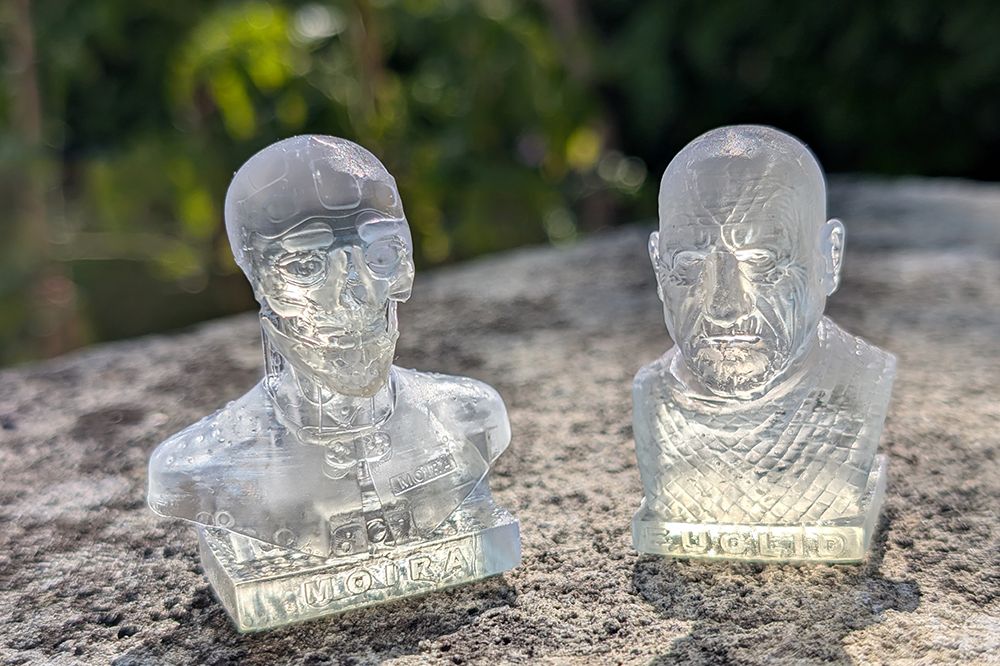
Humanoid robots are becoming increasingly convincing conversational partners, but can they also become good storytellers? This intriguing question will be explored at New Scientist Live 2026 in London during the Family session “Science Bites: Why are robots bad story tellers?” on October 10 from 12:40 to 1:20 p.m. Computer scientist Dr. Carl Strathearn and lecturer and computer scientist Emilia Sobolewska will present their two AI-powered humanoid robots, Euclid and Moira, and let them engage in a live conversation. While today’s AI systems can generate impressive text, storytelling remains a difficult challenge because compelling narratives require contextual understanding, shared knowledge, creativity, and the ability to connect ideas in meaningful ways. During the demonstration, the two robots will exchange thoughts and ideas, and the audience may even witness them gradually drifting into hallucinations and constructing a shared fantasy world. The researchers hope that these spontaneous interactions could offer new insights into how imagination and creativity might emerge in autonomous AI systems. Euclid has already attracted considerable attention this summer as one of the highlights of the 18th International Conference on Social Robotics (ICSR + Art 2026) in London, where visitors were able to interact directly with the advanced humanoid robot. Developed by Carl Strathearn and Emilia Sobolewska, Euclid combines automatic speech recognition, computer vision, generative AI, skin sensors, and an innovative robotic mouth that produces highly realistic speech movements through machine learning. Unlike many famous humanoid robots with idealized faces, Euclid deliberately represents an older man with deeply lined features, challenging established design conventions while emphasizing authenticity, diversity, and natural human interaction. The upcoming New Scientist Live session now offers another opportunity to experience Euclid in action, this time in an experiment that explores one of the most fascinating frontiers of artificial intelligence: whether machines can move beyond generating language and begin creating genuinely imaginative stories together
Euclid and Moira Tell Stories