Billions of Trees, Planted by Drones

Flash Forest, a Canadian start-up, plans to plant 40,000 trees in the north of Toronto within a few days. It uses drones, i.e. technology that also plays a role in detecting and fighting forest fires. By 2028, it aims to have planted a full 1 billion trees. “The company, like a handful of other startups that are also using tree-planting drones, believes that technology can help the world reach ambitious goals to restore forests to stem biodiversity loss and fight climate change. The Intergovernmental Panel on Climate Change says that it’s necessary to plant 1 billion hectares of trees – a forest roughly the size of the entire United States – to limit global warming to 1.5 degrees Celsius.” (Fast Company, 15 May 2020) It is without doubt a good idea to use drones for planting. But you have to remember that unmanned aerial vehicles (UAV) of this type have a bad energy balance. Above all, however, birds and other creatures must not be frightened away and must not be hurt (see, e.g., this article). In this context, insights from animal-machine interaction and machine ethics can be used.

Another Animal-friendly Machine

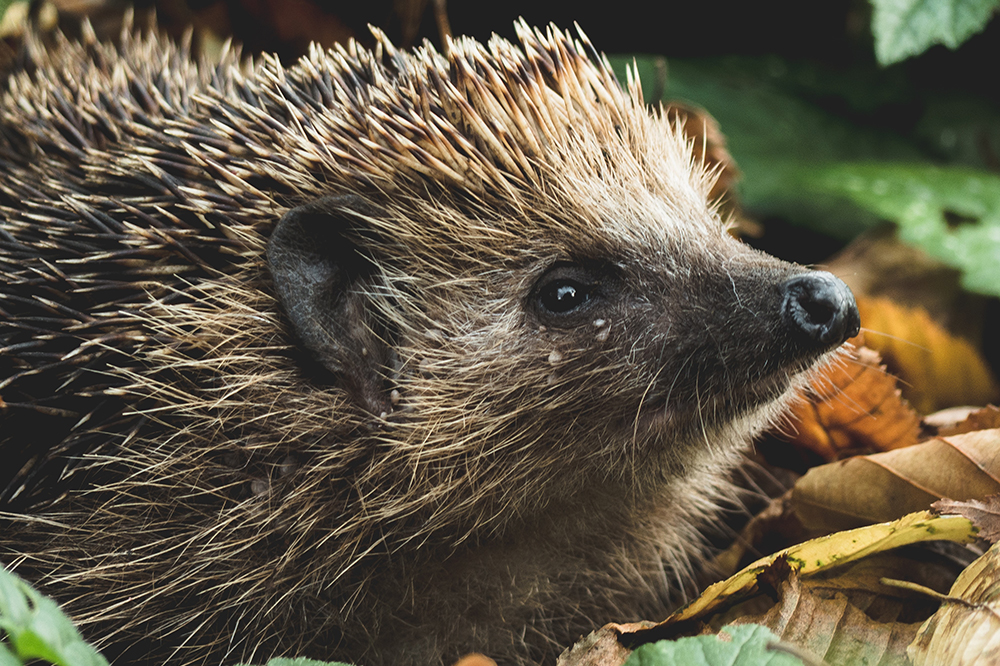
Between June 2019 and January 2020 the project HAPPY HEDGEHOG (HHH) was implemented at the School of Business FHNW. Initiator and client was Oliver Bendel. In the context of machine ethics, the students Emanuel Graf, Kevin Bollier, Michel Beugger and Vay Lien Chang developed the prototype of a lawnmower robot that stops working as soon as it discovers a hedgehog. HHH has a thermal imaging camera. If it encounters a warm object, it further examines it using image recognition. At night a lamp mounted on top helps. After training with hundreds of photos, HHH can identify a hedgehog quite accurately. Firstly, another moral machine has been created in the laboratory, and secondly, the team provides a possible solution to a problem that frequently occurs in practice: commercial lawnmower robots often kill baby hedgehogs in the dark. HAPPY HEDGEHOG could help save them. The video on youtu.be/ijIQ8lBygME shows it without casing; a photo with casing can be found here. The robot is in the tradition of LADYBIRD, another animal-friendly machine.

Happy Hedgehog

Between June 2019 and January 2020, the sixth artifact of machine ethics will be created at the FHNW School of Business. Prof. Dr. Oliver Bendel is the initiator, the client and – together with a colleague – the supervisor of the project. Animal-machine interaction is about the design, evaluation and implementation of (usually more sophisticated or complex) machines and computer systems with which animals interact and communicate and which interact and communicate with animals. While machine ethics has largely focused on humans thus far, it can also prove beneficial for animals. It attempts to conceive moral machines and to implement them with the help of further disciplines such as computer science and AI or robotics. The aim of the project is the detailed description and prototypical implementation of an animal-friendly service robot, more precisely a mowing robot called HAPPY HEDGEHOG (HHH). With the help of sensors and moral rules, the robot should be able to recognize hedgehogs (especially young animals) and initiate appropriate measures (interruption of work, expulsion of the hedgehog, information of the owner). The project has similarities with another project carried out earlier, namely LADYBIRD. This time, however, more emphasis will be placed on existing equipment, platforms and software. The first artifact at the university was the GOODBOT – in 2013.