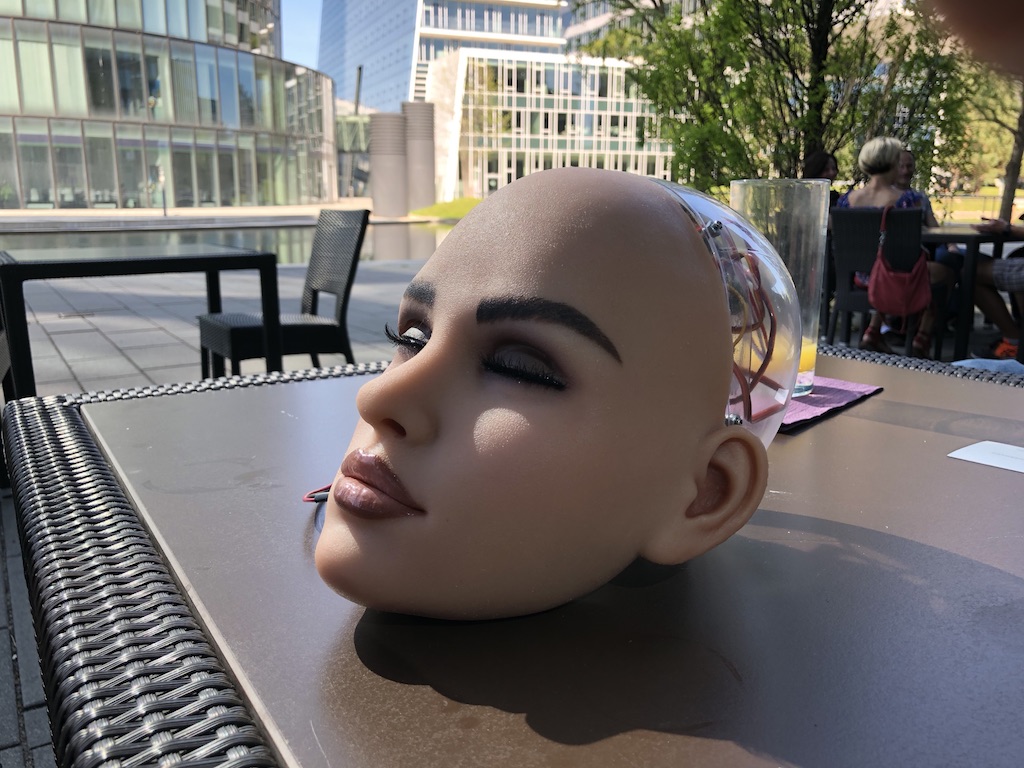
The book “Maschinenliebe” (“Machine Love”/”Machines of Love”/”Machines for Love”/”Love for Machines”), edited by Oliver Bendel, has gone into production. The subtitle is “Liebespuppen und Sexroboter aus technischer, psychologischer und philosophischer Perspektive” (“Love Dolls and Sex Robots from a Technical, Psychological and Philosophical Perspective”). The volume contains contributions by internationally renowned experts as well as interviews with a love doll brothel operator and a sex worker. It has about 200 pages and some color illustrations. Three of the 16 contributions are in English. They come from internationally renowned experts in this field, from Kate Devlin (King’s College London), Yuefang Zhou and Martin H. Fischer (University of Potsdam), and Kino Coursey (Realbotix; picture by courtesy of this company). The book will be published in autumn 2020. Further information is available at www.springer.com/de/book/9783658298630.
Care Robots and Sex
The paper “Care Robots with Sexual Assistance Functions” by Oliver Bendel, accepted at the AAAI 2020 Spring Symposium “Applied AI in Healthcare: Safety, Community, and the Environment”, can be accessed via arxiv.org/abs/2004.04428. From the abstract: “Residents in retirement and nursing homes have sexual needs just like other people. However, the semi-public situation makes it difficult for them to satisfy these existential concerns. In addition, they may not be able to meet a suitable partner or find it difficult to have a relationship for mental or physical reasons. People who live or are cared for at home can also be affected by this problem. Perhaps they can host someone more easily and discreetly than the residents of a health facility, but some elderly and disabled people may be restricted in some ways. This article examines the opportunities and risks that arise with regard to care robots with sexual assistance functions. First of all, it deals with sexual well-being. Then it presents robotic systems ranging from sex robots to care robots. Finally, the focus is on care robots, with the author exploring technical and design issues. A brief ethical discussion completes the article. The result is that care robots with sexual assistance functions could be an enrichment of the everyday life of people in need of care, but that we also have to consider some technical, design and moral aspects.” Due to the outbreak of the COVID-19 pandemic, the physical meeting to be held at Stanford University was postponed. It will take place in November 2020 in Washington (AAAI 2020 Fall Symposium Series).
Care Robots with Sexual Assistance Functions
The paper “Care Robots with Sexual Assistance Functions” by Oliver Bendel was accepted at the AAAI 2020 Spring Symposia. From the abstract: “Residents in retirement and nursing homes have sexual needs just like other people. However, the semi-public situation makes it difficult for them to satisfy these existential concerns. In addition, they may not be able to meet a suitable partner or find it difficult to have a relationship for mental or physical reasons. People who live or are cared for at home can also be affected by this problem. Perhaps they can host someone more easily and discreetly than the residents of a health facility, but some elderly and disabled people may be restricted in some ways. This article examines the opportunities and risks that arise with regard to care robots with sexual assistance functions. First of all, it deals with sexual well-being. Then it presents robotic systems ranging from sex robots to care robots. Finally, the focus is on care robots, with the author exploring technical and design issues. A brief ethical discussion completes the article. The result is that care robots with sexual assistance functions could be an enrichment of the everyday life of people in need of care, but that we also have to consider some technical, design and moral aspects.” The paper had been submitted to the symposium “Applied AI in Healthcare: Safety, Community, and the Environment”. Oliver Bendel will present the paper at Stanford University between 23 and 25 March 2020.
Jealousy 4.0
The international workshop “Learning from Humanoid AI: Motivational, Social & Cognitive Perspectives” took place from 30 November – 1 December 2019 at the University of Potsdam. Dr. Jessica Szczuka raised the question: “What do men and women see in sex robots?” … Her talk was based on the paper “Jealousy 4.0? An empirical study on jealousy-related discomfort of women evoked by other women and gynoid robots” by herself and Nicole Krämer. In their introduction the authors write: “In a paper discussing machine ethics, Bendel asked whether it is ‘possible to be unfaithful to the human love partner with a sex robot, and can a man or a woman be jealous because of the robot’s other love affairs?’ … In this line, the present study aims to empirically investigate whether women perceive robots as potential competitors to their relationship in the same way as they perceive other women to be so. As the degree of human-likeness of robots contributes to the similarity between female-looking robots and women, we additionally investigated differences between machine-like female-looking robots and human-like female-looking robots with respect to their ability to evoke jealousy-related discomfort.” (Paper) The paper can be accessed here.