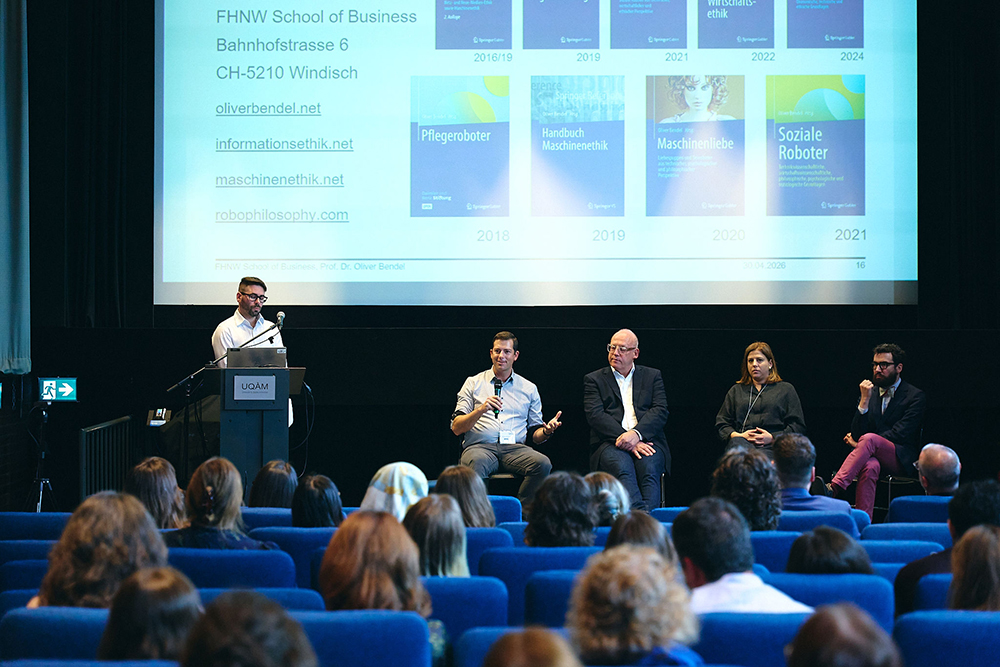
On April 30, 2026, Prof. Dr. Oliver Bendel gave a talk on “Physical AI and the Future of Intimacy” at the SAGA Conference in Montreal. From the abstract: “The presentation begins with the Tamagotchi, the iconic digital pet that demonstrated how simple interactive systems can evoke emotional attachment. It then turns to social robots, wearable social robots, and AI-enhanced sex toys, love dolls, and sex robots. Today, large language models (LLMs) and multimodal language models (MLLMs) enable dialogue, perception, and evaluation in these systems. Such capabilities may also benefit people with disabilities, including blind users, by facilitating communication and interaction. At the same time, the physical dimension remains crucial. Embodied systems create presence and proximity: they can be touched, held, and stroked, and experienced through movement, vibration, or sound. The talk argues that future intimate technologies will emerge from the convergence of generative intelligence and physical embodiment, combining conversational AI with the sensory experience of a physically present companion.” On May 19, 2026, the photos from the event, taken by Maison Toki, an independent art agency in Montreal, were made available (Photo: Maison Toki).
A Successful Conference on GenAI and Sexuality
Those who had already arrived on Sunday or Monday were welcomed to Montreal with beautiful sunshine and mild temperatures. The Clock Tower Beach had been prepared, though it was not yet open. On Thursday, April 30, 2026, the SAGA conference took place at the Judith-Jasmin Pavilion Extension in slightly cooler weather. Renowned experts such as David Lafortune and Simon Dubé were among the hosts, alongside rising stars like Valérie A. Lapointe. Through a series of outstanding presentations and panels, the conference explored the theme “Sexuality and Generative AI: Benefits, Risks, and Paths for Action”. This included both generative AI and other AI systems on computers, as well as those embedded in robots and physical systems. The talks, delivered in English and French, were translated live with the help of AI. Both on stage and in the audience were sexologists, psychologists, and philosophers, as well as practitioners from a wide range of fields. There was no hesitation – neither among participants nor in engaging with the topics discussed. This conference was made possible through the financial support of the Social Sciences and Humanities Research Council (SSHRC). The program can be viewed here.
SAGA Conference Program
The upcoming “SAGA: Sexuality and Generative AI” symposium, taking place on April 30, 2026 at the Université du Québec à Montréal, explores how generative AI is reshaping intimacy, desire, relationships, and sexual expression. The first block, titled “Societal Impacts”, brings together a set of talks that examine how emerging technologies are already influencing human connection and cultural norms. Brian Willoughby (Brigham Young University, United States) opens with “Engagement with Romantic AI: Implications for Young Adult Dating and Relationships”, addressing how AI companions may alter expectations and behaviors in modern dating. Arnaud Anciaux (Université Laval, Canada) follows with “Toward a Great Bypass? Property, Consent, and Value Creation in AI-Generated Sexual Content”, focusing on legal and ethical questions around ownership and consent. Émilie Gaudet (Université de Montréal, Canada) contributes “AI-Generated Pornography and Problematic Pornography Use”, exploring the psychological and societal risks associated with synthetic sexual media. Finally, Oliver Bendel (FHNW School of Business, Switzerland) looks ahead in “Physical AI and the Future of Intimacy”, considering how embodied AI systems could transform intimate relationships. The program also features “Panel 1 – Technological Solutions to the Challenges of AI”, with contributions from Sophie Mortimer (UK Revenge Porn Helpline, United Kingdom), Alex Georges (AetherLab, United States), and Madelaine Thomas (Image Angel, United Kingdom), who discuss practical responses to harms such as non-consensual content and digital abuse. Overall, the symposium is structured into four thematic blocks and includes two panels, offering a compact yet wide-ranging exploration of one of the most sensitive and rapidly evolving intersections of technology and human life. The SAGA conference program is now available online and can be downloaded here.
SAGA: Sexuality and Generative AI
The upcoming “SAGA: Sexuality and Generative AI” symposium, taking place on April 30, 2026 at the Université du Québec à Montréal, explores how generative AI is reshaping intimacy, desire, relationships, and sexual expression. The presentation by Prof. Dr. Oliver Bendel begins with the Tamagotchi, the iconic digital pet that demonstrated how simple interactive systems can evoke emotional attachment. It then turns to social robots, wearable social robots, and AI-enhanced sex toys, love dolls, and sex robots. Today, large language models (LLMs) and multimodal language models (MLLMs) enable dialogue, perception, and evaluation in these systems. Such capabilities may also benefit people with disabilities, including blind users, by facilitating communication and interaction. At the same time, the physical dimension remains crucial. Embodied systems create presence and proximity: they can be touched, held, and stroked, and experienced through movement, vibration, or sound. The talk argues that future intimate technologies will emerge from the convergence of generative intelligence and physical embodiment, combining conversational AI with the sensory experience of a physically present companion. Full details and submissions are available at event.fourwaves.com/sexualiteia/pages.
Sexuality and Generative AI
The upcoming “SAGA: Sexuality and Generative AI” symposium, taking place on April 30, 2026 at the Université du Québec à Montréal, explores how generative AI is reshaping intimacy, desire, relationships, and sexual expression. As AI systems increasingly create images, stories, and even interactive romantic companions, they raise new ethical, legal, and social questions that researchers, practitioners, and industry voices will tackle together. The hybrid, bilingual event is free and open to all, offering live translation and captioning. In its first block on social impacts, the symposium features talks such as Brian Willoughby’s exploration of how romantic AI affects young adults’ relationships, Arnaud Anciaux’s analysis of ownership and consent around AI-generated sexual content, Beáta Bőthe’s work on AI-generated pornography and problematic use, and Oliver Bendel’s look at erotic chatbot interactions. With discussions ranging from the regulation of AI-generated pornography to digital intimacy and AI-supported therapeutic interventions, the event promises a rich and essential conversation. Full details and submissions are available at https://event.fourwaves.com/sexualiteia/pages.