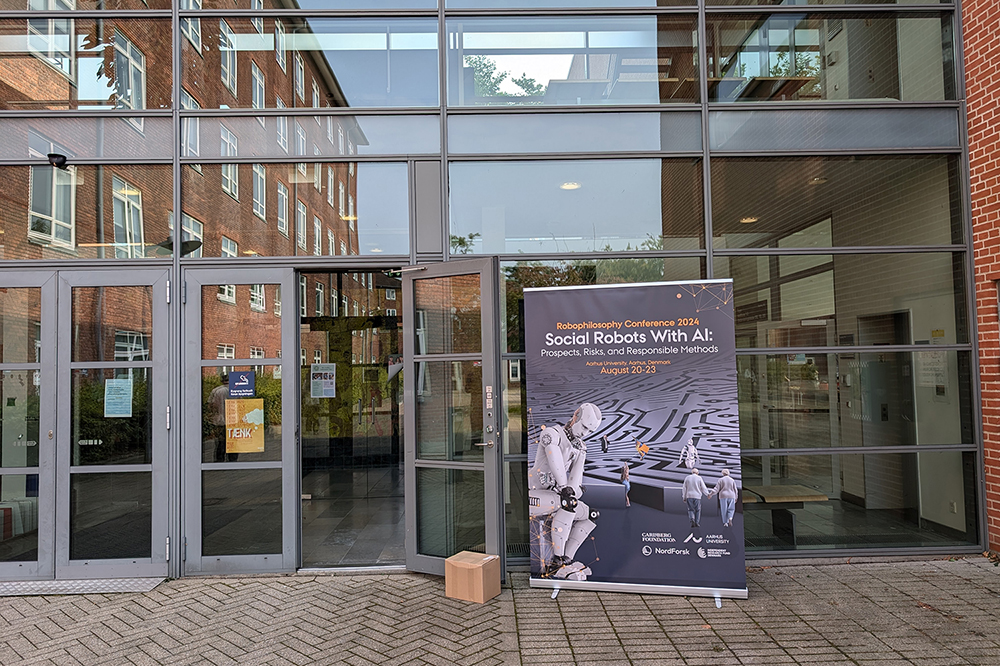
On August 20, 2024, Robophilosophy 2024 was opened with words of welcome from Maja Horst, Dean of the Faculty of Arts at Aarhus University, and Johanna Seibt, Professor of the School of Culture and Society at Aarhus University. The website says: “The international research conference RP2024 will discuss the questions that really matter in view of the new technological potential of social robotics. In over 100 research talks, RP2024 will address concrete and deep issues that reach far beyond safety and privacy concerns into the conceptual and normative fabric of our societies and individual self-comprehension.” (Website Robophilosophy 2024) The first keynote on the first day of the conference was given by Wendell Wallach, one of the world’s best-known machine ethicists. With his book “Moral Machines” (2009), he laid the foundation for a discipline that has been developing in science fiction and science for years and decades. This was followed in 2011 by “Machine Ethics” by Michael Anderson and Susan L.eigh Anderson. In addition to machine ethics, Robophilosophy is dedicated to robot ethics and other interesting perspectives on social robots.
A Cobot as Conductor of a Symphony
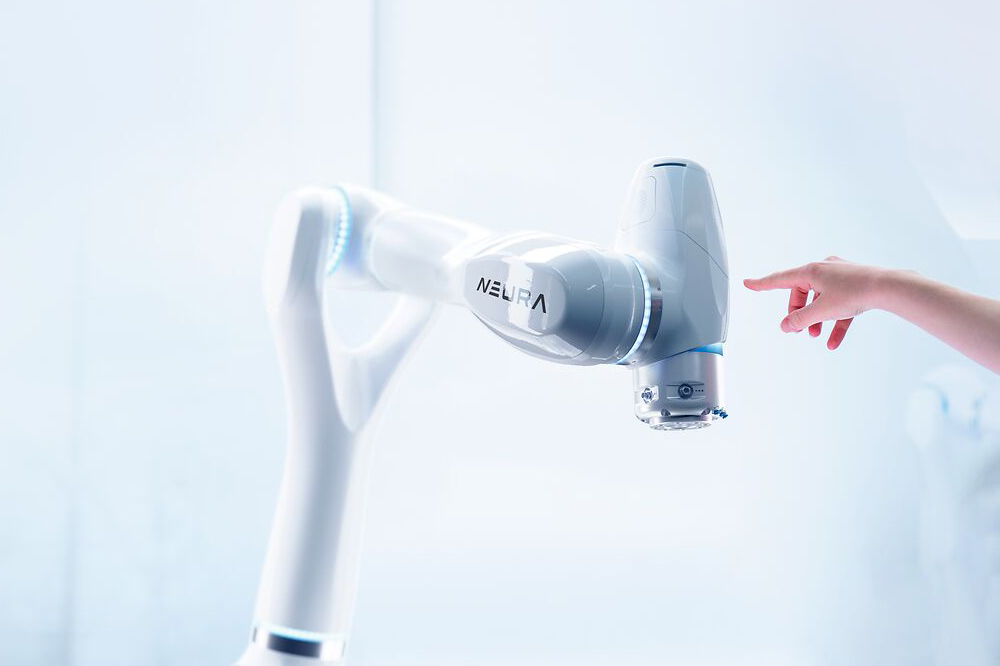
Cobots that dance with humans have been around for a long time. In 2016, the audience at Südpol Luzern witnessed dance and robot history being written by Huang Yi, a choreographer from Taiwan. Cobots that set the pace for humans, on the other hand, are not yet the order of the day. The Dresden Symphony Orchestra is about to perform the “Roboter.Sinfonie”. After a while, conductor Michael Helmrath will hand over to MAiRA Pro S, a product from NEURA Robotics. According to Deutschlandfunk, the machine’s three arms will be able to guide the orchestra, which is divided into groups, through the most complex passages independently of each other. This will break completely new musical ground. According to the Dresden Symphony Orchestra’s calendar, the concerts will take place on October 12 and 13, 2024 at the Europäisches Zentrum der Künste Hellerau (Image: NEURA Robotics).
Deadline for ICSR 2024 Extended Again
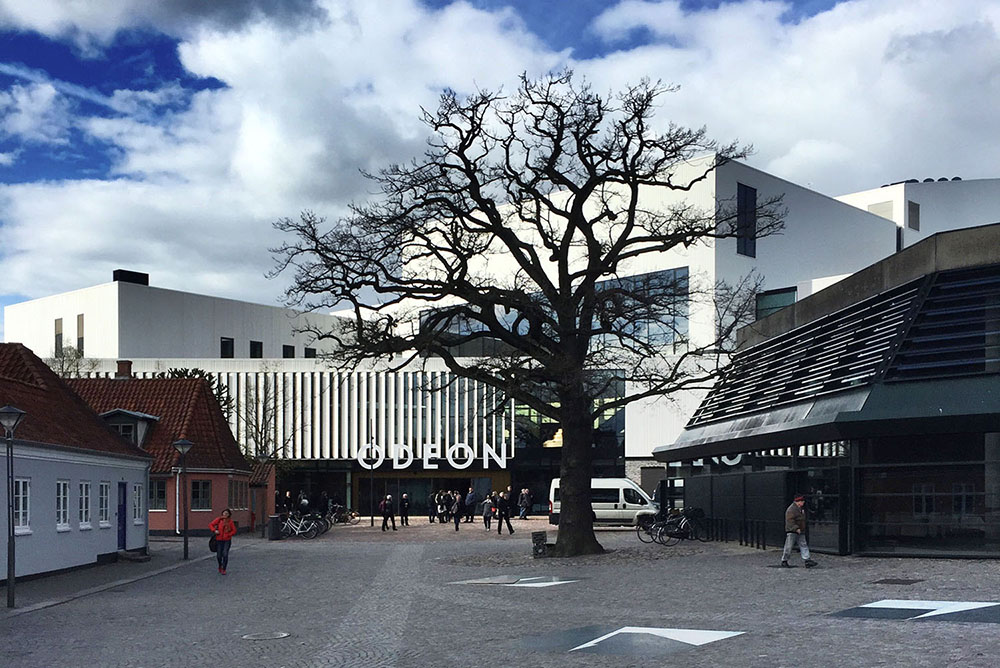
The deadline for the International Conference on Social Robotics 2024 (ICSR 2024) has been extended again. Experts in social robotics and related fields have until July 19 to submit their full papers. The prestigious event was last held in Florence (2022) and Qatar (2023). Now it enters its next round. The 16th edition will bring together researchers and practitioners working on human-robot interaction and the integration of social robots into our society. The title of the conference includes the addition “AI”. This is a clarification and demarcation that has to do with the fact that there will be two further formats with the name ICSR in 2024. ICSR’24 (ICSR + AI) will take place as a face-to-face conference in Odense, Denmark, from 23 to 26 October 2024. The theme of this year’s conference is “Empowering Humanity: The role of social and collaborative robotics in shaping our future”. The topics of the Call for Papers include “collaborative robots in service applications (in construction, agriculture, etc.)”, “Human-robot interaction and collaboration”, “Affective and cognitive sciences for socially interactive robots”, and “Context awareness, expectation, and intention understanding”. The general chairs are Oskar Palinko, University of Southern Denmark, and Leon Bodenhagen, University of Southern Denmark. More information is available at icsr2024.dk (Photo: Jacob Christensen).
Extended Deadline for ICSR 2024
The deadline for the International Conference on Social Robotics 2024 (ICSR 2024) has been extended. Experts in social robotics and related fields have until July 12 to submit their papers. The prestigious event was last held in Florence (2022) and Qatar (2023). Now it enters its next round. The 16th edition will bring together researchers and practitioners working on human-robot interaction and the integration of social robots into our society. The title of the conference includes the addition “AI”. This is a clarification and demarcation that has to do with the fact that there will be two further formats with the name ICSR in 2024. ICSR’24 (ICSR + AI) will take place as a face-to-face conference in Odense, Denmark, from 23 to 26 October 2024. The theme of this year’s conference is “Empowering Humanity: The role of social and collaborative robotics in shaping our future”. The topics of the Call for Papers include “collaborative robots in service applications (in construction, agriculture, etc.)”, “Human-robot interaction and collaboration”, “Affective and cognitive sciences for socially interactive robots”, and “Context awareness, expectation, and intention understanding”. The general chairs are Oskar Palinko, University of Southern Denmark, and Leon Bodenhagen, University of Southern Denmark. More information is available at icsr2024.dk.
The ICSR 2024 is Approaching
The deadline for the International Conference on Social Robotics 2024 (ICSR 2024) is approaching. Experts in social robotics and related fields have until July 5 to submit their papers. The prestigious event was last held in Florence (2022) and Qatar (2023). Now it enters its next round. The 16th edition will bring together researchers and practitioners working on human-robot interaction and the integration of social robots into our society. The title of the conference includes the addition “AI”. This is a clarification and demarcation that has to do with the fact that there will be two further formats with the name ICSR in 2024. ICSR’24 (ICSR + AI) will take place as a face-to-face conference in Odense, Denmark, from 23 to 26 October 2024. The theme of this year’s conference is “Empowering Humanity: The role of social and collaborative robotics in shaping our future”. The topics of the Call for Papers include “collaborative robots in service applications (in construction, agriculture, etc.)”, “Human-robot interaction and collaboration”, “Affective and cognitive sciences for socially interactive robots”, and “Context awareness, expectation, and intention understanding”. The general chairs are Oskar Palinko, University of Southern Denmark, and Leon Bodenhagen, University of Southern Denmark. More information is available at icsr2024.dk.
When Alpha Mini Meets Navel
Learntec is the leading e-learning trade fair and conference in Europe. For decades, it has been the meeting place for education managers, HR staff, heads of e-learning institutions, university lecturers, teachers, and all interested parties. It is shaped by experts such as Sünne Eichler and Prof. Dr. Peter A. Henning. In the Future Lab “Social Robots and GPTs” on June 6, 2024 at LEARNTEC, you can interact and communicate with Navel and Alpha Mini. For example, you can make them move their bodies, admire their gestures and facial expressions or have a conversation with them. Both models are state-of-the-art social robots that can be used in a learning context. The three sessions will be introduced by Prof. Dr. Oliver Bendel from the FHNW School of Business with his keynote speech “Social robots and GPTs in the learning sector”. The contact persons for the two robots are Claude Toussaint from navel robotics in Munich and Rainer E. Becker from BECKER ROBOTICS in Wuppertal. You will also have the opportunity to communicate with a GPT called Social Robotics Girl, which Prof. Dr. Oliver Bendel uses in his teaching.
UFSKW Paper-of-the-Month Award
The article “‘Ick bin een Berlina’: dialect proficiency impacts a robot’s trustworthiness and competence evaluation” by Katharina Kühne, Erika Herbold, Oliver Bendel, Yuefang Zhou, and Martin H. Fischer has been granted the UFSKW Paper-of-the-Month Award for March 2024. All authors are researchers in the Potsdam Embodied Cognition Group (PECoG) at the University of Potsdam, with the exception of Oliver Bendel, who works at the FHNW School of Business and is an associated researcher in the group. “UFSKW” stands for “Universitärer Forschungsschwerpunkt Kognitionswissenschaften”. It is based at the University of Potsdam. The UFSKW Paper of the Month provides a special stage for current cognitive science research at the UFSKW. It is chosen monthly by the selection committee from all submissions. The paper says about the background of the project: “Robots are increasingly used as interaction partners with humans. Social robots are designed to follow expected behavioral norms when engaging with humans and are available with different voices and even accents. Some studies suggest that people prefer robots to speak in the user’s dialect, while others indicate a preference for different dialects.” The following results are mentioned: “We found a positive relationship between participants’ self-reported Berlin dialect proficiency and trustworthiness in the dialect-speaking robot. Only when controlled for demographic factors, there was a positive association between participants’ dialect proficiency, dialect performance and their assessment of robot’s competence for the standard German-speaking robot. Participants’ age, gender, length of residency in Berlin, and device used to respond also influenced assessments. Finally, the robot’s competence positively predicted its trustworthiness.” The article can be accessed at www.frontiersin.org/articles/10.3389/frobt.2023.1241519/full.
When Animals Meet Machines
The manuscript of the book “Non-Human Animals, Ethics and Engineering” (alternative title “Animals, Ethics and Engineering”) was sent to the publisher Jenny Stanford in May 2024. It contains 16 chapters on this topic, including by Clara Mancini (“Animal-Centered Technology and Sustainable Development”), Fiona French (“Designing and Crafting Systems for Non-Human Animals”), and Leonie Bossert together with Thilo Hagendorff (“Animals and AI: The Role of Animals in AI Research and Application”). In “An Investigation into the Encounter Between Social Robots and Animals” (Chapter 12), Oliver Bendel “delves into the evolving landscape of social robots designed to interact with animals, dissecting the intricate dynamics of these interactions and their ethical ramifications” (Information from the editors). The philosopher of technology also presents his own projects, such as concepts and prototypes of animal-friendly machines, developed in the context of machine ethics, animal-machine interaction, and social robotics. The editors are Rosalyn W. Berne and Madeline A. Kibler from the University of Virginia. The book is scheduled for publication in late summer or fall 2024.
ICSR 2024 + Competition
The main conference of the ICSR will be held in Odense in 2024, and its full name is “16th International Conference on Social Robotics +AI”. There is also the ICSR-2024 Competition in Naples, Italy. According to the website, it is “The 1st Competition of the International Conference on Social Robotics”. The new format will take place on 8-9 May 2024. The General Chair explains the intention of the event: “ICSR Competition aims at being not only a competition but an extraordinary showcase of innovation and talent in the field of robotics. This event marks the convergence of brilliance, where teams comprising students, PhD students, researchers, and esteemed professors will compete in a series of captivating competitions through a groundbreaking exploration into the realms of robotics, where cutting-edge technologies and social applications come together. In the spirit of fostering collaboration and pushing the boundaries of what is possible, our competitions will showcase the diverse capabilities of robotics.” (Website ICSR-24 Competition) According to the organizers, teams will compete in four different competitions: the Robotic Arm Challenge, the Humanoid Robot Challenge, the Robot Design Challenge, and the Game Jam Challenge. More information is available at www.icsr2024-competition.org.
ICSR + BioMed 2024
In addition to the ICSR in Odense, which focuses on social robotics and artificial intelligence, there is also the ICSR in Naples this year, which organizes a robot competition. In addition, an ICSR conference focusing on biomedicine and the healthcare sector will take place in Singapore from August 16-18, 2024. The website states: “The 16th International Conference on Social Robotics + BioMed (ICSR + BioMed 2024) focuses on interdisciplinary innovation on Bio-inspired, Biomedical, and Surgical Robotics. By fostering the much-needed merging of these disciplines, together with fast emerging Biotech, the conference aims to ensure the lesson learned from these communities blend to unleash the real potential of robots. … The conference will serve as the scientific, technical, and business platform for fostering collaboration, exploration, and advancement in these cutting-edge fields. It will showcase the latest breakthroughs and methodologies, shaping the future of robotics design and applications across several sectors including Biomedical and healthcare.” (Website ICSR) Papers must be submitted by June 5, 2024. Further information on the conference is available at robicon2024.org.