Preprint on Hugging Robots

From March 27-29, 2023, the AAAI 2023 Spring Symposia featured the symposium “Socially Responsible AI for Well-being” by Takashi Kido (Teikyo University, Japan) and Keiki Takadama (The University of Electro-Communications, Japan). This time the venue was exceptionally not Stanford University, but the Hyatt Regency SFO Airport. On March 28, Prof. Dr. Oliver Bendel presented the paper “Increasing Well-being through Robotic Hugs”, written by himself, Andrea Puljic, Robin Heiz, Furkan Tömen, and Ivan De Paola. The paper has now been published as a preprint and can be downloaded via arxiv.org/abs/2304.14409. From the abstract: “This paper addresses the question of how to increase the acceptability of a robot hug and whether such a hug contributes to well-being. It combines the lead author’s own research with pioneering research by Alexis E. Block and Katherine J. Kuchenbecker. First, the basics of this area are laid out with particular attention to the work of the two scientists. The authors then present HUGGIE Project I, which largely consisted of an online survey with nearly 300 participants, followed by HUGGIE Project II, which involved building a hugging robot and testing it on 136 people. At the end, the results are linked to current research by Block and Kuchenbecker, who have equipped their hugging robot with artificial intelligence to better respond to the needs of subjects.” More information on the conference via aaai.org/conference/spring-symposia/sss23/.

A “weak” Robot

How do social robots emerge from simple, soft shapes? As part of their final thesis in 2021 at the School of Business FHNW, 23-year-old students Nhi Tran Hoang Yen and Thang Hoang Vu from Ho Chi Minh City (Vietnam) have answered this question posed by their supervisor Prof. Dr. Oliver Bendel. They have submitted eleven proposals for novel robots. The first is a pillow to which a tail has been added. Its name is Petanion, a portmanteau of “pet” and “companion”. The tail could move like the tail of a cat or dog. In addition, the pillow could make certain sounds. It would be optimal if the tail movements were based on the behavior of the user. Thus, as desired, a social robot is created from a simple, soft form, in this case a pet substitute. Petanion is soft and cute and survives a long time. It can also be used if one has certain allergies or if there is not enough space or money in a household for a pet. Last but not least, the ecological balance is probably better – above all, the robot does not eat animals that come from factory farming. The inspiration may have been Qoobo, a pillow with a tail, designed to calm and to “heal the heart”. Panasonic also believes in robots that emerge from simple, soft forms. It promotes its new robot NICOBO as a “yowai robotto”, a “weak” robot that has hardly any functions or capabilities. The round, cute robot has two separate displays as eyes and a tail that it constantly moves. According to the company, it is aimed primarily at singles and the elderly. There could well be a high demand for it, even beyond the target groups (Photo: Panasonic).

ACI 2023 in North Carolina

The Tenth International Conference on Animal-Computer Interaction will be held December 4-8, 2023, in Raleigh, North Carolina, hosted by North Carolina State University. “ACI is the leading International Conference on Animal-Computer Interaction. It is a highly multidisciplinary event drawing researchers and practitioners from diverse backgrounds to share and discuss work and topics related to the research and design of computing-enabled and interactive technology for and with animals.” (Website ACI) The Ninth International Conference on Animal-Computer Interaction was held in Newcastle upon Tyne at the end of 2022. Also this year the organizers are interested in a variety of topics in animal-computer interaction and animal-machine interaction, as the call for papers (CfP) reveals: “Submissions might address topics such as: the role of technology in shaping human-animal relationships; studies and/or analysis of large-scale technology for animal deployments; considerations on the wider context of technology for animal use; methods and reflections on studying the next generation of technology for animals; or how to conduct ACI research in a world where commercial design and deployment of technology for animals outpaces academic thought.” (Website ACI) The CfP can be accessed at www.aciconf.org/aci2023.

ICSR 2023 in Qatar

Next to Robophilosophy, ICSR may be the most important conference on social robotics. The fourteenth edition took place in Florence at the end of 2022 and was dedicated to the health sector. “The 15th International Conference on Social Robotics (ICSR 2023) will bring together researchers and practitioners working on the interaction between humans and intelligent robots and on the integration of social robots into our society.  ICSR 2023 will take place in Doha as a face-to-face conference on December 4-7, 2023. This will be the first time that the conference will be hosted in Qatar and in the Middle East and North Africa region.” (Website ICSR) The theme of this year’s ICSR is “Human-Robot Collaboration: Sea, Air, Land, Space and Cyberspace”. According to the organizers, the theme emphasizes on all physical and cyber-physical domains where humans and robots collaborate. Whether Doha is suitable as a venue for the conference needs to be discussed. Qatar is ruled as an absolute monarchy. Sharia law is considered a main source of legislation. The human rights situation in the country has been critical for decades. More information and CfP via icrs.iovision.tn.

Self-driving Cars Stopped by Fog

“Five self-driving vehicles blocked traffic early Tuesday morning in the middle of a residential street in San Francisco’s Balboa Terrace neighborhood, apparently waylaid by fog that draped the southwestern corner of the city.” (San Francisco Chronicle, 11 April 2023) The San Francisco Chronicle reported this in an article published on April 11, 2023. The fact that fog is a problem for Waymo’s vehicles has been known to the company for some time. A blog post from 2021 states: “Fog is finicky – it comes in a range of densities, it can be patchy, and can affect a vehicle’s sensors differently.” (Blog Waymo, 15 November 2021) Against this background, it is surprising that vehicles are allowed to roll through the city unaccompanied, especially since Frisco – this name comes from sailors – is very often beset by fog. But fog is not the only challenge for the sensors of self-driving cars. A thesis commissioned and supervised by Prof. Dr. Oliver Bendel presented dozens of phenomena and methods that can mislead sensors of self-driving cars. The San Francisco Chronicle article “Waymo says dense S.F. fog brought 5 vehicles to a halt on Balboa Terrace street” can be accessed at www.sfchronicle.com/bayarea/article/san-francisco-waymo-stopped-in-street-17890821.php.

AAAI Spring Symposia Proceedings 1992-2018

The AAAI Spring Symposia is a legendary conference that has been held since 1992. It usually takes place at Stanford University. Until 2018, the leading US artificial intelligence organization itself published the proceedings. Since 2019, each symposium is responsible for its own. Following a restructuring of the AAAI website, the proceedings can be found in a section of the new “AAAI Conference and Symposium Proceedings” page. In 2016, Stanford University hosted one of the most important gatherings on machine ethics and robot ethics ever, the symposium “Ethical and Moral Considerations in Non-Human Agents” … Contributors included Peter M. Asaro, Oliver Bendel, Joanna J. Bryson, Lily Frank, The Anh Han, and Luis Moniz Pereira. Also present was Ronald C. Arkin, one of the most important and – because of his military research – controversial machine ethicists. The 2017 and 2018 symposia were also groundbreaking for machine ethics and attracted experts from around the world. The papers can be accessed at aaai.org/aaai-publications/aaai-conference-proceedings.

ACI 2022 Proccedings

The ACI took place from 5 to 8 December 2022 in Newcastle upon Tyne. It is the world’s leading conference on animal-computer interaction. The proceedings were published in the ACM Library on March 30, 2023. They include the paper “A Face Recognition System for Bears: Protection for Animals and Humans in the Alps” by Oliver Bendel and Ali Yürekkirmaz. From the abstract: “Face recognition, in the sense of identifying people, is controversial from a legal, social, and ethical perspective. In particular, opposition has been expressed to its use in public spaces for mass surveillance purposes. Face recognition in animals, by contrast, seems to be uncontroversial from a social and ethical point of view and could even have potential for animal welfare and protection. This paper explores how face recognition for bears (understood here as brown bears) in the Alps could be implemented within a system that would help animals as well as humans. It sets out the advantages and disadvantages of wildlife cameras, ground robots, and camera drones that would be linked to artificial intelligence. Based on this, the authors make a proposal for deployment. They favour a three-stage plan that first deploys fixed cameras and then incorporates camera drones and ground robots. These are all connected to a control centre that assesses images and developments and intervenes as needed. The paper then discusses social and ethical, technical and scientific, and economic and structural perspectives. In conclusion, it considers what could happen in the future in this context.” The proceedings can be accessed via dl.acm.org/doi/proceedings/10.1145/3565995.

Mind-controlled Four-legged Robot

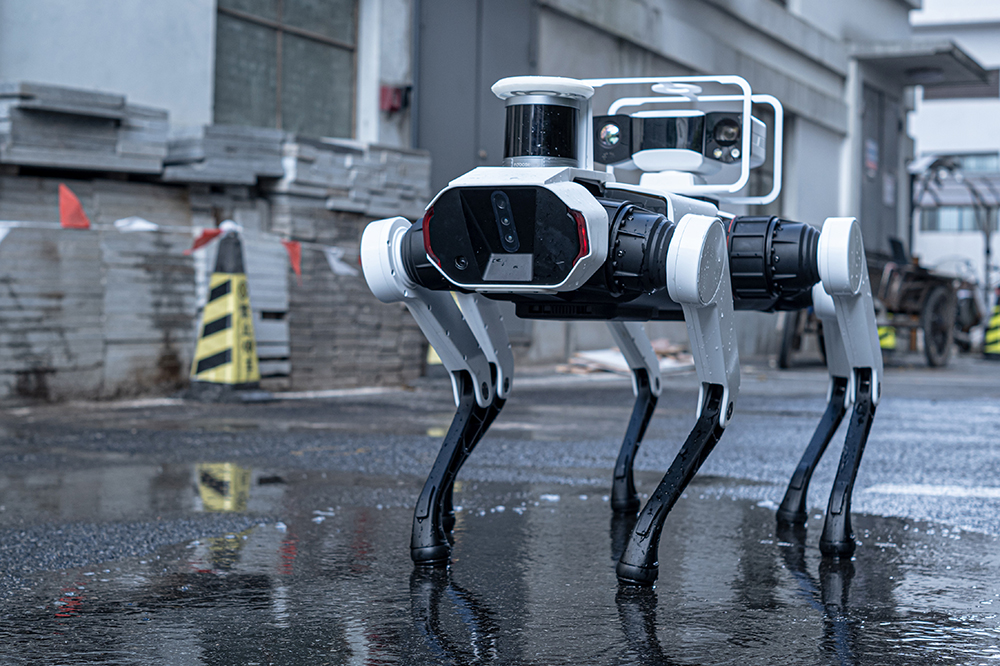
“Researchers from the University of Technology Sydney (UTS) have developed biosensor technology that will allow you to operate devices, such as robots and machines, solely through thought-control.” (UTS, 20 March 2023) This was reported by UTS on its website on March 20, 2023. The brain-machine interface was developed by Chin-Teng Lin and Francesca Iacopi (UTS Faculty of Engineering and IT) in collaboration with the Australian Army and Defence Innovation Hub. “The user wears a head-mounted augmented reality lens which displays white flickering squares. By concentrating on a particular square, the brainwaves of the operator are picked up by the biosensor, and a decoder translates the signal into commands.” (UTS, 20 March 2023) According to the website, the technology was demonstrated by the Australian Army, where selected soldiers operated a quadruped robot using the brain-machine interface. “The device allowed hands-free command of the robotic dog with up to 94% accuracy.” (UTS, 20 March 2023) The paper “Noninvasive Sensors for Brain–Machine Interfaces Based on Micropatterned Epitaxial Graphene” can be accessed at pubs.acs.org/doi/10.1021/acsanm.2c05546.

Bar Robots for Well-being of Guests

From March 27-29, 2023, the AAAI 2023 Spring Symposia will feature the symposium “Socially Responsible AI for Well-being” by Takashi Kido (Teikyo University, Japan) and Keiki Takadama (The University of Electro-Communications, Japan). The venue is usually Stanford University. For staffing reasons, this year the conference will be held at the Hyatt Regency in San Francisco. On March 28, Prof. Dr. Oliver Bendel and Lea Peier will present their paper “How Can Bar Robots Enhance the Well-being of Guests?”. From the abstract: “This paper addresses the question of how bar robots can contribute to the well-being of guests. It first develops the basics of service robots and social robots. It gives a brief overview of which gastronomy robots are on the market. It then presents examples of bar robots and describes two models used in Switzerland. A research project at the School of Business FHNW collected empirical data on them, which is used for this article. The authors then discuss how the robots could be improved to increase the well-being of customers and guests and better address their individual wishes and requirements. Artificial intelligence can play an important role in this. Finally, ethical and social problems in the use of bar robots are discussed and possible solutions are suggested to counter these.” More Information via aaai.org/conference/spring-symposia/sss23/.

An Investigation of Robotic Hugs

From March 27-29, 2023, the AAAI 2023 Spring Symposia will feature the symposium “Socially Responsible AI for Well-being” by Takashi Kido (Teikyo University, Japan) and Keiki Takadama (The University of Electro-Communications, Japan). The venue is usually Stanford University. For staffing reasons, this year the conference will be held at the Hyatt Regency in San Francisco. On March 28, Prof. Dr. Oliver Bendel will present the paper “Increasing Well-being through Robotic Hugs”, written by himself, Andrea Puljic, Robin Heiz, Furkan Tömen, and Ivan De Paola. From the abstract: “This paper addresses the question of how to increase the acceptability of a robot hug and whether such a hug contributes to well-being. It combines the lead author’s own research with pioneering research by Alexis E. Block and Katherine J. Kuchenbecker. First, the basics of this area are laid out with particular attention to the work of the two scientists. The authors then present HUGGIE Project I, which largely consisted of an online survey with nearly 300 participants, followed by HUGGIE Project II, which involved building a hugging robot and testing it on 136 people. At the end, the results are linked to current research by Block and Kuchenbecker, who have equipped their hugging robot with artificial intelligence to better respond to the needs of subjects.” More information via aaai.org/conference/spring-symposia/sss23/.