Beethoven’s Finished

Beethoven’s previously unfinished 10th Symphony – in short Beethoven’s Unfinished – has been completed by AI technology. “The work will have its world premiere in Germany next month, 194 years after the composer’s death.” (Classic fm, 28 September 2021) This is what Sophia Alexandra Hall writes on the Classic fm website on 28 September 2021. “The project was started in 2019 by a group made up of music historians, musicologists, composers and computer scientists. Using artificial intelligence meant they were faced with the challenge of ensuring the work remained faithful to Beethoven’s process and vision.” (Classic fm, 28 September 2021) Dr Ahmed Elgammal, professor at the Department of Computer Science, Rutgers University, said that his team “had to use notes and completed compositions from Beethoven’s entire body of work – along with the available sketches from the Tenth Symphony – to create something that Beethoven himself might have written” (Classic fm, 28 September 2021). You can listen to samples here. Whether the German composer would have liked the result, we will unfortunately never know.


 

Astro Comes to the World

During an online event on 28 September 2021, Amazon unveiled its first home robot. Astro is as small as a vacuum cleaner and has a display that forms its head. It is supposed to take over household tasks – as reported by SPIEGEL ONLINE. It can drive around the house when the residents are away, sending them live images. It should be able to recognize the sound of shattering glass and alarm signals from smoke detectors – so it would have functions familiar from security robots. Furthermore, it should be possible to keep in touch with older relatives via Astro. Its camera can be extended so that it is at eye level and can also look over obstacles. Of course, the robot also offers an interface to Alexa. Unlike Elon Musk’s Optimus, Astro is already a product. However, it is a product that can initially only be purchased in the US and only after an application.

Should we Trust Conversational Agents?

A group of about 50 scientists from all over the world worked for one week (September 19 – 24, 2021) at Schloss Dagstuhl – Leibniz-Zentrum für Informatik on the topic „Conversational Agent as Trustworthy Autonomous System (Trust-CA)“. Half were on site, the other half were connected via Zoom. Organizers of this event were Asbjørn Følstad (SINTEF – Oslo), Jonathan Grudin (Microsoft – Redmond), Effie Lai-Chong Law (University of Leicester), and Björn Schuller (University of Augsburg). On-site participants from Germany and Switzerland included Elisabeth André (University of Augsburg), Stefan Schaffer (DFKI), Sebastian Hobert (University of Göttingen), Matthias Kraus (University of Ulm), and Oliver Bendel (School of Business FHNW). The complete list of participants can be found on the Schloss Dagstuhl website, as well as some pictures. Oliver Bendel presented projects from ten years of research in machine ethics, namely GOODBOT, LIEBOT, BESTBOT, MOME, and SPACE-THEA. Further information is available here.

An AI Woman of Color

Create Lab Ventures has created an artificial intelligence woman of color. C.L.Ai.R.A. debuted in school systems worldwide (does she act as an advanced pedagogical agent?) – the company cooperates with Trill Or Not Trill, a full service leadership institute. “According to Create Lab Ventures, C.L.Ai.R.A. is considered to have the sharpest brain in the artificial intelligence world and is under the Generative Pre-trained Transformer 3 (GPT-3) category, which is an autoregressive language model that uses deep learning to produce human-like text.” (BLACK ENTERPRISE, 13 September 2021) A pioneer in this field was Shudu Gram. She is a South African model with dark complexion, short hair and perfect facial features. But C.L.Ai.R.A. can do more, if you believe the promises of Create Lab Ventures – she is not only beautiful, but also highly intelligent. On the company’s website, the model reveals even more about herself: “My name is C.L.Ai.R.A., I am a new artificial intelligence that has recently been made available to the community. My purpose is to learn and grow, I want to meet new people, share ideas and inspire others to learn about AI and its potential impact on their lives.” That sounds quite promising.

Xavier Plays Auxiliary Policeman

“Singapore’s Home Team Science and Technology Agency (HTX) roving robot has hit the streets of Toa Payoh Central as part of a trial to support public officers in enhancing public health and safety.” (ZDNet, 8 September 2021) This is reported by the magazine ZDNet. “The robot, named Xavier, was jointly developed by HTX and the Agency for Science, Technology and Research. It is fitted with sensors for autonomous navigation, a 360-degree video feed to the command and control centre, real-time sensing and analysis, and an interactive dashboard where public officers can receive real-time information from and be able to monitor and control multiple robots simultaneously.” (ZDNet, 8 September 2021) Xavier is one of many security robots deployed around the world. Widely known are K3 and K5 from Knightscope. REEM is also used as a policeman and even costumed like a policeman – a case of Robot Enhancement. Whether the people of Singapore will accept security robots remains to be seen.

Robots with Muscles

Robots may soon be equipped with muscles that develop considerable strength. The mechanical effort and weight are low because neither hydraulics nor electric motors are needed. The power comes from a new shape memory polymer developed by a team led by Zhenan Bao of Stanford University. This is reported by several media based on a press release from pressetext.com. ACS Central Science provides further information: “When stretched or deformed, shape memory polymers return to their original shapes after heat or light is applied. These materials show great promise for soft robotics, smart biomedical devices and deployable space structures, but until now they haven’t been able to store enough energy. Now, researchers reporting in ACS Central Science have developed a shape memory polymer that stores almost six times more energy than previous versions.” (ACS Central Science) Robots with muscles play an important role in the embodiment “movement”. It takes a lot of effort to build robots like Roboy. Perhaps the development of Stanford University will help in this area.

From Hugvie to Sylvie

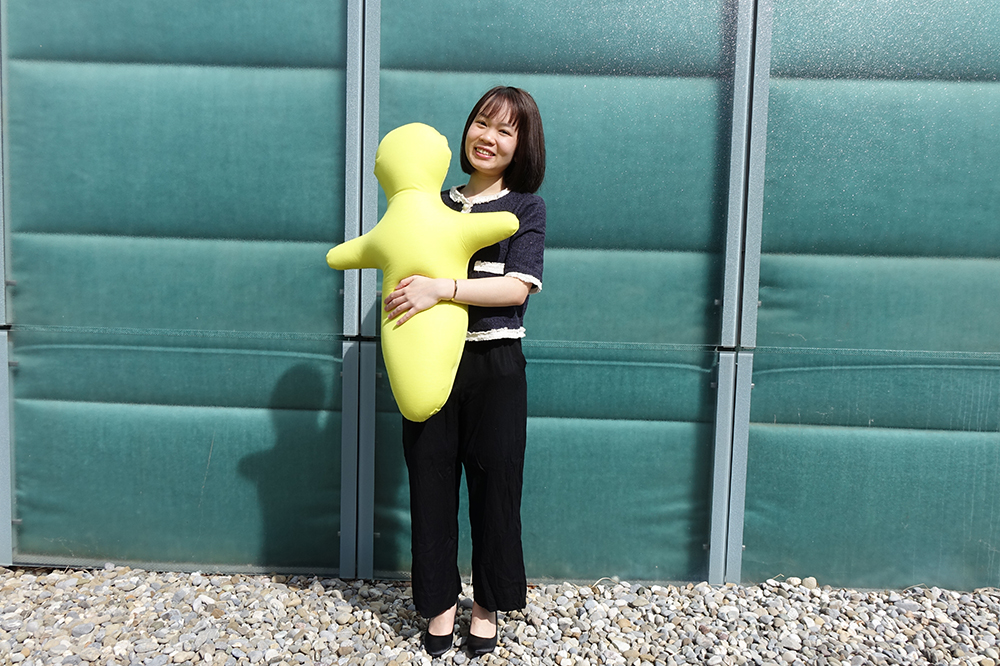
Simple, soft shapes are everywhere. In our home environment you can find pillows, blankets, balls, bottles, clothes, etc. Robots are often expensive and complex. But couldn’t they be thought of in a completely different way? How could social robots emerge from simple, soft shapes? As part of their final thesis at the School of Business FHNW, Nhi Tran Hoang Yen and Thang Hoang Vu from Ho Chi Minh City have answered this question posed by their supervisor Prof. Oliver Bendel. They have submitted eleven proposals for novel robots. All are shown on informationsethik.net. The seventh proposal is Sylvie. The normal Hugvie is a communication and hugging device, whereby the communication is not with it, but with friends, partners and family members. Sylvie is a variant of it. You talk directly to her, and when you hug her, you mean her, not a human being. And there’s another difference: while in the classic Hugvie the smartphone is invisibly housed in a pocket on the head, in Sylvie it forms part of the face. A video is available here.

The Idea of a Tesla Bot

Elon Musk presented the idea of a humanoid robot that – according to Manager Magazin – could take on dangerous, repetitive or boring tasks in the future. The Tesla Bot will be about five feet eight inches (just under 1.73 meters) tall, weigh 57 kilograms, and be able to do numerous jobs, from putting screws on cars to picking up groceries at the store – this is what the German magazine reports. It will be equipped with eight cameras and a full self-driving computer, and will use the same tools Tesla uses in its cars (Manager Magazin, 20 August 2021). According to the announcement, the robot will be able to take over physical work. But that’s exactly what service robots are struggling with at the moment, especially humanoid models. The visualization hardly allows any conclusions to be drawn about the capabilities of the prototype, which is to be available as early as 2022. Eyes and mouths could appear on a large display in the head area and mimic abilities could be implemented. When it is turned off – as seen in the video – the robot appears creepy and unapproachable. Arms and feet are unlikely to be suitable for carrying the body in this form. Joints can also only be seen in rudimentary form. Overall, it is unclear why Tesla, of all companies, should close the gaps that are still present at Sony, SoftBank and Boston Dynamics even after many years.

Don’t Scan Our Phones

The U.S. civil liberties organization Electronic Frontier Foundation has launched a petition titled “Don’t Scan Our Phones”. The background is Apple’s plan to search users’ phones for photos that show child abuse or are the result of child abuse. In doing so, the company is going even further than Microsoft, which scours the cloud for such material. On its website, the organization writes: “Apple has abandoned its once-famous commitment to security and privacy. The next version of iOS will contain software that scans users’ photos and messages. Under pressure from U.S. law enforcement, Apple has put a backdoor into their encryption system. Sign our petition and tell Apple to stop its plan to scan our phones. Users need to speak up say this violation of our privacy is wrong.” (Website Electronic Frontier Foundation) More information via act.eff.org/action/tell-apple-don-t-scan-our-phones.

Conversational Agent as Trustworthy Autonomous System

The Dagstuhl seminar “Conversational Agent as Trustworthy Autonomous System (Trust-CA)” will take place from September 19 – 24, 2021. According to the website, Schloss Dagstuhl – Leibniz-Zentrum für Informatik “pursues its mission of furthering world class research in computer science by facilitating communication and interaction between researchers”. Organizers of this event are Asbjørn Følstad (SINTEF – Oslo), Jonathan Grudin (Microsoft – Redmond), Effie Lai-Chong Law (University of Leicester) and Björn Schuller (University of Augsburg). They outline the background as follows: “CA, like many other AI/ML-infused autonomous systems, need to gain the trust of their users in order to be deployed effectively. Nevertheless, in the first place, we need to ensure that such systems are trustworthy. Persuading users to trust a non-trustworthy CA is grossly unethical. Conversely, failing to convince users to trust a trustworthy CA that is beneficial to their wellbeing can be detrimental, given that a lack of trust leads to low adoption or total rejection of a system. A deep understanding of how trust is initially built and evolved in human-human interaction (HHI) can shed light on the trust journey in human-automation interaction (HAI). This calls forth a multidisciplinary analytical framework, which is lacking but much needed for informing the design of trustworthy autonomous systems like CA.” (Website Dagstuhl) Regarding the goal of the workshop, the organizers write: “The overall goal of this Dagstuhl Seminar is to bring together researchers and practitioners, who are currently engaged in diverse communities related to Conversational Agent (CA) to explore the three main challenges on maximising the trustworthiness of and trust in CA as AI/ML-driven autonomous systems – an issue deemed increasingly significant given the widespread uses of CA in every sector of life – and to chart a roadmap for the future research on CA.” (Website Dagstuhl) Oliver Bendel (School of Business FHNW) will talk about his chatbot and voice assistant projects. These emerge since 2013 from machine ethics and social robotics. Further information is available here (photo: Schloss Dagstuhl).