The goal of the First Geriatronics Summit is to highlight current and planned robotics solutions in the context of geriatronics and to raise awareness of the relevant technologies among policymakers. According to its website, the event, which will take place on June 20 and 21, 2022, in Garmisch-Partenkirchen (Germany), aims to answer the following questions: 1. How can geriatronics be used to address the growing shortage and geographic disparities in caregivers and overburdened healthcare? 2. How can robotics and AI promote independence, mobility, self-determination and health for older people for as long as possible? 3. What are the rules of autonomy and how can moral, ethical, cultural, and personal challenges and dilemmas be addressed for geriatrics? Invited scientists are Prof. Dr.-Ing. Tamim Asfour (KIT Karlsruhe), Dr. Sylvain Calinon (EPFL), Dr. Tadej Petrič (Jožef Stefan Institute), Dr. Matteo Laffranchi (Italian Institute of Technology – IIT), Prof. Adriana Tapus (Institut Polytechnique de Paris), Prof. Jim Tørresen (University of Oslo), Prof. Dr.- Ing. Sami Haddadin (TUM), Prof. Dr. med. Alena M. Buyx (TUM), Prof. Dr. oec. Oliver Bendel (Hochschule für Wirtschaft FHNW), Prof. Dr. Christian Djeffal (TUM), Prof. Vera Lúcia Raposo (University of Coimbra), Prof. Dr. Lee Bygrave (University of Oslo), and Prof. Dr. Martin Ebers (Humboldt-Universität zu Berlin/University of Tartu). The event is supported by the Munich Institute of Robotics and Machine Intelligence (MIRMI) of the Technical University of Munich (TUM) and the Volkswagen Foundation, among others.
No More Drone Transports over Lake Zurich?
Swiss Post and PostBus are pioneers in the operation of robotic vehicles, robots, and drones. Swiss Post now reports the withdrawal from an project in which drones were used to transport laboratory samples: “Swiss Post drones have flown across various Swiss cities as a service for hospitals since 2017. After five years of pioneering work, the company has now decided to hand over its drone project to the Californian drone systems developer Matternet. Although the autonomous drones have attracted global interest, the current regulatory environment for unmanned aerial vehicles in Switzerland means Swiss Post is unable to use the drones widely enough or operate them at a profit. With its new strategy, the company is focusing on logistics solutions in its core business and on continuing to finance the public service for Switzerland using its own resources. This strategic decision is a logical step as part of its strategy.” (Media release Swiss Post, June 1, 2022) There were repeated problems within the project. For example, a drone once crashed into Lake Zurich. Nevertheless, the approach was generally considered innovative. It will be interesting to see whether the drone transports will be resumed one day.
The ABBAtars in London
ABBA are currently performing in London – but the four band members are being represented by their avatars. The ABBAtars, as they are called, appear very perfect. They have the facial expressions, gestures, and movements of the originals. Knowing how they look today, you think they fell into the fountain of youth. They look like they did in the ’70s. You see every detail of the faces, bodies, and suits and dresses. And they appear three-dimensional. You could call them quasi- or pseudo-holograms. The band has been performing their songs for weeks. Systems captured their movements when they danced and their emotions when they sang. Most of all, motion capture was used. The four wore special full-body suits with markers attached to them. In addition, facial expressions were recorded, mainly to be able to show emotions. 160 cameras filmed Agnetha, Björn, Anni-Frid, and Benny from all sides. The faces were then digitally rejuvenated – and apparently also the bodies. ABBA is probably writing cultural history with this project. The avatars and their movements are unusually perfect. In addition, there are real people, a live band playing with the four ABBAtars. The show is very elaborate. It is a new business model – in principle, you can give several concerts a day, 365 days a year. At least if you leave out the live band. On Deutschlandfunk Kultur, early in the morning of May 27, 2022, moderator Dieter Kassel spoke with Prof. Dr. Oliver Bendel about the ABBA show Voyage in London and the ABBAtars. Oliver Bendel published the chapter “Hologram Girl” in the 2019 Springer book “AI Love You“.
Hold a Video Call Naked Without Trouble
A software developer has created a tool that retouches pants on lower body to protect from embarrassing situations. He presents his solution in his video channel Everything Is Hacked on YouTube, under the title “I made a Zoom filter to add pants when you forget to wear them”. Under the video the software developer writes: “Using Python, OpenCV, MediaPipe, and pyvirtualcam to create a Zoom (or Teams or Hangouts or whatever) video filter to blur out your lower half or add customizable pants. This should work on any platform + video call app, as well as on recordings.” (Everything Is Hacked, May 10, 2022) You can watch the video here. The code is available at https://github.com/everythingishacked/Pants …
A Robot Among Penguins
British Filmmaker John Downer has created artificial monkeys, wolves, hippos, turtles, alligators, etc., to observe appropriate wildlife and obtain spectacular images. His well-known robots are very intricately designed and resemble the animals they mimic in almost every detail. It is not necessary to resort to such technically elaborate and artistically demanding means for all species. USA Today reports in a recent article about a robot called ECHO. “ECHO is a remote-controlled ground robot that silently spies on the emperor penguin colony in Atka Bay. The robot is being monitored by the Single Penguin Observation and Tracking observatory. Both the SPOT observatory, which is also remote-operated through a satellite link, and the ECHO robot capture photographs and videos of animal population in the Arctic.” (USA Today, May 6, 2022) ECHO does not resemble a penguin in any way. It is a yellow vehicle with four thick wheels. But as a video shows, the animals seem to have gotten used to it. It comes very close to them without scaring them. Wildlife monitoring using robots is becoming increasingly important, and obviously very different types are being considered.
A New Language AI
“Meta’s AI lab has created a massive new language model that shares both the remarkable abilities and the harmful flaws of OpenAI’s pioneering neural network GPT-3. And in an unprecedented move for Big Tech, it is giving it away to researchers – together with details about how it was built and trained.” (MIT Technology Review, May 3, 2022) This was reported by MIT Technology Review on May 3, 2022. GPT-3 (Generative Pre-trained Transformer 3) is an autoregressive language model that uses deep learning to generate natural language. Not only web-based systems, but also voice assistants and social robots can be equipped with it. Amazing texts emerge, and long meaningful conversations are possible – almost like between two real people. “Meta’s move is the first time that a fully trained large language model will be made available to any researcher who wants to study it. The news has been welcomed by many concerned about the way this powerful technology is being built by small teams behind closed doors.” (MIT Technology Review, May 3, 2022)
Robots and Cops
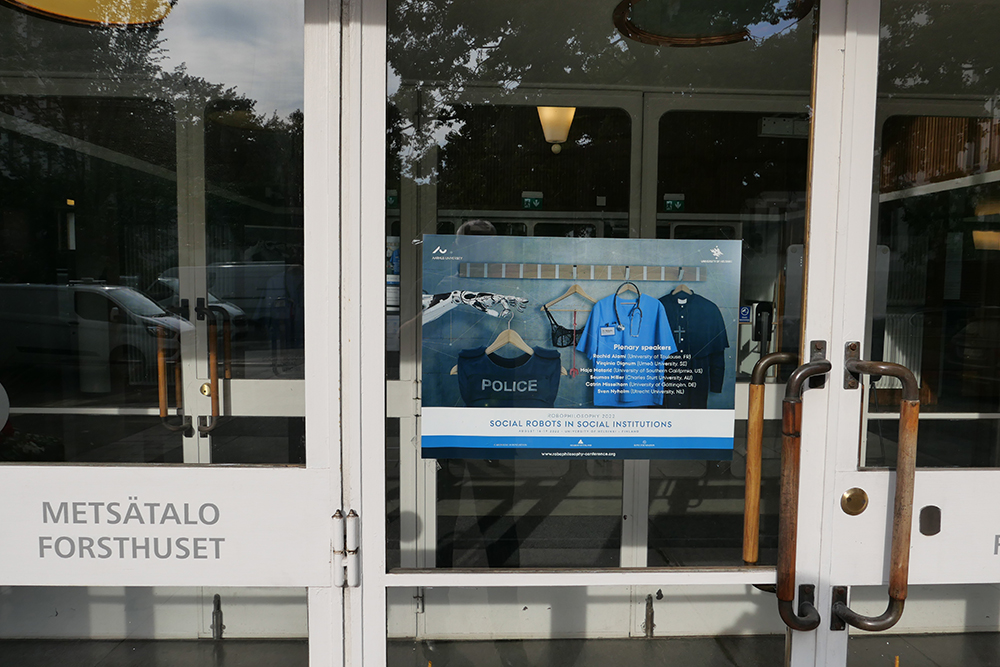
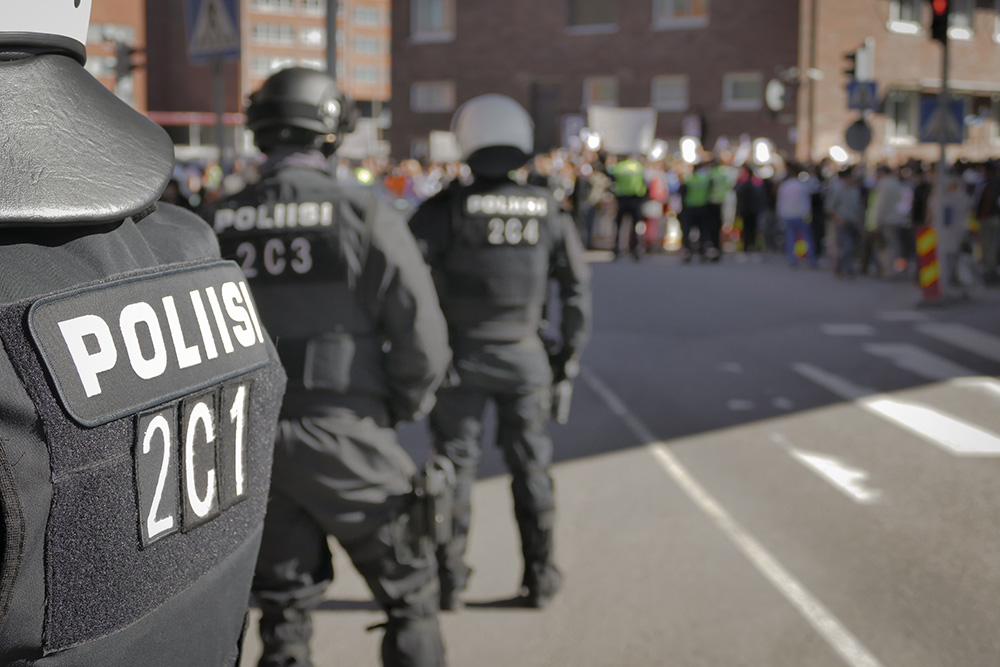
Robophilosophy 2022 is the fifth event in the biennial Robophilosophy Conference Series. It “will explore the societal significance of social robots for the future of social institutions with its usual broad scope, embracing both theoretical and practical angles” (CfP Robophilosophy). It “is an invitation to philosophers and other SSH researchers, as well as researchers in social robotics and HRI, to investigate from interdisciplinarily informed perspectives whether and how social robotics as an interdisciplinary endeavour can contribute to the ability of our institutions to perform their functions in society” (CfP Robophilosophy). Social institutions include retirement and nursing homes, strip clubs and brothels, monasteries and seminaries, and police departments. As announced by the organizers on April 15, Oliver Bendel (School of Business FHNW) will have the opportunity to present his paper entitled “Robots in Policing” at the conference. It is about how service robots and social robots are changing policing as “social work”. In addition, a poster by Katharina Kühne and Melinda Mende (University of Potsdam) as well als Oliver Bendel entitled “Tamagotchi on our couch: Are social robots perceived as pets?” was accepted.
The Revival of Pepper
United Robotics is taking over “the European robotics branch” (Handelsblatt, April 12, 2022, own translation) of SoftBank, according to a report in the Handelsblatt, with the aim of reviving the Pepper social robot, among other things (Photo: Daimler and Benz Foundation). The Japanese company announced the year before last that it would forgo further development and production of its flagship product and focus on service robots. NAO and Pepper originally came from the French company Aldebaran, which was then acquired by SoftBank. Amazing things now seem to be happening under the umbrella of the RAG Foundation. The intention is to “form a European robotics champion” (Handelsblatt, April 12, 2022, own translation), as Thomas Hahn of the Automation and Robotics division is quoted. Formally, the acquisition of SoftBank’s European robotics business is a merger. “The Japanese will contribute their division to United Robotics Group and receive a 24.9 percent stake in return.” (Handelsblatt, April 12, 2022, own translation)
Transport Robots on the Streets of LA
Hundreds of transport robots are on the streets of Los Angeles for Coco, an American food delivery company. According to them, they cover all major neighborhoods in the city and save considerable time and money. As Engadget reports, Coco has now expanded beyond its home base. It says the service is already available in Austin, and will also be available in Dallas, Houston, and Miami in the future. The vehicles are controlled remotely by employees, from their own homes. Other providers, however, are focusing on autonomous mobility. Oliver Bendel was able to see for himself on site in Santa Monica at the beginning of April 2022 that the transport robots manufactured by Segway drive along the sidewalks and cross the streets in compliance with the rules. Still, he considers them – like the Starship Technologies devices that Swiss Post has experimented with – to be tripping hazards. In metropolitan areas like Los Angeles, moreover, vandalism is likely to be a problem. Still, delivery seems to work on the whole (Photo: Coco).
Best Presentation Awards at AAAI 2022 Spring Symposium
The AAAI 2022 Spring Symposium “How Fair is Fair? Achieving Wellbeing AI” was held March 21-23, 2022 at Stanford University. In the Best Presentation Awards, Oliver Bendel and Liliana Alves took 3rd place (“Should Social Robots in Retail Manipulate”), and Martin Spathelf and Oliver Bendel took 2nd place (“The SPACE THEA Project”). In 1st place was Hiroaki Hamada (“AI agents for facilitating social interactions and wellbeing”). Oliver Bendel had won first place at the AAAI 2019 Spring Symposium “Interpretable AI for Well-Being: Understanding Cognitive Bias and Social Embeddedness” with his paper “Are Robot Tax, Basic Income or Basic Property Solutions to the Social Problems of Automation?”, along with two other researchers and their teams. Both symposia – from 2019 and from 2022 – were hosted by Takashi Kido and Keiki Takadama from Japan. They are among the pioneers in the field of Responsible AI.