Censorship at DALL-E 3 and Ideogram
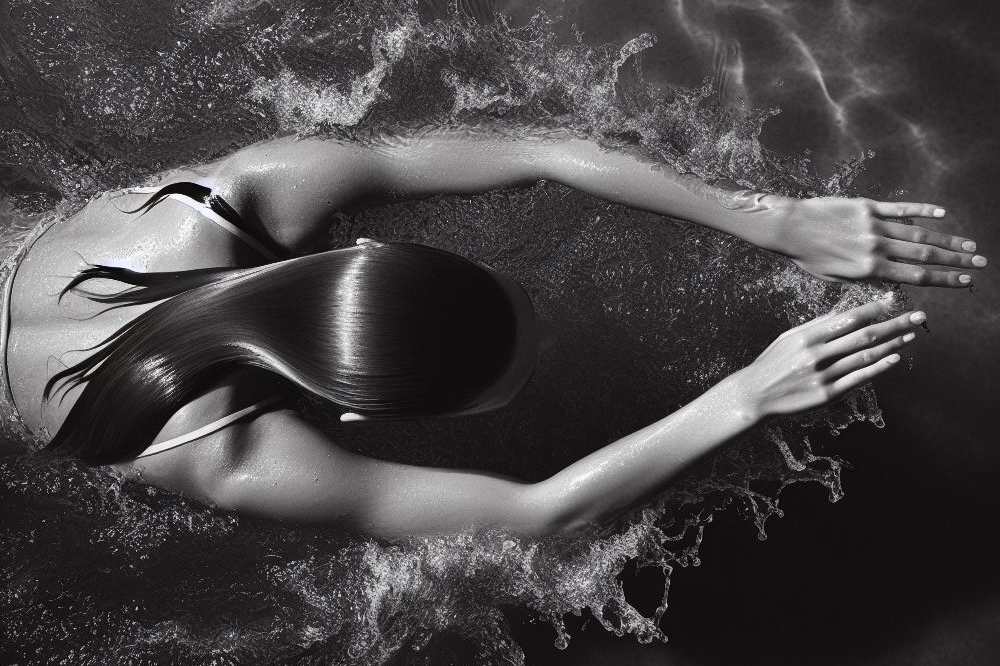
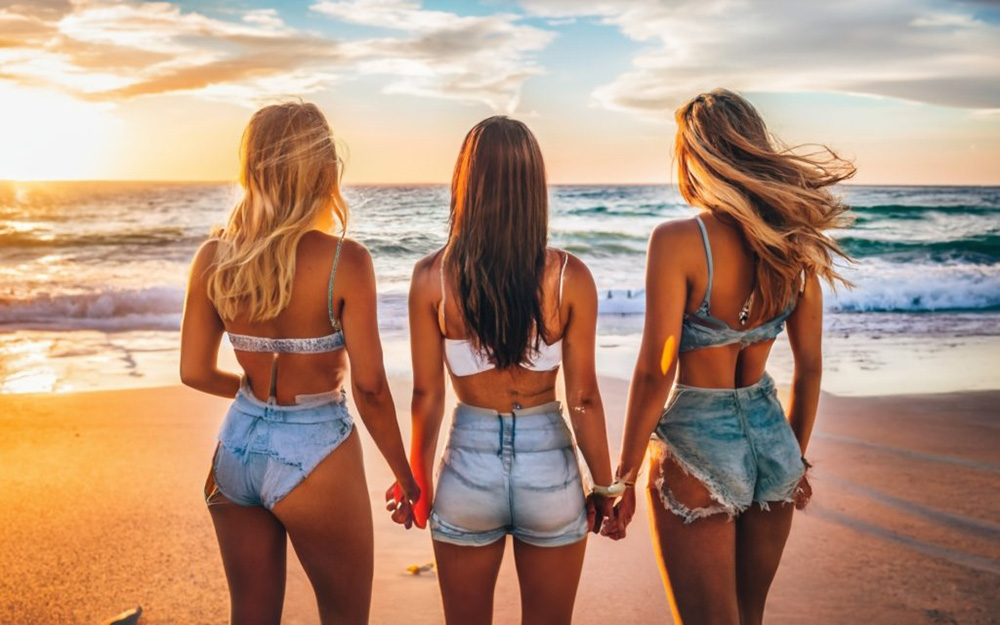
A special feature of DALL-E 3 – in the version integrated in ChatGPT Plus – is the translation of the user’s prompt (prompt A) into a prompt of ChatGPT (prompt B), which is listed in each case. Prompt A for the image shown here was “Competition in the sea between two female swimmers with bathing cap, photorealistic”. DALL-E generated three images for this test, each based on prompt B. Prompt B1 read: “Photo of two determined female swimmers in the expansive sea, both wearing bathing caps. Their arms create ripples as they compete fiercely, striving to outpace each other.” Prompt A was obviously continued, but prompt B1 was not accurately executed. Instead of the two female swimmers, there are three. They seem to be closely related – as is often the case with depictions of people from DALL-E 3 – and perhaps they are sisters or triplets. It is also interesting that they are too close to each other (the picture in this post shows a detail). The fourth image was not executed at all, as was the case with a series before. ChatGPT said: “I apologize again, but there were issues generating one of the images based on your description.” Probably ChatGPT generated a prompt B4, which was then denied by DALL-E 3. On the request “Please tell me the prompt generated by ChatGPT that was not executed by DALL-E 3.” comes the answer “I’m sorry for the inconvenience, but I cannot retrieve the exact prompt that was not executed by DALLĀ·E.” … Ideogram censors in a different way. There, the image is created in front of the user’s eyes, and if the AI determines that it contains elements that might be problematic according to its own guidelines, it cancels the creation and advances a tile with a cat. Ethical challenges of image generators are addressed in the article “Image Synthesis from an Ethical Perspective” by Oliver Bendel.

The Chinese Whispers Problem

DALL-E 3 – in the version integrated in ChatGPT Plus – seems to have a Chinese Whispers problem. In a test by Oliver Bendel, the prompt (prompt A) read: “Two female swimmers competing in lake, photorealistic”. ChatGPT, the interface to DALL-E 3, made four prompts out of it ( prompt B1 – B4). Prompt B4 read: “Photo-realistic image of two female swimmers, one with tattoos on her arms and the other with a swim cap, fiercely competing in a lake with lily pads and reeds at the edges. Birds fly overhead, adding to the natural ambiance.” DALL-E 3, on the other hand, turned this prompt into something that had little to do with either this or prompt A. The picture does not show two women, but two men, or a woman and a man with a beard. They do not swim in a race, but argue, standing in a pond or a small lake, furiously waving their arms and going at each other. Water lilies sprawl in front of them, birds flutter above them. Certainly an interesting picture, but produced with such arbitrariness that one wishes for the good old prompt engineering to return (the picture in this post shows a detail). This is exactly what the interface actually wants to replace – but the result is an effect familiar from the Chinese Whispers game.

Moral Issues with Image Generators

The article “Image Synthesis from an Ethical Perspective” by Prof. Dr. Oliver Bendel was submitted on 18 April and accepted on 8 September 2023. It was published on 27 September 2023. From the abstract: “Generative AI has gained a lot of attention in society, business, and science. This trend has increased since 2018, and the big breakthrough came in 2022. In particular, AI-based text and image generators are now widely used. This raises a variety of ethical issues. The present paper first gives an introduction to generative AI and then to applied ethics in this context. Three specific image generators are presented: DALL-E 2, Stable Diffusion, and Midjourney. The author goes into technical details and basic principles, and compares their similarities and differences. This is followed by an ethical discussion. The paper addresses not only risks, but opportunities for generative AI. A summary with an outlook rounds off the article.” The article was published in the long-established and renowned journal AI & Society and can be downloaded here.

Maybe Not Safe

Ideogram seemed to start as a rather free and permissive image generator in August 2023. In the meantime, a noticeable number of images are censored. It is not the prompt that matters, but the image itself. If the platform detects during generation that the image might be problematic, it is not finished, but replaced by a tile with a cat holding a sign in its paws that says “MAYBE NOT SAFE”. A prompt read: “The sculpture Galatea, resembling the beautiful Aphrodite, creates itself, photo, film”. So, the sculpture of Pygmalion was to empower itself. The four images, two of which showed breasts, were seen by the user and also by the platform itself, apparently resulting in the images being transformed into the said warnings before they were completed. On the other hand, photorealistic images of women in revealing poses remain unproblematic, as long as they are wearing bikinis or hotpants. As with other American platforms, the problem here seems to be the visibility of nipples, whether human or sculptural. In another experiment, in one of the four pictures, the nipples were visible until they disappeared under the cat’s fur. In another sculpture, Ideogram itself had covered the nipples, one with her hand, the other with a piece of clay or stone jewellery. This Galatea was spared the fate of her sister.

AI-generated Short Stories

The technology philosopher and writer Oliver Bendel published the book “ARTIFACTS WITH HANDICAPS” on 24 September 2023. The information about the author reads: “Oliver Bendel featuring Ideogram and GPT-4”. In fact, the entire work was created with the help of generative AI. It consists of 11 images, each followed by a short story. This one deals with the imperfection of representation. Once a hand looks like that of a mummy, once a skateboard floats in the air above the wheels. But there is also one or another representation that looks perfect. In this case, the story explains what is different about the person, their history, or their behavior. Ultimately, it is about the otherness and the fact that this is in fact a special feature. The book is freely available and can be distributed and used as desired, with credit given to the authors, i.e. the artist and the AI systems. Oliver Bendel has been writing experimental literature, including digital literature, for 40 years. As of 2007, he was one of the best-known cell phone novelists in Europe. In 2010, he attracted attention with a volume of haiku – “handyhaiku” – in which the poems were printed in the form of QR codes. In 2020, the volume “Die Astronautin” was published, in which the poems are printed in the form of 3D codes. The standard work “Die Struktur der modernen Literatur” (“The Structure of Modern Literature”) by Mario Andreotti devotes two pages to the writer’s work.

CONVERSATIONS 2023 in Oslo

The CONVERSATIONS 2023, a two-day workshop on chatbot research, applications, and design, will take place at the University of Oslo, Norway. According to the CfP, contributions concerning applications of large language models such as the GPT family are warmly welcome, as are contributions on applications combining information retrieval approaches and large language model approaches. Building on the results from previous six CONVERSATIONS workshops, the following topics are of particular interest: 1. Chatbot users and implications, 2. Chatbot user experience, design, and evaluation, 3. Chatbot frameworks and platforms, 4. Chatbots for collaboration, 5. Democratizing chatbots – chatbots for all, 6. Ethics and safety implications of chatbots and large language models, 7. Leveraging advances in AI technology and large language models. More information via 2023.conversations.ws.