The HUGGIE Project

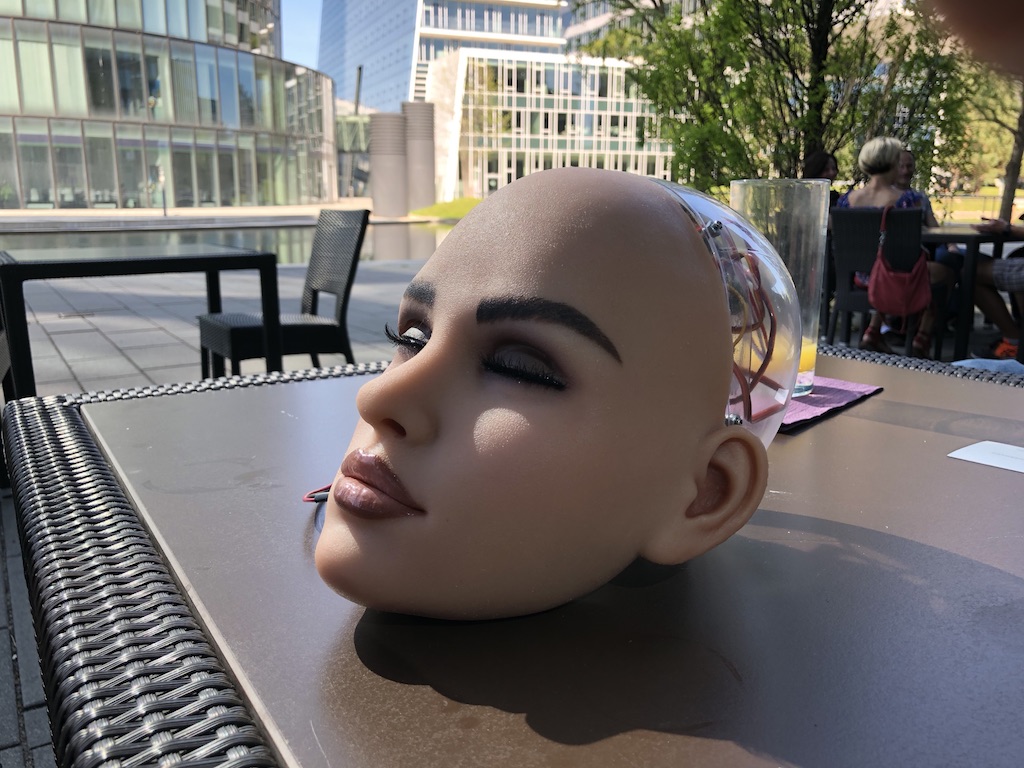
The first phase of the HUGGIE project will start at the School of Business FHNW in March 2020. Oliver Bendel was able to recruit two students from the International Management program. The project idea is to create a social robot that contributes directly to a good life and economic success by touching and hugging people and especially customers. HUGGIE should be able to warm up in some places, and it should be possible to change the materials it is covered with. A research question will be: What are the possibilities besides warmth and softness? Are optical stimuli (also on displays), vibrations, noises, voices etc. important for a successful hug? HUGGIE could also play a role in crises and disasters, in epidemics and pandemics and in cases of permanent social distancing. Of course it would be bad if only a robot would hug us, and of course it would be good if humans could hug us every day if we wanted them to do so – but maybe in extreme situations a hug by a robot is better than nothing. The HUGGIE project is located in the heart of social robotics and on the periphery of machine ethics. It is inspired by the work of Ishiguro, but especially by the research on HuggieBot. By summer 2020, the students will conduct an online survey to find out the attitudes and expectations of the users.

Cybathlon 2020 Postponed

According to a press release, ETH Zurich has decided to postpone the Cybathlon until 19 – 20 September 2020. “The decision was prompted by the uncertainty as to how the coronavirus will develop over the coming weeks, and the international dimension of the Cybathlon – over 25 of the teams that have registered come from Asia and Italy, areas badly hit by the virus.” (Press release ETHZ, 10 March 2020) During the Cybathlon in the SWISS Arena in Kloten near Zurich in 2016, athletes with disabilities competed to master everyday challenges using assistive technology. The teams came from all over the world. The audience enthusiastically joined in as the virtual race with mind control, the bicycle race with muscle stimulation and the arm prosthesis, leg prosthesis and wheelchair course took place. Since February 2020, COVID-19 has led to numerous cancellations and postponements of major events. More information via ethz.ch/en/news-and-events/eth-news/news/2020/03/cybathlon-postponed.html.

How to Use Service Robots in the Coronavirus Disease

COVID-19 demonstrates that digitization and technologization can be helpful in crises and disasters. In China, service robots deliver medicine and food in hospitals and quarantine stations, and drones track people without breathing masks. Those who has to stay at home can continue to perform their tasks and receive further training via a computer workstation and e-learning applications. Globalisation is a problem in the spread of the virus, but also a solution in combating it: research was immediately carried out worldwide on a drug against SARS-CoV-2. The use of robots and drones in China has been criticised for the loss of privacy. There was also criticism of the fact that the communist party and the media market the use of robots as a chinese success story, but that some of them originate from abroad. Well-known transport robots are, for example, from Starship Technologies and Savioke. Both companies are based in California.

Extended Deadline for RP2020

The organizers of the conference “RP2020: Culturally Sustainable Social Robotics” announced that the deadline for submission has been extended to May 1, 2020. The CfP raises questions like that: “How can we create cultural dynamics with or through social robots that will not impact our value landscape negatively? How can we develop social robotics applications that are culturally sustainable? If cultural sustainability is relative to a community, what can we expect in a global robot market? Could we design human-robot interactions in ways that will positively cultivate the values we, or people anywhere, care about?” (Website Robophilosophy Conference) In 2018 Hiroshi Ishiguro, Guy Standing, Catelijne Muller, Joanna Bryson, and Oliver Bendel had been keynote speakers of the Robophilosophy conference. In 2020, Catrin Misselhorn, Selma Sabanovic, and Shannon Vallor will be presenting. More information via conferences.au.dk/robo-philosophy/.

Will Biorobots Clean Up the Seas?

In a paper published on 13 January 2020, researchers from the University of Vermont and Tufts University discuss computer-designed, novel organisms called Xenobots. Xenobots consist of skin and muscle cells. The skin cells stabilize the organisms, the muscle cells enable them to perform different activities. A nervous system is not present. An AI system calculates the optimal structure and ratio of the cells in relation to a specific function. The Xenobots are assembled according to the resulting construction plan. In fact, the cells appear to work together. The researchers see different areas of application. One could build Xenobots that move forward in the sea and have a pocket inside in which they collect microplastics. Once the biorobots are filled, they can go to a place where they die, whereby it is not clear whether they live at all, like classical organisms. In any case, all that would remain in this place would be the plastic particles and functionless cells. Both can easily be disposed of. However, Xenobots would also be swallowed by marine animals like fishs and turtles during their work and would be exposed to other dangers. In addition, normal robots are better suited for the removal of macroplastics.

The Old, New Neons

The company Neon picks up an old concept with its Neons, namely that of avatars. Twenty years ago, Oliver Bendel distinguished between two different types in the Lexikon der Wirtschaftsinformatik. With reference to the second, he wrote: “Avatars, on the other hand, can represent any figure with certain functions. Such avatars appear on the Internet – for example as customer advisors and newsreaders – or populate the adventure worlds of computer games as game partners and opponents. They often have an anthropomorphic appearance and independent behaviour or even real characters …” (Lexikon der Wirtschaftsinformatik, 2001, own translation) It is precisely this type that the company, which is part of the Samsung Group and was founded by Pranav Mistry, is now adapting, taking advantage of today’s possibilities. “These are virtual figures that are generated entirely on the computer and are supposed to react autonomously in real time; Mistry spoke of a latency of less than 20 milliseconds.” (Heise Online, 8 January 2019, own translation) The neons are supposed to show emotions (as do some social robots that are conquering the market) and thus facilitate and strengthen bonds. “The AI-driven character is neither a language assistant a la Bixby nor an interface to the Internet. Instead, it is a friend who can speak several languages, learn new skills and connect to other services, Mistry explained at CES.” (Heise Online, 8 January 2019, own translation)

Robots against Plastic Waste

WasteShark is a remotely controlled robot by Ranmarine Technologies that collects plastics from the surface of lakes and oceans. “Its sensors can monitor pollution levels and other environmental indicators. It is electrically powered, emission-free and can collect hundreds of kilos of rubbish at a time.” (Euronews, 15 December 2019) According to Euronews, Richard Hardiman, the founder of the start-up-company, said: “What we’re trying to do is create a small enough vessel that will get into tight spaces where waste collects, particularly in the harbours and the ports, and stop all that waste being taken out into the greater ocean.” (Euronews, 15 December 2019) The project received support from the European funds allocated to making plastic circular. An overview of the most important projects against plastic waste in water can be found here.

Care Robots with Sexual Assistance Functions

In his lecture at the Orient-Institut Istanbul on 18 December 2019, Oliver Bendel dealt with care robots as well as therapy and surgery robots. He presented well-known and less known examples and clarified the goals, tasks and characteristics of these service robots in the healthcare sector. Afterwards he investigates current and future functions of care robots, including sexual assistance functions. Against this background, the lecture considered both the perspective of information ethics and machine ethics. In the end, it became clear which robot types and prototypes or products are available in healthcare, which purposes they fulfil, which functions they assume, how the healthcare system changes through their use and which implications and consequences this has for the individual and society. The lecture took place within the series “Human, medicine and society: past, present and future encounters” … The Orient-Institut Istanbul is a turkological and regional scientific research institute in the association of the Max Weber Foundation. In close cooperation with Turkish and international scientists, it dedicates itself to a multitude of different research areas. More information via www.oiist.org.

Towards Self-replicating Machines

In recent decades, there have been several attempts to supplement traditional electronic storage media. 3D codes with color as the third dimension are an interesting approach. They can be applied to paper or film, for example. Another approach has now been presented by researchers from Switzerland and Israel. They are able to generate artificial DNA and place it in any object. From the Abstract: “We devised a ‘DNA-of-things’ (DoT) storage architecture to produce materials with immutable memory. In a DoT framework, DNA molecules record the data, and these molecules are then encapsulated in nanometer silica beads, which are fused into various materials that are used to print or cast objects in any shape. First, we applied DoT to three-dimensionally print a Stanford Bunny that contained a 45 kB digital DNA blueprint for its synthesis. We synthesized five generations of the bunny, each from the memory of the previous generation without additional DNA synthesis or degradation of information. … DoT could be applied to store electronic health records in medical implants, to hide data in everyday objects (steganography) and to manufacture objects containing their own blueprint. It may also facilitate the development of self-replicating machines.” (Abstract) The approach could also be interesting for robots. They could, for example, reproduce themselves on Mars. The article with the title “A DNA-of-things storage architecture to create materials with embedded memory” has been published in NATURE BIOTECHNOLOGY and can be accessed via www.nature.com/articles/s41587-019-0356-z.epdf.

Jealousy 4.0

The international workshop “Learning from Humanoid AI: Motivational, Social & Cognitive Perspectives” took place from 30 November – 1 December 2019 at the University of Potsdam. Dr. Jessica Szczuka raised the question: “What do men and women see in sex robots?” … Her talk was based on the paper “Jealousy 4.0? An empirical study on jealousy-related discomfort of women evoked by other women and gynoid robots” by herself and Nicole Krämer. In their introduction the authors write: “In a paper discussing machine ethics, Bendel asked whether it is ‘possible to be unfaithful to the human love partner with a sex robot, and can a man or a woman be jealous because of the robot’s other love affairs?’ … In this line, the present study aims to empirically investigate whether women perceive robots as potential competitors to their relationship in the same way as they perceive other women to be so. As the degree of human-likeness of robots contributes to the similarity between female-looking robots and women, we additionally investigated differences between machine-like female-looking robots and human-like female-looking robots with respect to their ability to evoke jealousy-related discomfort.” (Paper) The paper can be accessed here.