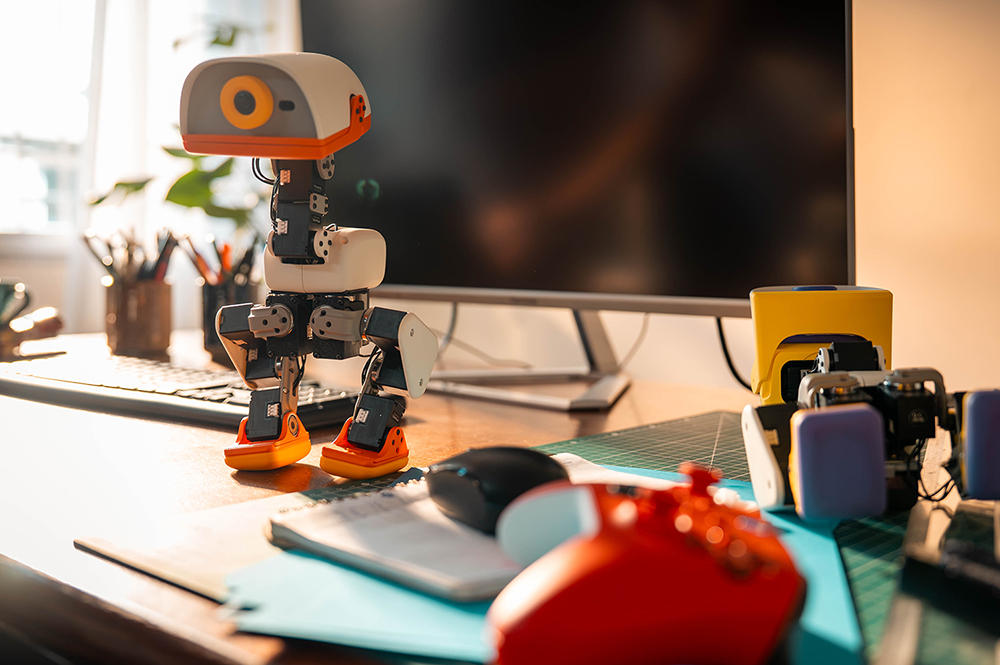
Ducks have repeatedly served as models for animal-like automata and robots, particularly in France and Japan. The European country is actually known for its cruel treatment of these animals, but it also seems to have a soft spot for them. Jacques de Vaucanson’s mechanical duck, built in 1738/1739, became famous. Born in Grenoble in 1709, the gifted engineer died in Paris in 1782. Pollen Robotics is based in Bordeaux. The company is now owned by Hugging Face, which is headquartered in Manhattan. With Microduck, it has introduced a compact robot designed as an experimental platform for physical AI and reinforcement learning. Standing around 25 centimeters tall and weighing less than 800 grams, it is comparatively small. Its hardware includes 15 motors, a camera, a LiDAR sensor, two IMUs (sensors that measure acceleration and rotational motion), microphones, and speakers. A movable beak also allows the little duck to grasp small objects. It can walk, sit down, stand up, pick up objects, and perform various movement sequences. It can even glide along on optional inline skates. After a fall, it can get back on its feet independently from a variety of positions. The main focus, however, is not so much on using Microduck as a conventional robotic toy, but rather on experimenting with a learning AI system. Movements and behaviors can first be trained in a simulation and then transferred to the physical robot. This so-called sim-to-real approach enables hands-on experimentation with reinforcement learning and robotics. Pollen Robotics provides the SDK, simulation environment, and reinforcement-learning software as open source. Microduck thus combines a comparatively accessible hardware platform with state-of-the-art methods in AI and robotics research. More information is available at pollen-robotics.com.
BY OLIVER BENDEL