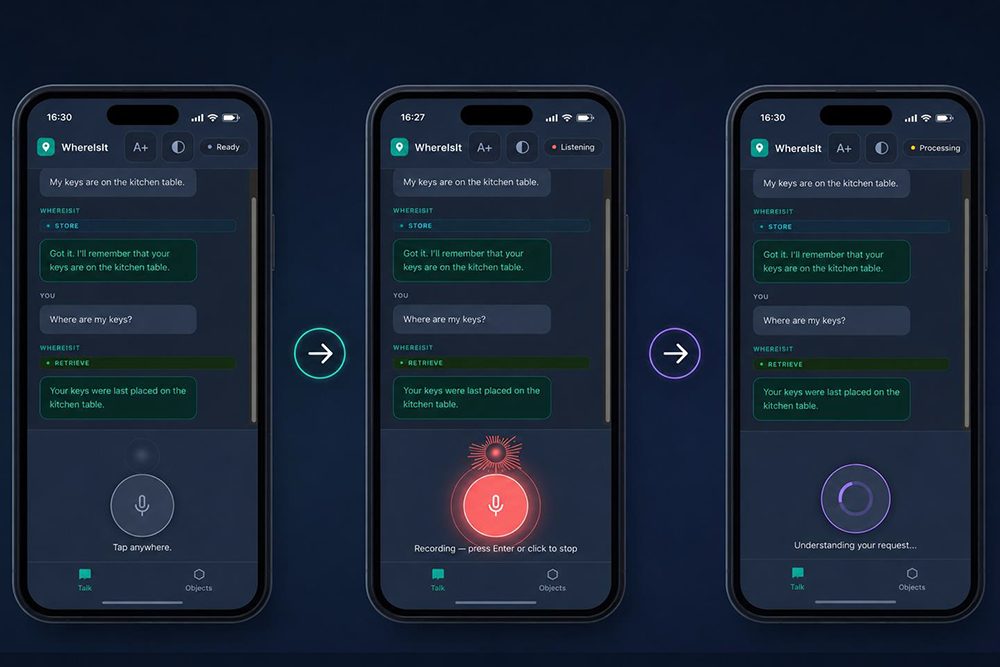
On November 6, 2026, the article “Not Searching, But Finding” by Oliver Bendel and Damian Huckele was published in Wiley Industry News. It presents the WhereIsIt project, which was conducted at the FHNW School of Business from March to August 2026. As part of a bachelor’s thesis, a voice-based assistant was developed to help blind and visually impaired people locate misplaced objects. Users can, for example, tell the system where they have placed their keys and later retrieve the stored location through a voice query. The application uses artificial intelligence (AI) for speech processing and operates entirely locally, eliminating the need to transmit personal data to external services. In initial tests involving twelve participants, 84.4 percent of the tasks were completed successfully, although some assistance was required. The results demonstrate the potential of the approach while also highlighting the need for further improvements, particularly in speech recognition, accessibility, and reliability. Real-world testing with blind users has yet to be conducted. The article places WhereIsIt within the research field of Inclusive AI and discusses not only the technical possibilities but also issues related to information ethics and data privacy. The article is available at wileyindustrynews.com/en/contributions/not-searching-but-finding.
The Perfect Companion
The 2025 American science-fiction thriller “Companion” marks Drew Hancock’s directorial debut. It has been available on Netflix since late August. The story centers on Iris (Sophie Thatcher), who spends a weekend with her boyfriend Josh (Jack Quaid) and a group of friends, only to discover that she is not human but a humanoid companion robot. The artificial humans in the film – including Iris and a male companion robot named Patrick – show no outward signs of their technological nature. Unlike in the Russian science-fiction series “Better Than Us”, there is none of the often ridiculous, forced robotic behavior in their speech, facial expressions, gestures, or movements. The film also demonstrates the realism and adaptability of synthetic voices. Iris can switch between languages – at one point, she pretends to be Spanish when speaking to a police officer – and even changes her female voice to a male one. She also attempts to clone her boyfriend’s voice to unlock another machine: an intelligent car. All of this is technologically close to reality. The film also offers a glimpse into a possible future of androids that are not merely sex robots, although that is certainly one of their primary functions. A companion of this kind truly seems to be the perfect companion (“The Perfect Companion” is the subtitle of the German version). In an interview with “Entertainment Weekly”, director Drew Hancock explained that, unlike films such as “M3GAN” or “Subservience”, his story is not about an artificial intelligence that goes out of control, but rather one that takes control of its own destiny (Photo: Cybrothel).