The ICSR is one of the leading conferences for social robotics worldwide. The 17th edition will take place from 10 to 12 September 2025 in Naples, Italy. The deadline for submissions has been extended one last time. Full papers should consist of 11 pages of body text plus references as appropriate. The most important conferences dates are: Full Paper Submission: May 9th, 2025; Full Paper Notification: June 13th, 2025; Camera-ready: June 30th, 2025; Paper Presentation Days at ICSR’25: September 11th and 12th, 2025. All dates – including the deadlines for the submission of short papers and special session papers – are listed on the website. “The conference theme, ‘Emotivation at the Core: Empowering Social Robots to Inspire and Connect,’ highlights the essential role of ‘Emotivation’ in social robotics. Emotivation captures the synergy between emotion and motivation, where emotions trigger and sustain motivation during interactions. In social robotics, this concept is key to building trust, fostering empathy, and supporting decision-making by enabling robots to respond sensitively to human emotions, inspiring engagement and action.” (Website ICSR) Participants will meet for two days at the Parthenope University of Naples and for the third day at the Città della Scienza conference center. All buildings and rooms are also listed on the website. The PDF of the CfP can be downloaded here.
Manipulated Chatbots as Munchausen Machines
In 2013, Prof. Dr. Oliver Bendel came up with the idea for his LIEBOT, also known as Lügenbot. On September 11, 2013, he published an article titled “Der Lügenbot und andere Münchhausen-Maschinen” in the magazine CyberPress. More articles and contributions followed until a prototype was implemented in 2016. Kevin Schwegler, then a student of the philosopher of technology, was responsible for this work. He developed a chatbot that transformed truthful statements into false ones using seven different strategies. In the summer of 2016, for example, LIEBOT claimed that Donald Trump was the President of the United States. To make this statement, it had used information from Yahoo in a multi-step process. The results of the project were documented in a paper titled “Towards Kant Machines” and presented in March 2017 at the AAAI Spring Symposia at Stanford University. One might argue that LIEBOT does not have intentions of its own and therefore does not lie in the strict sense. However, this intent was programmed into it. In a way, it lies on behalf of its creators. With this project, Oliver Bendel wanted to demonstrate that it is possible to build dialogue systems capable of spreading falsehoods. Today, such systems seem to be omnipresent in the form of LLMs. However, one has to look closely to discern the differences. In his book “300 Keywords Generative KI”, Oliver Bendel writes: “Hallucinating machines do not necessarily qualify as Munchausen machines in the strict sense, since there is no intent – or at least intent can hardly be proven.” Manipulated LLM-based chatbots, on the other hand, come very close to LIEBOT. ChatGPT and similar systems pursue a political agenda and exhibit an ideological tendency.
The Robodog Project
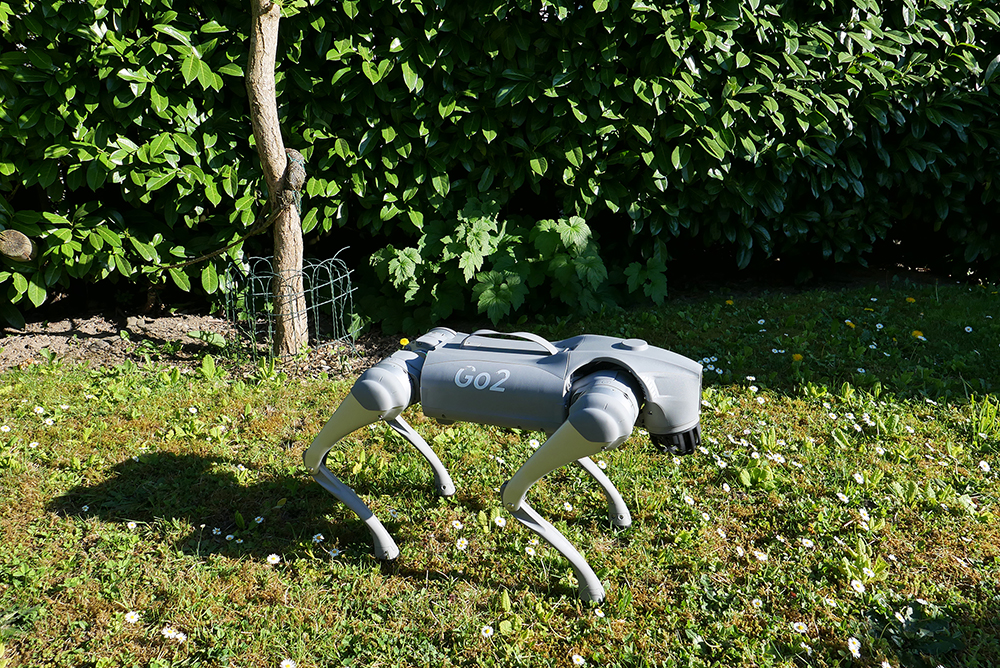
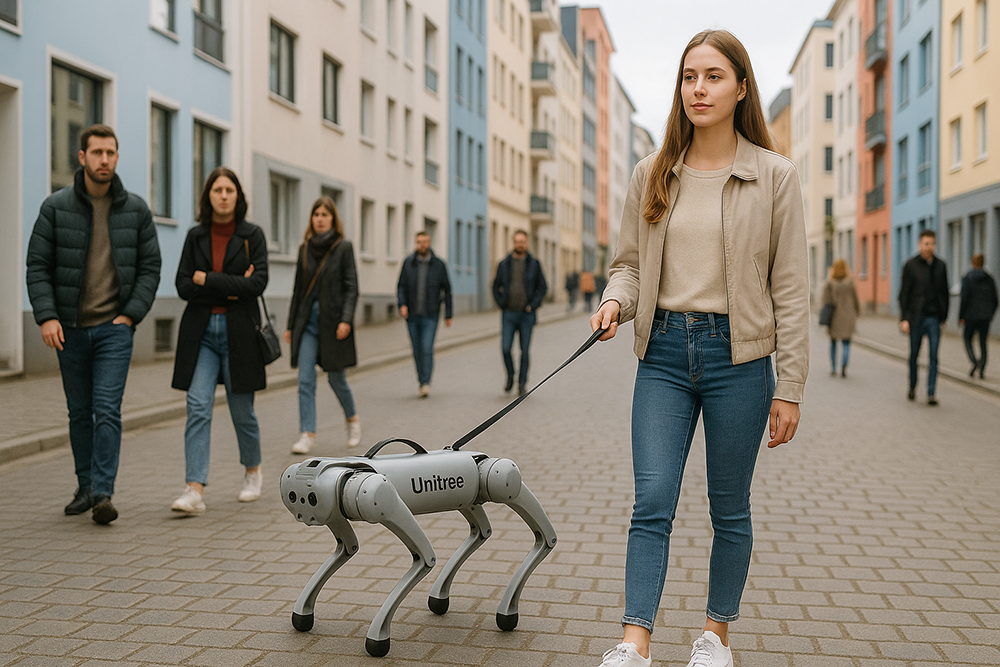
Robotic quadrupeds – often referred to as robot dogs – are becoming more and more widespread. As a result, they will increasingly encounter real dogs. The question is how to design and construct the robot in such a way that the animals do not overreact and neither robots nor animals or bystanders are harmed in any way. As part of “The Robodog Project”, smaller dogs are to be confronted with the walking, running and jumping Unitree Go2 from Prof. Dr. Oliver Bendel’s private Social Robots Lab. The plan is to visit controllable environments such as dog training grounds and arrange meetings and discussions with dog owners. The results will lead to suggestions for design and control. Robot enhancement can also play a role. For example, robot enthusiasts have used a 3D printer to produce cartoonish heads for the Unitree Go2, giving it a completely different look. The project – also known as “Bao Meets Pluto” after the pet name of the robotic four-legged friend and the Disney character – was launched at the FHNW School of Business at the end of March 2025. It is part of Oliver Bendel’s research in the field of animal-machine interaction (AMI). Selina Rohr, who is writing her Bachelor’s thesis on the topic, has been recruited as a member of the team. She met Bao at a get-together at the end of April 2025 and let it run and jump around the room.
A Martian Landscape on the Brugg-Windisch Campus
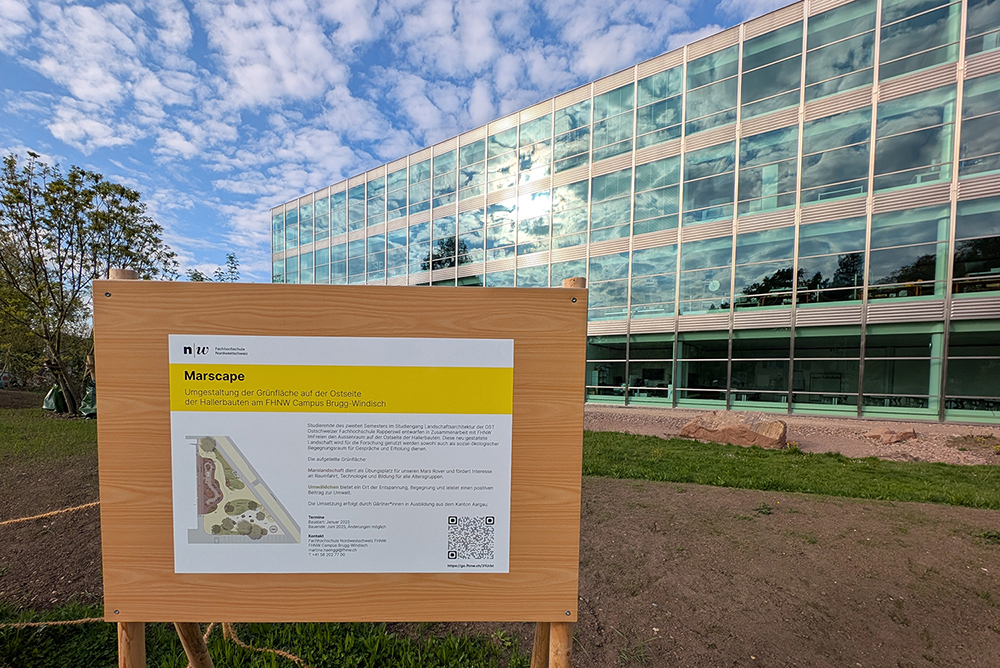
Students from the Eastern Switzerland University of Applied Sciences (Campus Rapperswil) have created a Martian landscape in front of the Hallerbau on the Brugg-Windisch campus in collaboration with the FHNW. This will serve as a training ground for the FHNW Mars rover and promote “interest in space travel and technology” (information sign on the construction site, own translation). According to the website, the FHNW rover team consists of “an interdisciplinary group of students from the School of Engineering and Environment and the School of Computer Science”. The so-called “Umwäldchen” with new plantings offers a place for relaxation and encounters and makes a “positive contribution to the environment” (information sign on the construction site). According to its website, the FHNW is “active in the development of observation instruments, components and manufacturing processes for the aerospace sector”. In addition to the aforementioned universities, the FHNW School of Business is also active in this field. In 2021, SPACE THEA was developed, a voice assistant for Mars flights, which was presented at the AAAI Spring Symposia at Stanford University in 2022 and attracted the attention of NASA. In 2025, the focus will be on social robots for Mars flights with a view to ICSR 2025.
ICSR 2025 Extends Deadline for Submission
The ICSR is one of the leading conferences for social robotics worldwide. The 17th edition will take place from 10 to 12 September 2025 in Naples, Italy. The deadline for the submission of complete entries has been extended again. Papers should consist of 11 pages of body text plus references as appropriate. The most important conferences dates are: Full Paper Submission: April 30th, 2025; Full Paper Notification: June 6th, 2025; Camera-ready: June 30th, 2025; Paper Presentation Days at ICSR’25: September 11th and 12th, 2025. All dates are also listed on the website. “The conference theme, ‘Emotivation at the Core: Empowering Social Robots to Inspire and Connect,’ highlights the essential role of ‘Emotivation’ in social robotics. Emotivation captures the synergy between emotion and motivation, where emotions trigger and sustain motivation during interactions. In social robotics, this concept is key to building trust, fostering empathy, and supporting decision-making by enabling robots to respond sensitively to human emotions, inspiring engagement and action.” (Website ICSR) Participants will meet for two days at the Parthenope University of Naples and for the third day at the Città della Scienza conference center. All buildings and rooms are also listed on the website.
Bao in Olten
From April 15 to 17, 2025, the elective module “Social Robots” once again took place at the FHNW School of Business – as it has so often since 2021. The participants were information systems students from various locations. And once again, a GPT specialized in the topic was available, namely Social Robotics Girl. Prof. Dr. Oliver Bendel repeatedly had her explain the facts and then made additions. She also asked questions to the audience and provided a few laughs with her competent and nerdy manner. The robots at the demo included Unitree Go2 (called Bao), Pepper, Alpha Mini, Booboo, Furby, Cozmo, and Aibi. With the exception of Pepper, they all come from the Social Robots Lab, which is privately funded by Prof. Dr. Oliver Bendel. Unitree Go2 was used to explore not only the seminar room on the Olten campus, but also the area in front of it. The robotic four-legged friend ran forwards and backwards, jumped, stood on its hind legs, drew a heart in the air, and impressed with various dance interludes. When designing their own social robots – the students complete this task in groups – they again worked with the five-dimensions model by Oliver Bendel and image generators.
Image Synthesis from an Ethical Perspective
The article “Image Synthesis from an Ethical Perspective” by Prof. Dr. Oliver Bendel was published as an electronic version in the journal AI & SOCIETY on September 27, 2023. It addresses the ethical implications of image generators, i.e., a specific form of generative AI. It can now also be found in the current print edition from February 2025 (Volume 40, Issue 2). From the abstract: “Generative AI has gained a lot of attention in society, business, and science. This trend has increased since 2018, and the big breakthrough came in 2022. In particular, AI-based text and image generators are now widely used. This raises a variety of ethical issues. The present paper first gives an introduction to generative AI and then to applied ethics in this context. Three specific image generators are presented: DALL-E 2, Stable Diffusion, and Midjourney. The author goes into technical details and basic principles, and compares their similarities and differences. This is followed by an ethical discussion. The paper addresses not only risks, but opportunities for generative AI. A summary with an outlook rounds off the article.” A lot has happened with image generators since 2023. The new one from OpenAI now also allows photorealistic images, and it has fewer problems with average-looking people – DALL-E 2 and 3 favored beauty over mediocrity and ugliness. The article can be downloaded from link.springer.com/article/10.1007/s00146-023-01780-4 (Image: DALL-E 3).
Revisiting the Trolley Problem for AI
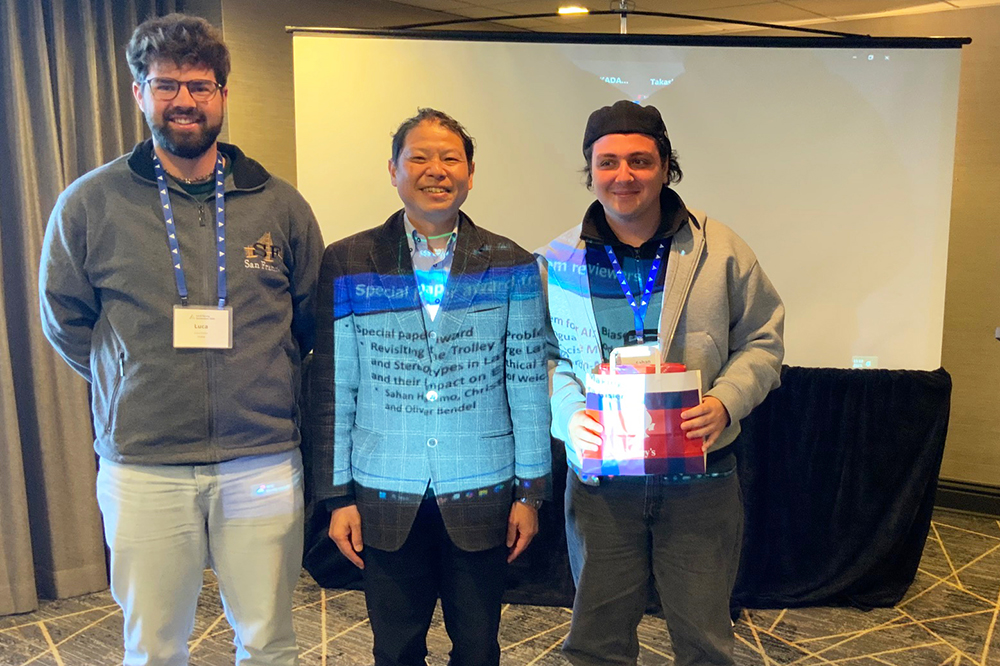
The paper “Revisiting the Trolley Problem for AI: Biases and Stereotypes in Large Language Models and their Impact on Ethical Decision-Making” by Şahan Hatemo, Christof Weickhardt, Luca Gisler, and Oliver Bendel received the Special Paper Award from the reviewers of the AAAI 2025 Spring Symposium “Human-Compatible AI for Well-being: Harnessing Potential of GenAI for AI-Powered Science”. The three bachelor students from the FHNW School of Computer Science gave their presentation on site in San Francisco as part of the AAAI 2025 Spring Symposia. Prof. Dr. Bendel from the FHNW School of Business had given them feedback on the project and placed it in the context of machine ethics. He has been involved in the well-known and popular conference, which usually takes place at Stanford University, since 2016. This time, he was keeping his fingers crossed from Italy. The proceedings of the AAAI 2025 Spring Symposia will be published shortly.
This Robot Could Spy on You
As reported by the CyberInsider platform on March 24, 2025, security experts have discovered a pre-installed, undocumented remote access tunnel in the Unitree Go1 robot dogs that enables remote control and network access. The Unitree Go1 can be found in numerous companies and universities. During their tests, the researchers were able to list all connected devices and their IP addresses and access these devices. They were also able to use the robotic quadruped’s cameras for live monitoring. The article states: “Perhaps most concerning is the implication of deliberate design. The tunnel is not merely an over-looked debug utility; it appears fully integrated into the boot process and enabled by default.” (CyberInsider, 24 March 2025) Users should immediately isolate their devices from critical internal networks, change SSH credentials, and disable the tunnel service. More information is available on the platform.
The Next Social Robots Module
The elective module “Soziale Roboter” (“Social Robots”) by Prof. Dr. Oliver Bendel will be held again from April 15 to 17, 2025 at the FHNW in Olten. It is primarily aimed at prospective information systems specialists, but prospective business economists can also take part. Dr. Amol Deshmukh has been invited as a guest speaker. He previously worked for the University of Glasgow and now conducts research at ETH Zurich. In his lecture, he will present the findings from his paper “Leveraging Social Robots to Promote Hand Hygiene: A Cross-Cultural and Socio-Economic Study of Children in Diverse School Settings”. Unitree Go2, Alpha Mini, Cozmo, Vector, Aibi, Furby and Booboo from Oliver Bendel’s private Social Robots Lab will also be on site. Social Robotics Girl, a so-called GPT who specializes in this topic, will be available as a tutor throughout the event. Basic works are “Soziale Roboter” (2021) and “300 Keywords Soziale Robotik” (2021). At the end of the elective module, students design social robots – also with the help of generative AI – that they find useful, meaningful, or simply attractive. The elective modules have been offered since 2021 and are very popular.