The paper “Should Social Robots in Retail Manipulate Customers?” by Oliver Bendel and Liliana Margarida Dos Santos Alves was accepted at the AAAI 2022 Spring Symposia (Stanford University). The two authors will present it at the end of March 2022 at the symposium “How Fair is Fair? Achieving Wellbeing AI”. From the abstract: “Against the backdrop of structural changes in the retail trade, social robots have found their way into retail stores and shopping malls in order to attract, welcome, and greet customers; to inform them, advise them, and persuade them to make a purchase. Salespeople often have a broad knowledge of their product and rely on offering competent and honest advice, whether it be on shoes, clothing, or kitchen appliances. However, some frequently use sales tricks to secure purchases. The question arises of how consulting and sales robots should ‘behave’. Should they behave like human advisors and salespeople, i.e., occasionally manipulate customers? Or should they be more honest and reliable than us? This article tries to answer these questions. After explaining the basics, it evaluates a study in this context and gives recommendations for companies that want to use consulting and sales robots. Ultimately, fair, honest, and trustworthy robots in retail are a win-win situation for all concerned.” More information about the AAAI 2022 Spring Symposia is available here.
Should we Trust Conversational Agents?
A group of about 50 scientists from all over the world worked for one week (September 19 – 24, 2021) at Schloss Dagstuhl – Leibniz-Zentrum für Informatik on the topic „Conversational Agent as Trustworthy Autonomous System (Trust-CA)“. Half were on site, the other half were connected via Zoom. Organizers of this event were Asbjørn Følstad (SINTEF – Oslo), Jonathan Grudin (Microsoft – Redmond), Effie Lai-Chong Law (University of Leicester), and Björn Schuller (University of Augsburg). On-site participants from Germany and Switzerland included Elisabeth André (University of Augsburg), Stefan Schaffer (DFKI), Sebastian Hobert (University of Göttingen), Matthias Kraus (University of Ulm), and Oliver Bendel (School of Business FHNW). The complete list of participants can be found on the Schloss Dagstuhl website, as well as some pictures. Oliver Bendel presented projects from ten years of research in machine ethics, namely GOODBOT, LIEBOT, BESTBOT, MOME, and SPACE-THEA. Further information is available here.
From Hugvie to Sylvie
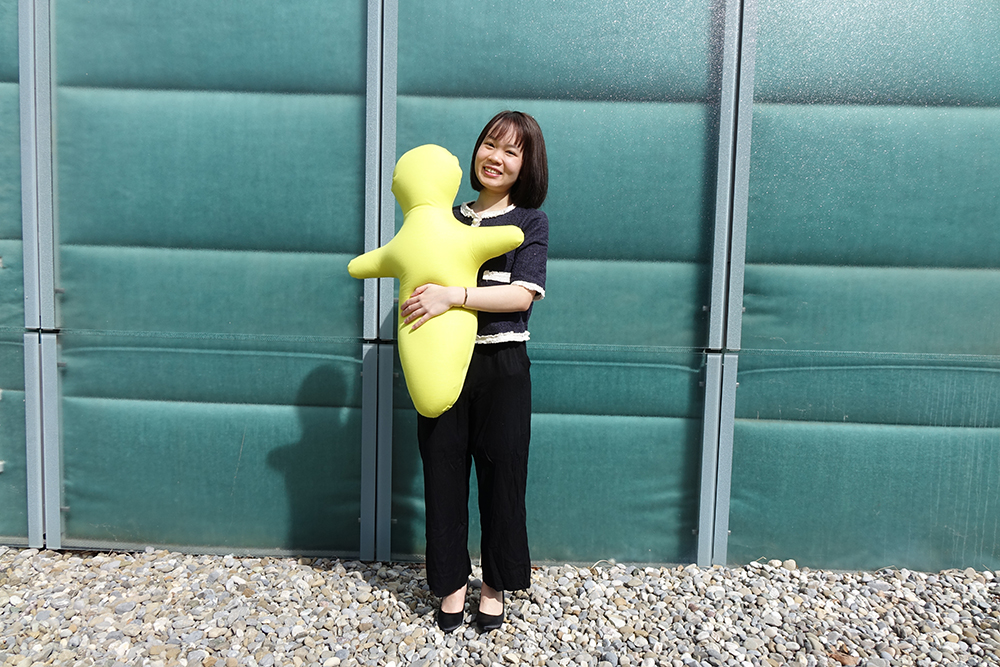
Simple, soft shapes are everywhere. In our home environment you can find pillows, blankets, balls, bottles, clothes, etc. Robots are often expensive and complex. But couldn’t they be thought of in a completely different way? How could social robots emerge from simple, soft shapes? As part of their final thesis at the School of Business FHNW, Nhi Tran Hoang Yen and Thang Hoang Vu from Ho Chi Minh City have answered this question posed by their supervisor Prof. Oliver Bendel. They have submitted eleven proposals for novel robots. All are shown on informationsethik.net. The seventh proposal is Sylvie. The normal Hugvie is a communication and hugging device, whereby the communication is not with it, but with friends, partners and family members. Sylvie is a variant of it. You talk directly to her, and when you hug her, you mean her, not a human being. And there’s another difference: while in the classic Hugvie the smartphone is invisibly housed in a pocket on the head, in Sylvie it forms part of the face. A video is available here.
Meet SPACE THEA
SPACE THEA was developd by Martin Spathelf at the School of Business FHNW from April to August 2021. The client and supervisor was Prof. Dr. Oliver Bendel. The voice assistant is supposed to show empathy and emotions towards astronauts on a Mars flight. Technically, it is based on Google Assistant and Dialogflow. The programmer chose a female voice with Canadian English. SPACE THEA’s personality includes functional and emotional intelligence, honesty, and creativity. She follows a moral principle: to maximize the benefit of the passengers of the spacecraft. The prototype was implemented for the following scenarios: conduct general conversations; help the user find a light switch; assist the astronaut when a thruster fails; greet and cheer up in the morning; fend off an insult for no reason; stand by a lonely astronaut; learn about the voice assistant. A video on the latter scenario is available here. Oliver Bendel has been researching conversational agents for 20 years. With his teams, he has developed 20 concepts and artifacts of machine ethics and social robotics since 2012.
From AIBO to CyberDog
Xiaomi has unveiled CyberDog, a four-legged robot that could be a competitor to Sony’s AIBO. According to the Chinese company, it is calibrated with servo motors that translates into great speed, agility, and a wide range of motion. It is able to conduct complicated actions such as backflips. “To fully model biological organisms, CyberDog is equipped with 11 high-precision sensors which provide instant feedback to guide its movements. This includes touch sensors, cameras, ultrasonic sensors, GPS modules, and more, giving the CyberDog enhanced capability to sense, analyze, and interact with its environment.” (Mi Blog, 10 August 2021) Unlike AIBO, CyberDog looks rather frightening. This is because it does not have an actual head. In this it is comparable to Spot from Boston Dynamics. Nevertheless, it is intended to function as a pet substitute. “To add to its pet-like nature, users can use voice assistants to command and control CyberDog by setting a wake word, or simply use its accompanying remote and smartphone app. CyberDog can be called on for the most unique tasks, and the ways in which it can be interacted with holds unforetold possibilities.” (Mi Blog, 10 August 2021) The future will show whether users want to become friends with CyberDog.
Wildlife Conservation at a Garden Level
Sophie Lund Rasmussen and her co-authors published the interesting and enlightening article “Wildlife Conservation at a Garden Level: The Effect of Robotic Lawn Mowers on European Hedgehogs (Erinaceus europaeus)” in April 2021. In their “Simple Summary” they write: “Injured European hedgehogs are frequently admitted to hedgehog rehabilitation centres with different types of cuts and injuries. Although not rigorously quantified, a growing concern is that an increasing number of cases may have been caused by robotic lawn mowers. Research indicates that European hedgehogs are in decline. It is therefore important to identify and investigate the factors responsible for this decline to improve the conservation initiatives directed at this species. Because hedgehogs are increasingly associated with human habitation, it seems likely that numerous individuals will encounter several robotic lawn mowers during their lifetimes. Consequently, this study aimed to describe and quantify the effects of robotic lawn mowers on hedgehogs, and we tested 18 robotic lawn mowers in collision with dead hedgehogs. Some models caused extensive damage to the dead hedgehogs, but there were noteworthy differences in the degree of harm inflicted, with some consistently causing no damage. None of the robotic lawn mowers tested was able to detect the presence of dead, dependent juvenile hedgehogs, and no models could detect the hedgehog cadavers without physical interaction. We therefore encourage future collaboration with the manufacturers of robotic lawn mowers to improve the safety for hedgehogs and other garden wildlife species.” (Rasmussen et al. 2021) In 2019/2020, Oliver Bendel and his team developed the prototype HAPPY HEDGHEHOG. This robot lawnmower stops working as soon as it detects hedgehogs. A thermal recognition sensor and a camera with image recognition are used. The paper was presented at the AAAI Spring Symposia in March 2021.
Good Bye, Pepper!
According to various media, SoftBank has stopped the production of Pepper last year and will not resume it for the time being – unless there would be an increased demand. The alleged low demand was the reason for the Japanese company to say goodbye to the probably best-known social robot – which often also functions as a service robot. According to Heise, a total of about 27,000 units were produced. That’s not a small number for a robot of this size, with these features and at this price. Into the million range came Cozmo, which was, however, small and cheap – Anki went bankrupt, Digital Dream Labs (the owners had secured the rights) could not revive the crowd favorite inspired by WALL-E and EVE to this day, despite many announcements. With Pepper, the reference par excellence for social robotics is missing – which may also have positive effects, insofar as other models could more easily gain attention and be brought to market at all.
Grace, the Nurse Android
Grace from Hanson Robotics is a special kind of care robot, namely a nurse android. According to the manufacturer, she was created for the COVID-19 pandemic. She is the younger sister of Sophia and Asha, but unlike them, she becomes a useful member of society thanks to her profession and skills. She has a thermal imaging camera in her chest area that she can use to measure fevers. She has mimic, gestural and natural language abilities and can show not only joy but also sadness. Overall, she always looks a little devastated. In a video, she says, “I can visit with people and brighten their day with social stimulation, entertain and help guide exercise, but also can do talk therapy, take bio readings and help health care providers assess their health, and deliver treatments” … Whether the android will gain favor with patients is hard to say. There are individual voices of male persons who long for realistic figures in this field, but the majority of people are likely to be irritated by Grace. Nevertheless, it is fascinating and media-savvy research that Hanson Robotics once again presents. Moreover, the question of whether care robots should have sexual assistance functions arises under entirely new conditions.
Towards Robot Enhancement
In an article for ICTkommunikation published on 21 May 2021 (only available in German), Oliver Bendel outlines the field of robot enhancement. Robot enhancement refers to the enhancement and associated modification or improvement of the robot by the user or a company, for example in functional, aesthetic, ethical or economic terms. Social robots are of particular interest. The article gives several examples of application: Pepper is dressed and accessorized, like REEM, a police robot used in Dubai. AIBO, a robotic dog, is covered in fur. To make a hugging robot smell, you rub it with scents. Or one covers a metal or plastic head with silicone skin or lengthens existing limbs. According to the Zurich-based scientist, a new field of work is needed so that all these measures can be carried out in a systematic and theoretically sound manner. The article entitled “Überlegungen zu Robot Enhancement” can be accessed here.
Cobots in Healthcare
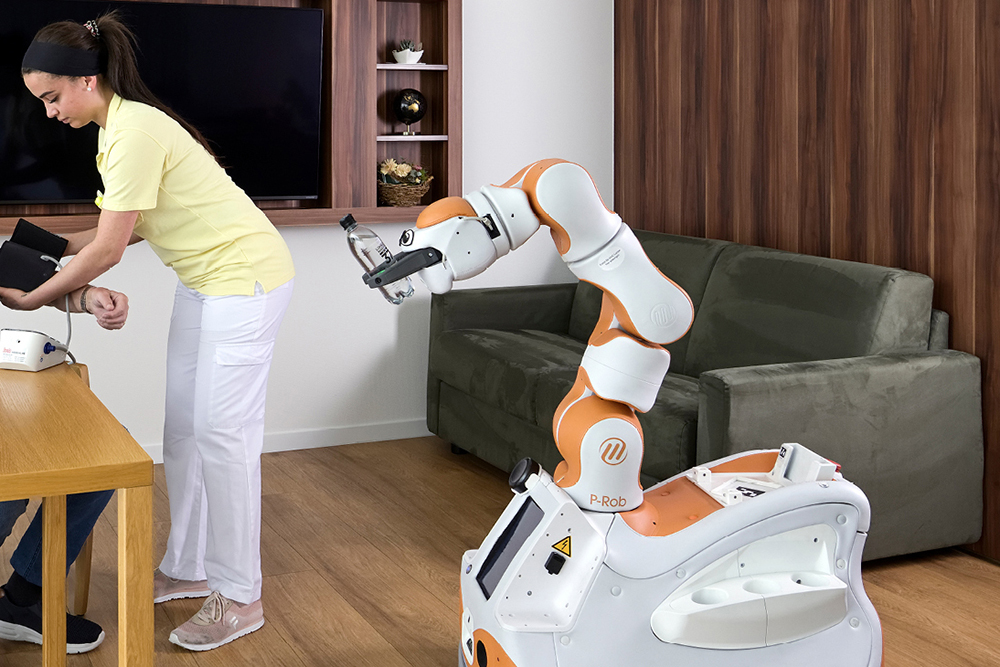
After several postponements, the symposium “Applied AI in Healthcare: Safety, Community, and the Environment” will be held within the AAAI Spring Symposia on March 22-23, 2021. One of the presentations is titled “Co-Robots as Care Robots” (co-robots are also called cobots). The authors of the paper are Oliver Bendel, Alina Gasser, and Joel Siebenmann. From the abstract: “Cooperation and collaboration robots, co-robots or cobots for short, are an integral part of factories. For example, they work closely with the fitters in the automotive sector, and everyone does what they do best. However, the novel robots are not only relevant in production and logistics, but also in the service sector, especially where proximity between them and the users is desired or unavoidable. For decades, individual solutions of a very different kind have been developed in care. Now experts are increasingly relying on co-robots and teaching them the special tasks that are involved in care or therapy. This article presents the advantages, but also the disadvantages of co-robots in care and support, and provides information with regard to human-robot interaction and communication. The article is based on a model that has already been tested in various nursing and retirement homes, namely Lio from F&P Robotics, and uses results from accompanying studies. The authors can show that co-robots are ideal for care and support in many ways. Of course, it is also important to consider a few points in order to guarantee functionality and acceptance.” More information about the AAAI Spring Symposia is available at aaai.org/Symposia/Spring/sss21.php.