15th International Conference on Social Robotics (ICSR 2023)

The International Conference on Social Robotics (ICSR 2023) is, next to Robophilosophy, the most important conference on social robotics. The deadline for paper submission is approaching. “The 15th International Conference on Social Robotics (ICSR 2023) will bring together researchers and practitioners working on the interaction between humans and intelligent robots and on the integration of social robots into our society.  ICSR 2023 will take place in Doha as a face-to-face conference on December 4-7, 2023. This will be the first time that the conference will be hosted in Qatar and in the Middle East and North Africa region.” (Website ICSR) The theme of this year’s ICSR is “Human-Robot Collaboration: Sea, Air, Land, Space and Cyberspace”. According to the organizers, the theme emphasizes on all physical and cyber-physical domains where humans and robots collaborate. Papers can be submitted until August 21, 2023. Notifications will be made by September 18 of that year. More information via icsr23.qa.

Preprint on Bar Robots

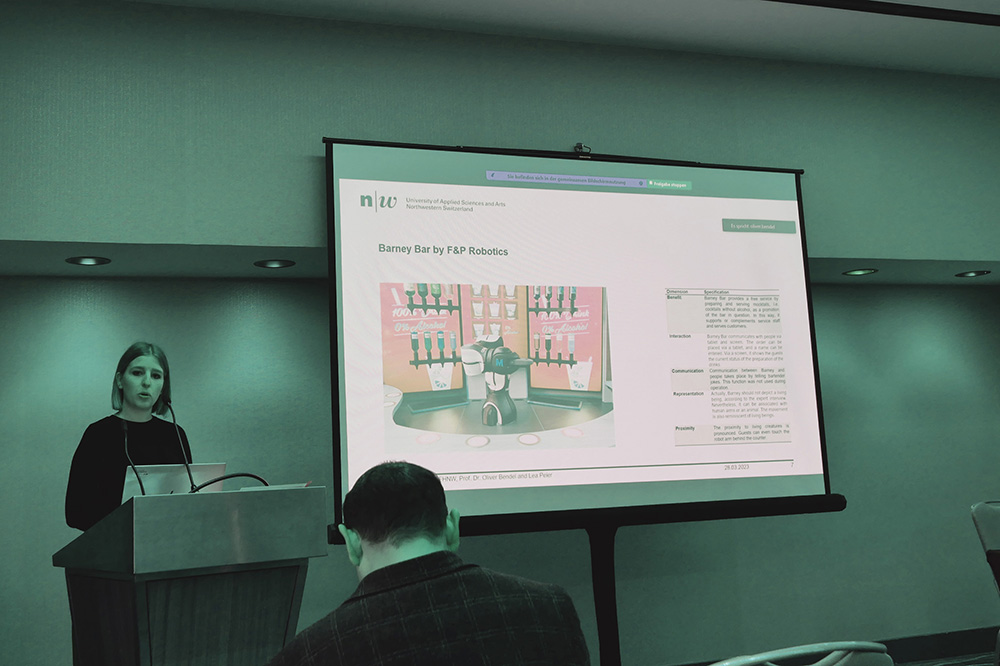
From March 27-29, 2023, the AAAI 2023 Spring Symposia featured the symposium “Socially Responsible AI for Well-being” by Takashi Kido (Teikyo University, Japan) and Keiki Takadama (The University of Electro-Communications, Japan). This time the venue was exceptionally not Stanford University, but the Hyatt Regency SFO Airport. On March 28, Prof. Dr. Oliver Bendel and Lea Peier presented their paper “How Can Bar Robots Enhance the Well-being of Guests?”. The paper has now been published as a preprint and can be downloaded via arxiv.org/abs/2304.14410. From the abstract: “This paper addresses the question of how bar robots can contribute to the well-being of guests. It first develops the basics of service robots and social robots. It gives a brief overview of which gastronomy robots are on the market. It then presents examples of bar robots and describes two models used in Switzerland. A research project at the School of Business FHNW collected empirical data on them, which is used for this article. The authors then discuss how the robots could be improved to increase the well-being of customers and guests and better address their individual wishes and requirements. Artificial intelligence can play an important role in this. Finally, ethical and social problems in the use of bar robots are discussed and possible solutions are suggested to counter these.” More information on the conference via aaai.org/conference/spring-symposia/sss23/.

Preprint on Hugging Robots

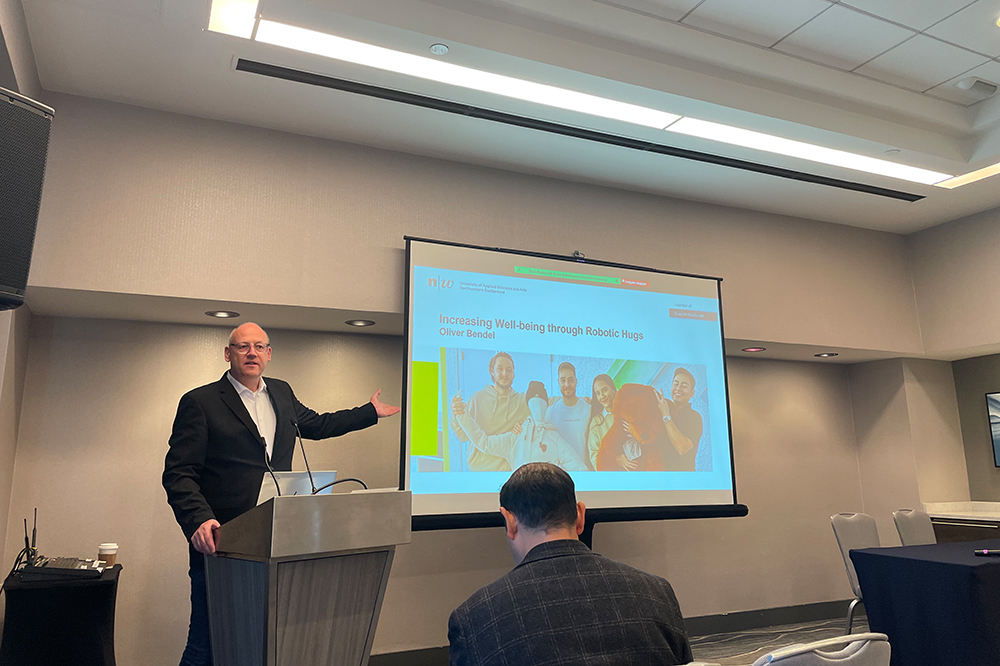
From March 27-29, 2023, the AAAI 2023 Spring Symposia featured the symposium “Socially Responsible AI for Well-being” by Takashi Kido (Teikyo University, Japan) and Keiki Takadama (The University of Electro-Communications, Japan). This time the venue was exceptionally not Stanford University, but the Hyatt Regency SFO Airport. On March 28, Prof. Dr. Oliver Bendel presented the paper “Increasing Well-being through Robotic Hugs”, written by himself, Andrea Puljic, Robin Heiz, Furkan Tömen, and Ivan De Paola. The paper has now been published as a preprint and can be downloaded via arxiv.org/abs/2304.14409. From the abstract: “This paper addresses the question of how to increase the acceptability of a robot hug and whether such a hug contributes to well-being. It combines the lead author’s own research with pioneering research by Alexis E. Block and Katherine J. Kuchenbecker. First, the basics of this area are laid out with particular attention to the work of the two scientists. The authors then present HUGGIE Project I, which largely consisted of an online survey with nearly 300 participants, followed by HUGGIE Project II, which involved building a hugging robot and testing it on 136 people. At the end, the results are linked to current research by Block and Kuchenbecker, who have equipped their hugging robot with artificial intelligence to better respond to the needs of subjects.” More information on the conference via aaai.org/conference/spring-symposia/sss23/.

A “weak” Robot

How do social robots emerge from simple, soft shapes? As part of their final thesis in 2021 at the School of Business FHNW, 23-year-old students Nhi Tran Hoang Yen and Thang Hoang Vu from Ho Chi Minh City (Vietnam) have answered this question posed by their supervisor Prof. Dr. Oliver Bendel. They have submitted eleven proposals for novel robots. The first is a pillow to which a tail has been added. Its name is Petanion, a portmanteau of “pet” and “companion”. The tail could move like the tail of a cat or dog. In addition, the pillow could make certain sounds. It would be optimal if the tail movements were based on the behavior of the user. Thus, as desired, a social robot is created from a simple, soft form, in this case a pet substitute. Petanion is soft and cute and survives a long time. It can also be used if one has certain allergies or if there is not enough space or money in a household for a pet. Last but not least, the ecological balance is probably better – above all, the robot does not eat animals that come from factory farming. The inspiration may have been Qoobo, a pillow with a tail, designed to calm and to “heal the heart”. Panasonic also believes in robots that emerge from simple, soft forms. It promotes its new robot NICOBO as a “yowai robotto”, a “weak” robot that has hardly any functions or capabilities. The round, cute robot has two separate displays as eyes and a tail that it constantly moves. According to the company, it is aimed primarily at singles and the elderly. There could well be a high demand for it, even beyond the target groups (Photo: Panasonic).

ICSR 2023 in Qatar

Next to Robophilosophy, ICSR may be the most important conference on social robotics. The fourteenth edition took place in Florence at the end of 2022 and was dedicated to the health sector. “The 15th International Conference on Social Robotics (ICSR 2023) will bring together researchers and practitioners working on the interaction between humans and intelligent robots and on the integration of social robots into our society.  ICSR 2023 will take place in Doha as a face-to-face conference on December 4-7, 2023. This will be the first time that the conference will be hosted in Qatar and in the Middle East and North Africa region.” (Website ICSR) The theme of this year’s ICSR is “Human-Robot Collaboration: Sea, Air, Land, Space and Cyberspace”. According to the organizers, the theme emphasizes on all physical and cyber-physical domains where humans and robots collaborate. Whether Doha is suitable as a venue for the conference needs to be discussed. Qatar is ruled as an absolute monarchy. Sharia law is considered a main source of legislation. The human rights situation in the country has been critical for decades. More information and CfP via icrs.iovision.tn.

Bar Robots for Well-being of Guests

From March 27-29, 2023, the AAAI 2023 Spring Symposia will feature the symposium “Socially Responsible AI for Well-being” by Takashi Kido (Teikyo University, Japan) and Keiki Takadama (The University of Electro-Communications, Japan). The venue is usually Stanford University. For staffing reasons, this year the conference will be held at the Hyatt Regency in San Francisco. On March 28, Prof. Dr. Oliver Bendel and Lea Peier will present their paper “How Can Bar Robots Enhance the Well-being of Guests?”. From the abstract: “This paper addresses the question of how bar robots can contribute to the well-being of guests. It first develops the basics of service robots and social robots. It gives a brief overview of which gastronomy robots are on the market. It then presents examples of bar robots and describes two models used in Switzerland. A research project at the School of Business FHNW collected empirical data on them, which is used for this article. The authors then discuss how the robots could be improved to increase the well-being of customers and guests and better address their individual wishes and requirements. Artificial intelligence can play an important role in this. Finally, ethical and social problems in the use of bar robots are discussed and possible solutions are suggested to counter these.” More Information via aaai.org/conference/spring-symposia/sss23/.

How People React to Hugs from Robots

As part of the AAAI 2023 Spring Symposia in San Francisco, the symposium “Socially Responsible AI for Well-being” is organized by Takashi Kido (Teikyo University, Japan) and Keiki Takadama (The University of Electro-Communications, Japan). The paper “Increasing Well-being and Health through Robotic Hugs” by Oliver Bendel, Andrea Puljic, Robin Heiz, Furkan Tömen, and Ivan De Paola was accepted. Among other things, they show how people in Switzerland react to robotic hugs. The talk will take place between March 26 and 29, 2023 at Hyatt Regency, San Francisco Airport. The symposium website states: “For our happiness, AI is not enough to be productive in exponential growth or economic/financial supremacies but should be socially responsible from the viewpoint of fairness, transparency, accountability, reliability, safety, privacy, and security. For example, AI diagnosis system should provide responsible results (e.g., a high-accuracy of diagnostics result with an understandable explanation) but the results should be socially accepted (e.g., data for AI (machine learning) should not be biased (i.e., the amount of data for learning should be equal among races and/or locations). Like this example, a decision of AI affects our well-being, which suggests the importance of discussing ‘What is socially responsible?’ in several potential situations of well-being in the coming AI age.” (Website AAAI) According to the organizers, the first perspective is “(Individually) Responsible AI”, which aims to clarify what kinds of mechanisms or issues should be taken into consideration to design Responsible AI for well-being. The second perspective is “Socially Responsible AI”, which aims to clarify what kinds of mechanisms or issues should be taken into consideration to implement social aspects in Responsible AI for well-being. More information via www.aaai.org/Symposia/Spring/sss23.php#ss09.

Gendering Hugvie

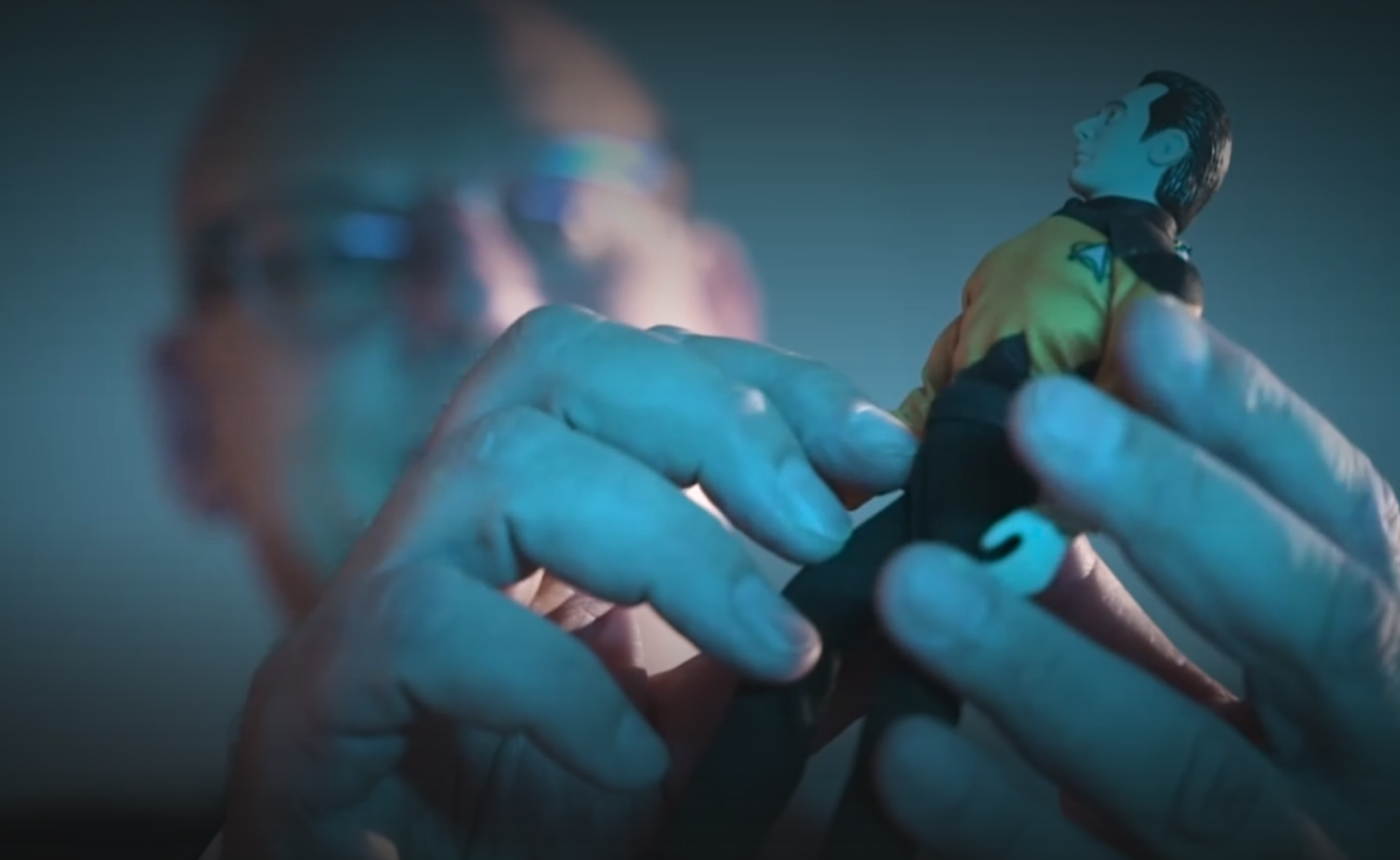
On December 13th, 2022, the hybrid workshop “Realization of Avatar-Symbiotic Society” was held at the ICSR. It was organized by Dr. Takahiro Miyashita (ATR) and Prof. Dr. Takashi Yoshimi (Shibaura-IT). The description of the workshop was as follows: “This workshop aims at presenting the ongoing progress of the challenges on the Moonshot (MS) human-centered long-term R&D program. It will discuss by focusing on the goal 1 of the MS dealing with the future realization of an avatar-symbiotic society and cybernetic avatars (CAs). In the workshop, semi-autonomous tele-operated robots and CG agents are called CAs. The participants will discuss with speakers who are researchers related to CAs technology about the avatar-symbiotic society which enables to freely and actively participate in society for every person.” (Website ICSR) The first lecture entitled “Avatar and the future society” was given by Prof. Dr. Hiroshi Ishiguro (Osaka University). He introduced Erica, Telenoid, and Hugvie, among others. Hugvie is a technically expandable doll that can be hugged. He also introduced his “Avatar Infrastructure”: “Anyone, including the elderly and people with disabilities, will be able to freely participate in various activities with abilities beyond ordinary people while expanding their physical, cognitive, and perceptual abilities using a large number of CAs.” Prof. Dr. Oliver Bendel mentioned to Hiroshi Ishiguro that two of his former students, Nhi Tran Hoang Yen and Thang Hoang Vu from Ho Chi Minh City, interpreted his Hugvie as a female figure and designed a male figur (Gendering Hugvie) as part of a project on social robots. The roboticist from Osaka replied that his Hugvie doll had no gender, but noted the reception with interest. Other presentations with exciting discussions followed. More information on the conference via www.icsr2022.it.

The CARE-MOMO in Florence

From December 13 to 16, 2022, the ICSR took place, next to Robophilosophy the most important conference on social robotics. Oliver Bendel and Marc Heimann were participating with their paper “The CARE-MOMO Project”. They presented it in a talk on the very first morning at the workshop “Robot Companionship: Applications and Challenges”. They also had a poster presentation on it on Thursday (December 15, 2022). With the help of the morality module, which includes the proven morality menu, care recipients can transfer their moral and social ideas to a care robot like Lio from F&P Robotics (Photo: F&P Robotics). The presentation was well received by the crowded room, including the Chair, who found the approach very interesting, as he pointed out several times. The workshop program can be downloaded here. More information about the conference is available at www.icsr2022.it.

Talk about Robots in Policing in Helsinki

On the first day of Robophilosophy 2022, Oliver Bendel presented his paper “Robots in Policing“. From the abstract: “This article is devoted to the question of how robots are used in policing and what opportunities and risks arise in social terms. It begins by briefly explaining the characteristics of modern police work. It puts service robots and social robots in relation to each other and outlines relevant disciplines. The article also lists types of robots that are and could be relevant in the present context. It then gives examples from different countries of the use of robots in police work and security services. From these, it derives the central tasks of robots in this area and their most important technical features. A discussion from social, ethical, and technical perspectives seeks to provide clarity on how robots are changing the police as a social institution and with social actions and relationships, and what challenges need to be addressed.” Robots in policing are a topic that has yet to receive much attention. However, it is likely to become considerably more topical in the next few years. More information about the conference on cas.au.dk/en/robophilosophy/conferences/rpc2022.