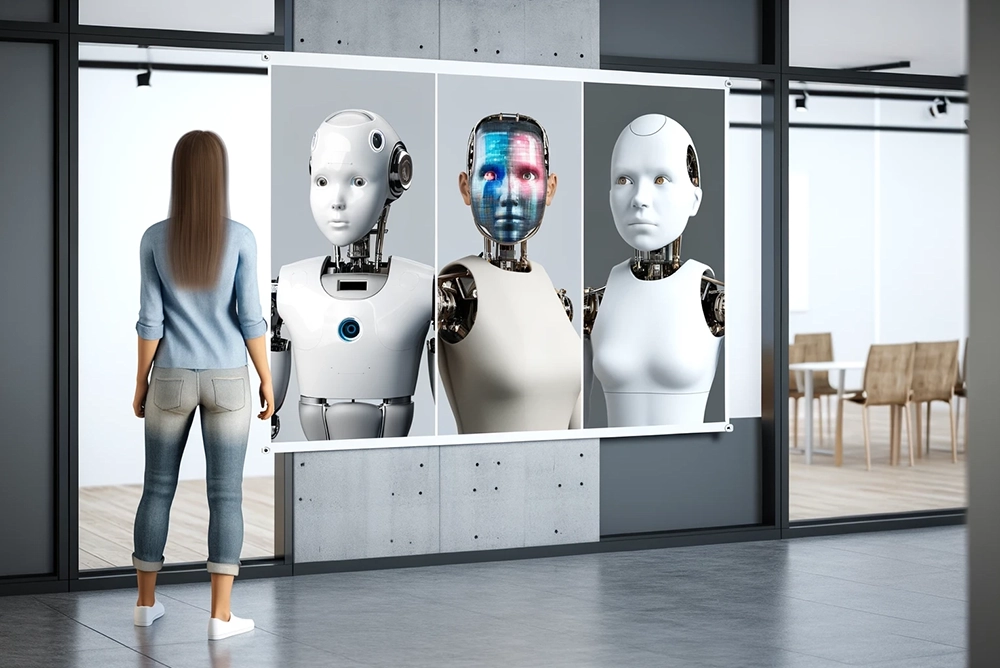
The last few years have seen the creation of a large number of quadruped and bipedal robots. Many have been inspired by Spot and Atlas from Boston Dynamics. These, in turn, can be traced back to Sparko and Elektro, which became famous around 1940. Atlas paved the way for the so-called general-purpose or universal robots that are now conquering the market, from H1 to Figure 01. They are not yet truly universal, but they are getting there. Most robotic quadrupeds don’t have a real head. A few talented hobbyists have produced their own with a 3D printer. This can be referred to as robot enhancement. Most robotic bipeds have a head that looks creepy or repulsive. This will be a key design problem in the coming years. It may be that people will quickly get used to ugly heads. But it would probably help with adoption and acceptance if the heads were nice to look at and had convincing facial expressions. After the huge technological advances that have been made in recent years, with new approaches to motor skills and the integration of speech models, what is needed most is a change in design.
An Electric New Era for Atlas
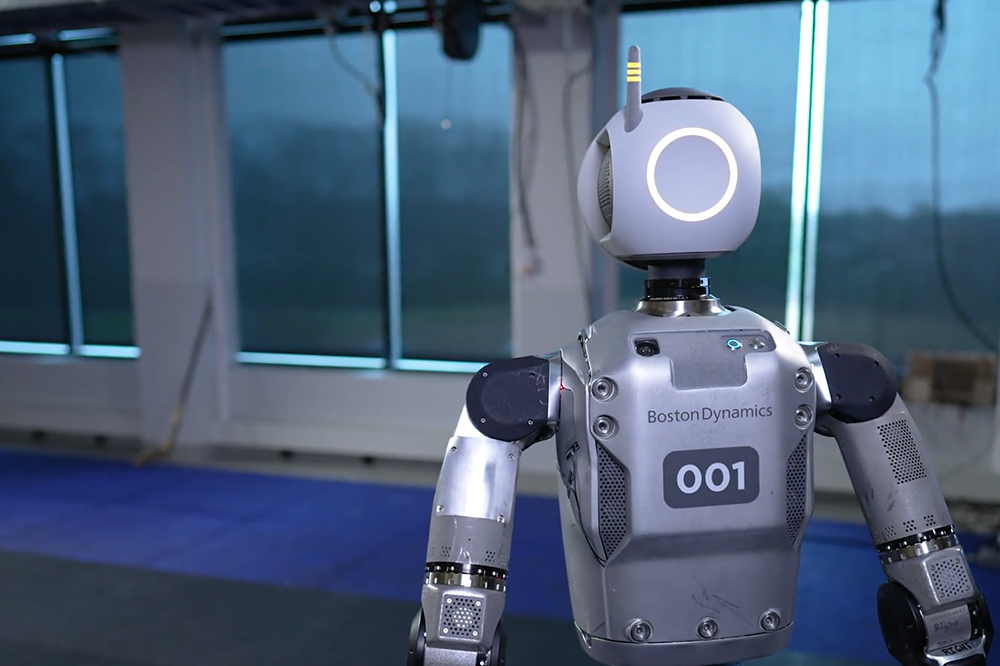
In recent years, a large number of quadruped and bipedal robots have been created. Many of them were inspired by Spot and Atlas from Boston Dynamics. These, in turn, can be traced back to Sparko and Elektro, which became famous around 1940. Atlas paved the way for the so-called general-purpose or universal robots that are now conquering the market, from H1 to Figure 01. They are not yet truly universal, but they are getting there. In these dynamic and productive times, the company, which is part of the Hyundai Motor Group, announces the end of the hydraulic version of the humanoid robot. A post on LinkedIn from April 17, 2024 states: “Atlas has sparked our imagination, inspired new roboticists, and leapt over technical barriers. Now it’s time for our hydraulic Atlas robot to kick back and relax. Take a look at everything we’ve accomplished with the Atlas platform to date.” (Boston Dynamics, 17 April 2024) At the end of the video it says: “‘Til we meet again, Atlas.” This immediately raised hopes of a successor. In fact, Boston Dynamics presented an electric, extremely mobile version on its blog just a few hours later. The title of the article is: “An Electric New Era for Atlas” (Image: Boston Dynamics).
Future Lab on Social Robots and VLCs
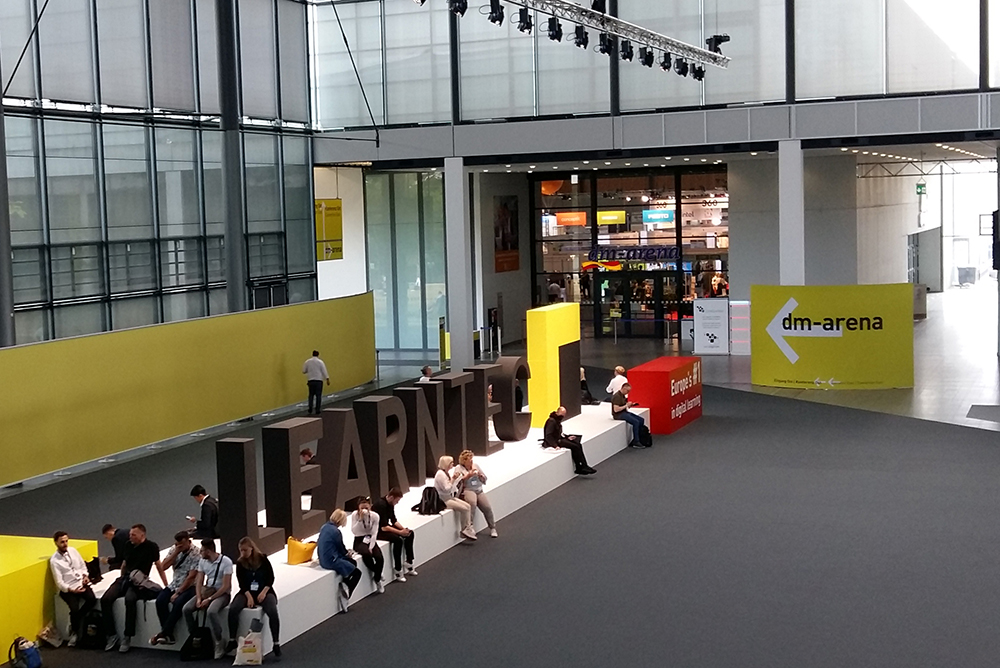
Learntec, Europe’s largest e-learning trade fair and conference, will take place in Karlsruhe from June 4 to 6, 2024. The curator of the Future Lab on social robots and Virtual Learning Companions (VLCs) is Prof. Dr. Oliver Bendel, who has been researching conversational agents as embodied or non-embodied entities for a quarter of a century. At the turn of the millennium, it was primarily pedagogical agents that attracted his interest. In the meantime, the focus has shifted to care and therapy robots, teacher robots and police robots as well as second-generation VLCs. At Learntec, visitors will be able to interact and communicate with two state-of-the-art social robots. Navel Robotics and Becker Robotics have confirmed their participation. There will also be a station where visitors can chat with Social Robotics Girl, a GPT developed by Oliver Bendel. Videos and keynote speeches on social robots and Virtual Learning Companions will impart knowledge on the topic and provide insights into projects. Further information will be available from May 2024 on the Learntec website. Oliver Bendel already contributed to the program as a speaker from 2002 to 2004. He has been on board again since 2022.
The AAAI Spring Symposia are Back Again
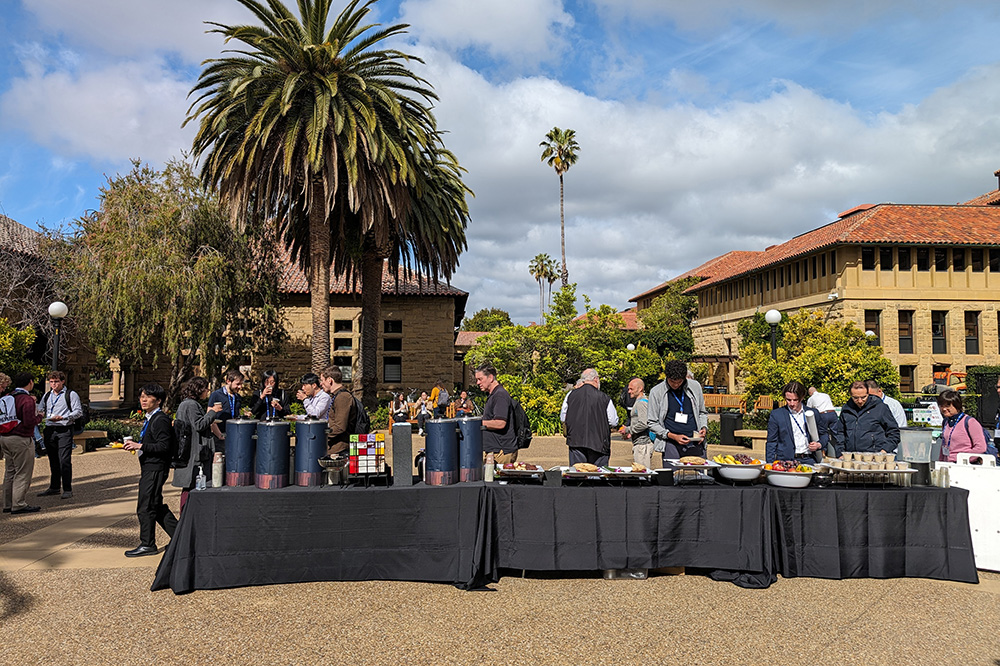
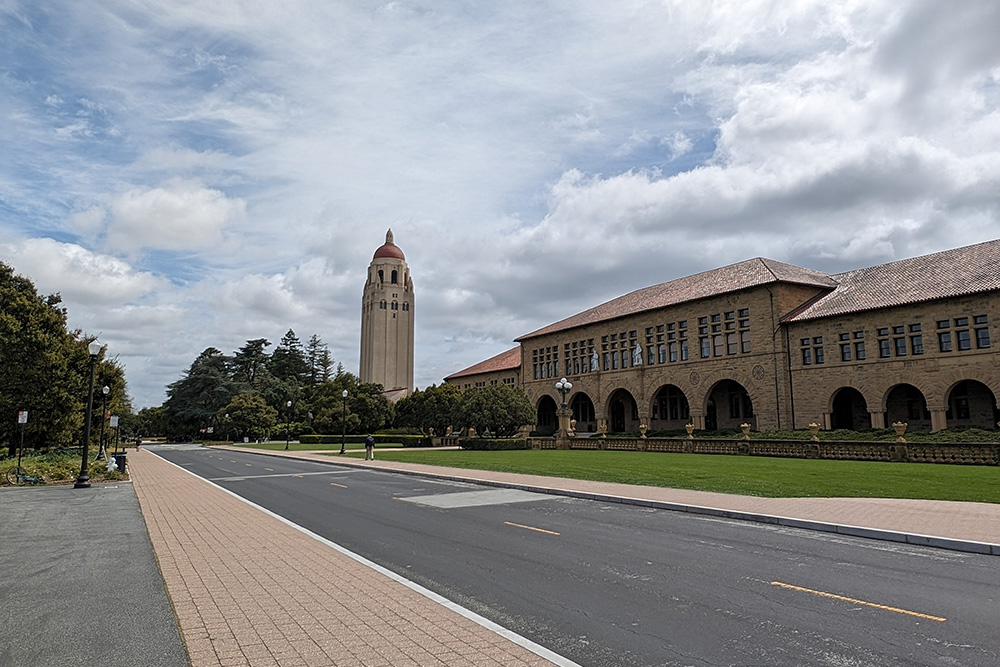
On the second day of the AAAI Spring Symposia, one could already get the impression that the traditional conference has returned to its former greatness. The Covid pandemic had damaged it. In 2023, there were still too few participants for some symposia. Many stayed home and watched the sessions online. It was difficult for everyone involved. But the problems had already started in 2019. At that time, the Association for the Advancement of Artificial Intelligence had decided not to publish the proceedings centrally any more, but to leave it to the individual organizers. Some of them were negligent or disinterested and left the scientists alone with their demands. In 2024, the association took over the publication process again, which led to very positive reactions in the community. Last but not least, of course, the boost from generative AI helped. In 2024, you can see many happy and exuberant AI experts at Stanford University, with mild temperatures and lots of sunshine.
Generative AI at Stanford University
On March 26, 2024, Oliver Bendel (School of Business FHNW) gave two talks on generative AI at Stanford University. The setting was the AAAI Spring Symposia, more precisely the symposium “Impact of GenAI on Social and Individual Well-being (AAAI2024-GenAI)”. One presentation was based on the paper “How Can Generative AI Enhance the Well-being of the Blind?” by Oliver Bendel himself. It was about the GPT-4-based feature Be My AI in the Be My Eyes app. The other presentation was based on the paper “How Can GenAI Foster Well-being in Self-regulated Learning?” by Stefanie Hauske (ZHAW) and Oliver Bendel. The topic was GPTs used for self-regulated learning. Both talks were received with great interest by the audience. All papers of the AAAI Spring Symposia will be published in spring. The proceedings are edited by the Association for the Advancement of Artificial Intelligence itself.
Start of the AAAI 2024 Spring Symposia
The AAAI 2024 Spring Symposium Series will be held at Stanford University from March 25-27, 2024. There are a total of eight symposia. One of them is “Impact of GenAI on Social and Individual Well-being”. It will be hosted by Takashi Kido (Teikyo University, Japan) and Keiki Takadama (The University of Electro-Communications, Japan). The announcement text reads: “Generative AI (GenAI) presents significant opportunities and challenges in the areas of individual and societal well-being. While its benefits in areas such as healthcare, the arts, and education are enormous, it also requires careful consideration of ethics, privacy, fairness, and security.” On March 25, 2024, Takashi Kido opened the symposium with an interesting talk, including how ChatGPT would decide on the trolley problem. More information about the symposium is available here.
A Robot Park in Switzerland
Robotics is booming, thanks in part to AI. Dozens of quadrupeds and bipeds are available, as well as numerous other social and service robots. After presenting the idea of a robot park several times since 2020, Prof. Dr. Oliver Bendel initiated the project “A Robot Park for Switzerland” in March 2024. The purpose of a robot park is to educate the public. Everyone should have the opportunity to interact and communicate with robots and to make up his or her own mind about them. The kick-off meeting took place at the School of Business FHNW on March 22, 2024. BIT student Susmy Chakkaith could be won over. She is developing a concept with maps and other visualizations. The robot park is to be located in Switzerland and will include 100-200 robots, both industrial and service robots. Social robots and four- and two-legged friends will play a special role. It will be based on an amusement park or a zoo. Technical, economic, and ethical aspects will play a role. In particular, the concept should convincingly demonstrate how procurement, operation, maintenance, repair, etc. can be guaranteed, not least for models from China or Japan. The entire infrastructure, including network connectivity, cloud computing, power supply, etc., is also relevant. A business model will be outlined and evaluated. The results will be available in August 2024 and will be made available to the public.
“The Animal Whisperer” Project Starts
On March 18, 2024, the kick-off meeting for the project “The Animal Whisperer” took place at the FHNW School of Business. It was initiated by Prof. Dr. Oliver Bendel, who has been working on animal-computer interaction and animal-machine interaction for many years. Nick Zbinden, a student of business information systems, has been recruited to work on the project. As part of his final thesis, he will develop three GPT-4-based applications that can be used to analyze the body language and environment of cows, horses and dogs. The aim is to avert danger to humans and animals. For example, a hiker can receive a recommendation on their smartphone not to cross a pasture if a mother cow and her calves are present. All they have to do is call up the application and take a photo of the area. Nick Zbinden will evaluate literature and conduct several expert interviews to find out more about the situation of farm and domestic animals and their behavior. He will demonstrate the possibilities, but also the limitations of multimodal language models in this context. The results will be available in August 2024 (Image: DALL-E 3).
The Six-legged Robot
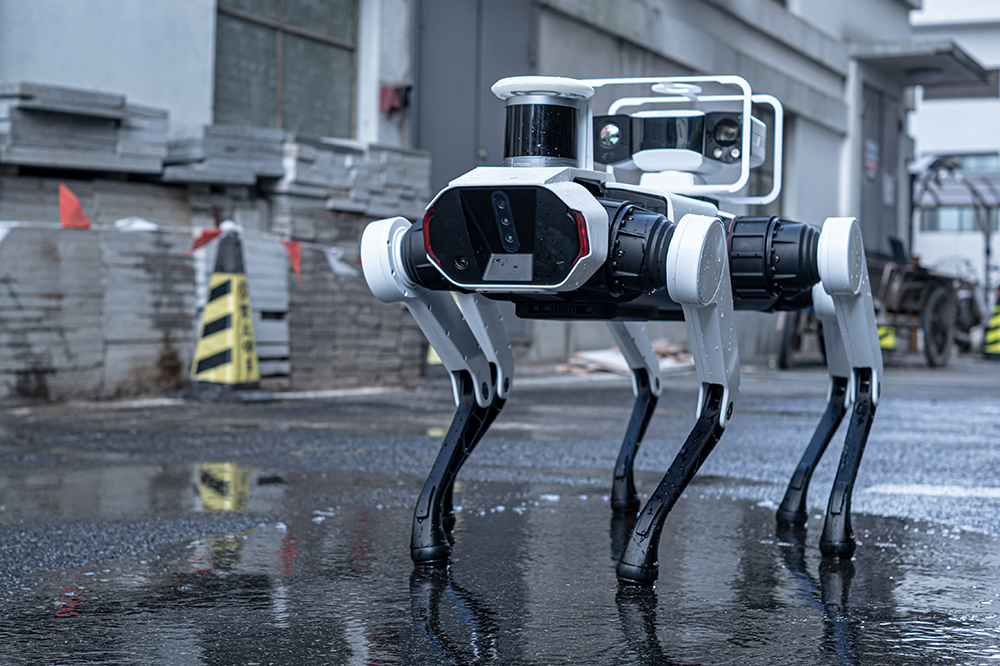
Laptop manufacturer Lenovo launched the Lenovo Daystar robot in 2020. The design of the machine, with four wheels and a cobot on the back, was less than convincing. The latest development is different. The website ifdesign.com reports on the award winner: “Step into the forefront of industrial automation and public services with Lenovo Daystar Bot GS. The groundbreaking six-legged design guarantees unmatched stability and maneuverability that surpasses traditional robotic platforms, allowing it to traverse diverse terrains with ease.” (iF DESIGN, 2024) The six legs are indeed unusual and a real eye-catcher. There is disagreement about the advantages. Perhaps the six legs provide more stability on stairs and very uneven terrain. The article continues: “Boasting an advanced control system, cutting-edge perception algorithms, and IP66 robust protection, GS outperforms in unforeseen scenarios, enabling comprehensive data collection at any location and time. In our unwavering pursuit of excellence, GS stands as a testament to innovation, efficiency, safety, and the boundless potential of automated exploration.” (iF DESIGN, 2024) Interestingly, Lenovo itself has nothing to say about the product. However, the media are now reporting intensively. The next few months will bring more clarity about the Lenovo Daystar Bot GS (Image: Lenovo/iF DESIGN).
ICSR’24 in Odense, Denmark
The prestigious International Conference on Social Robotics was last held in Florence (2022) and Qatar (2023). Now it enters its next round. The 16th edition will bring together researchers and practitioners working on human-robot interaction and the integration of social robots into our society. The title of the conference includes the addition „AI“. This is a clarification and demarcation that has to do with the fact that there will be two further formats with the name ICSR in 2024. ICSR’24 (ICSR + AI) will take place as a face-to-face conference in Odense, Denmark, from 23 to 26 October 2024. ICSR’24 will take place as a face-to-face conference in Odense, Denmark, from 23 to 26 October 2024. The theme of this year’s conference is “Empowering Humanity: The role of social and collaborative robotics in shaping our future”. The topics of the Call for Papers include “collaborative robots in service applications (in construction, agriculture, etc.)”, “Human-robot interaction and collaboration”, “Affective and cognitive sciences for socially interactive robots”, and “Context awareness, expectation, and intention understanding”. The general chairs are Oskar Palinko, University of Southern Denmark, and Leon Bodenhagen, University of Southern Denmark. More information is available at icsr2024.dk.