In late August 2023, AAAI announced the continuation of the AAAI Spring Symposium Series, to be held at Stanford University from 25-27 March 2024. Due to staff shortages, the prestigious conference had to be held at the Hyatt Regency SFO Airport in San Francisco in 2023 – and will now return to its traditional venue. The call for proposals is available on the AAAI Spring Symposium Series page. Proposals are due by 6 October 2023. They should be submitted to the symposium co-chairs, Christopher Geib (SIFT, USA) and Ron Petrick (Heriot-Watt University, UK), via the online submission page. Over the past ten years, the AAAI Spring Symposia have been relevant not only to classical AI, but also to roboethics and machine ethics. Groundbreaking symposia were, for example, “Ethical and Moral Considerations in Non-Human Agents” in 2016, “AI for Social Good” in 2017, or “AI and Society: Ethics, Safety and Trustworthiness in Intelligent Agents” in 2018. More information is available at aaai.org/conference/spring-symposia/sss24/.
A Universal Translator Comes
The idea of a Babel Fish comes from the legendary novel or series of novels “The Hitchhiker’s Guide to the Galaxy”. Douglas Adams alluded to the Tower of Babel. In 1997, Yahoo launched a web service for the automatic translation of texts under this name. Various attempts to implement the Babel Fish in hardware and software followed. Meta’s SeamlessM4T software can handle almost a hundred languages. In a blog post, the American company refers to the work of Douglas Adams. “M4T” stands for “Massively Multilingual and Multimodal Machine Translation”. Again, it is a language model that makes spectacular things possible. It has been trained on four million hours of raw audio. A demo is available at seamless.metademolab.com/demo. The first step is to record a sentence. The sentence is displayed as text. Then select the language you want to translate into, for example Japanese. The sentence is displayed again in text form and, if desired, in spoken language. A synthetic voice is used. You can also use your own voice, but this is not yet integrated into the application. A paper by Meta AI and UC Berkeley can be downloaded here.
Expansion of Robocar Operations in Frisco
Robot cabs have been seen in San Francisco for years, first by Uber, then by Cruise and Waymo. But there have been various restrictions on their operation in the past. NBC BAY AREA reported on August 10, 2023: “California regulators on Thursday approved an expansion that will allow two rival robotaxi services to operate throughout San Francisco at all hours, despite safety worries spurred by recurring problems with unexpected stops and other erratic behavior that resulted in unmanned vehicles blocking traffic, including emergency vehicles.” (NBC BAY AREA, 10 August 2023) It goes on to say: “The California Public Utilities Commission voted to approve rival services from Cruise and Waymo to operate around-the-clock service. It will make San Francisco first major U.S. city with two fleets of driverless vehicles competing for passengers against ride-hailing and taxi services dependent on humans to operate the cars.” (NBC BAY AREA, 10 August 2023) It is highly likely that accidents will occur, including personal injury. A city is a highly complex environment, and the technology for autonomous driving is far from mature. In addition, the population and tourists are not sufficiently prepared for this form of traffic.
15th International Conference on Social Robotics (ICSR 2023)
The International Conference on Social Robotics (ICSR 2023) is, next to Robophilosophy, the most important conference on social robotics. The deadline for paper submission is approaching. “The 15th International Conference on Social Robotics (ICSR 2023) will bring together researchers and practitioners working on the interaction between humans and intelligent robots and on the integration of social robots into our society. ICSR 2023 will take place in Doha as a face-to-face conference on December 4-7, 2023. This will be the first time that the conference will be hosted in Qatar and in the Middle East and North Africa region.” (Website ICSR) The theme of this year’s ICSR is “Human-Robot Collaboration: Sea, Air, Land, Space and Cyberspace”. According to the organizers, the theme emphasizes on all physical and cyber-physical domains where humans and robots collaborate. Papers can be submitted until August 21, 2023. Notifications will be made by September 18 of that year. More information via icsr23.qa.
The Robot-elevator Project
An elevator is still a bit of a problem for a service robot. A first approach is to use social features such as facial expressions and sounds. The user trusts the machine or feels sorry for it and helps it into the lift. A second option is for the robot to press the right buttons with its gripper. However, this can be very difficult and can also cause problems, for example when people are present. A third option is for the robot and the elevator to communicate via appropriate interfaces. This is certainly the most elegant solution, but it requires some technical standardisation and upgrading. As reported by the Korea Economic Daily, KT, LG Elec, and Hyundai Elevator have joined forces in the “robot-elevator project”. The vision is described in the teaser as follows: “A robot freely gets on and off an elevator and moves around a building, doing everything from coffee to parcel delivery and route guidance.” (KED, 28 July 2023) About the plans of the three companies, the magazine says: “The three will jointly plan and search for elevator-robot linkage services, con-duct cooperation to secure competitiveness in robotics services and look for new business lines. KT and LG Electronics said a far more competitive system of robotics services is possible by linking an elevator to a robot since robots must freely move between floors to increase their utility.” (KED, 28 July 2023) More information is available at www.kedglobal.com/robotics/newsView/ked202307280005.
Disabling Autonomous Vehicles
“Anti-car activists have come up with a novel and effective way of disabling driverless vehicles owned by Waymo and Cruise in San Francisco: placing traffic cones on their hoods. It’s the work of a group called Safe Streets Rebel, which has launched a protest dubbed ‘Week of Cone’.” (Techspot, 11 July 2023) This was reported by Techspot on 11 July 2023. Prof. Dr. Oliver Bendel has been pointing out for several years that automated and autonomous cars can be crippled in a simple way. On 6 March 2018, in an article in a Swiss IT journal, he asked, “Does autonomous driving fail because of manipulated sensors?” … A thesis by his student M. Hashem Birahjakli then systematically compiled and examined methods and means. A blog post about it states: “The results of the work suggest that every 14-year-old girl or boy could disable a self-driving car. So far, hacking has been seen as the greatest threat to autonomous driving. But while not everyone can hack, almost everyone carries chewing gum or lipstick. The automotive industry should consider this threat seriously.” The operator Waymo reacts helplessly to the actions. According to the German magazine Golem, a press spokesman emphasized that the traffic cone action shows a lack of understanding of how autonomous vehicles work and is vandalism. In fact, the activists know very well how autonomous vehicles work. And that is precisely the problem.
Little, Great Teacher
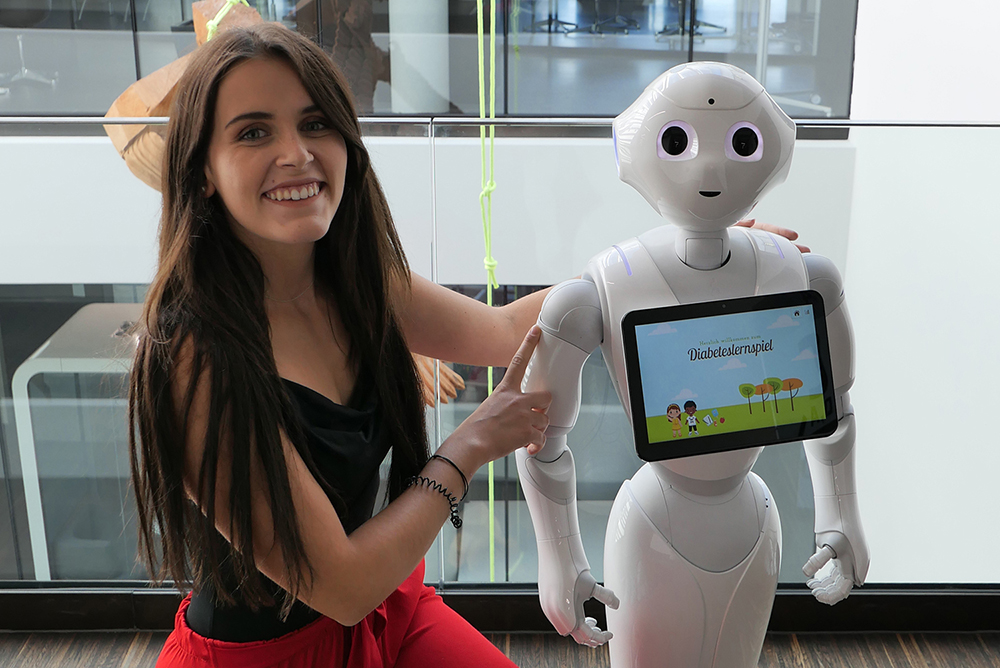
July 14, 2023 was the final presentation of the “Little Teacher” project, in which Alpha Mini plays a leading role. The initiator was Prof. Dr. Oliver Bendel, who has been researching conversational agents and social robots for a quarter of a century. Andrin Allemann contributed to the project as part of his thesis and carried out the implementation. In this application, Alpha Mini is intended for school or learning in a child’s room. It was connected to a tablet or laptop (a Microsoft Surface). It can teach simple learning material on geography and biology with the help of pictures and text on the display, and motivate children through verbal, gestural, and mimic feedback. It is therefore a small teacher with great possibilities. Alpha Mini is a social robot characterized by small size (and thus good transportability) and extensive natural language and motor skills. It is much less expensive than other humanoid robots with comparable capabilities. However, unlike Pepper, it does not have an integrated tablet. The project showed that it is possible to connect different components of a learning environment and to support learning success and learning enjoyment. The project was launched on March 8, 2023. Project completion is August 11, 2023. Until then, minor bugs will be fixed and several tests will be performed. The results will be published in a paper.
@llegra, a Chatbot for Vallader
Conversational agents have been a research subject of Prof. Dr. Oliver Bendel for a quarter of a century. He dedicated his doctoral thesis at the University of St. Gallen to them. At the School of Business FHNW, he developed them with his changing teams from 2012 to 2022, primarily in the context of machine ethics and social robotics. The philosopher of technology now devotes himself increasingly to dead, extinct, and endangered languages. After @ve (2022), a chatbot for Latin based on GPT-3, another project started in March 2023. The chatbot @llegra is developed by Dalil Jabou for the Rhaeto-Romanic idiom Vallader, which occurs in the Lower Engadine between Martina in the northeast and Zernez in the southwest, as well as in Val Müstair. The user can type text and gets text output. In addition, @llegra speaks with the help of a text-to-speech system from the company SlowSoft, which supports the project. The GPT-3 speech model produced rather unsatisfactory results. The breakthrough then came with the use of GPT-4. The knowledge base was supplemented with the help of four children’s books on Vallader. The project will be completed in August 2023. The results will be published thereafter.
Social Features for Industrial Robots
For years there has been a trend to add social features to service robots, such as delivery, security and cleaning robots, and also to industrial robots, resulting in cobots. They do not usually become fully social robots, but they benefit from having eyes and mouths or making sounds – or from being able to get very close to people without hurting or hindering them. Amazon is riding this wave with its Proteus transport robot. It can be found in a huge department store in Reading, Massachusetts. A Wired editor writes about his first encounter with two Proteus models: “Their round eyes and satisfied grins are rendered with light emitting diodes. They sport small lidar sensors like tiny hats that scan nearby objects and people in 3D. Suddenly, one of them plays a chipper little tune, its mouth starts flashing, and its eyes morph into heart shapes. This means, I am told, that the robot is happy.” (Wired, 26 June 2023) “Why would a robot be happy?”, asks the editor Sophie Li, a software engineer at Amazon. She explains that being able to express happiness can help Proteus work more effectively around people. “Proteus carries suitcase-sized plastic bins filled with packages over to trucks in a loading bay that is also staffed by humans. The robot is smart enough to distinguish people from inanimate objects and make its own decisions about how to navigate around a box or person in its path. But sometimes it needs to tell someone to move out of the way – or that it is stuck, which it does by showing different colors with its mouth. Li recently added the heart eyes to let Proteus also signal when it has completed a task as planned.” (Wired, 26 June 2023) The market for real social robots is still in its infancy. Care and therapy robots, entertainment and toy robots, or sex robots – there is a constant up and down, with companies emerging and disappearing, products appearing and disappearing. It is uncertain whether all social robots will be needed. What is certain is that social features will help to improve modern industrial robots and classic service robots.
AI-based Robots for the Disposal of Discarded Ammunition
The Robotics Innovation Center (RIC) at the German Research Centre for Artificial Intelligence (DFKI) in Bremen wants to clear the seabed of discarded ammunition in the North Sea and Baltic Sea. This was reported by the online magazine Golem on 14 June 2023. The researchers are using the autonomous underwater vehicle Cuttlefish, developed at DFKI, as a test platform. According to Golem, the robot has been equipped with two deep-sea-capable gripper systems. These are designed to enable flexible handling of objects under water, even difficult objects such as explosive devices. The AI-based control system allows the robot to change its buoyancy and centre of gravity during the dive. According to the online magazine, the AUV is equipped with numerous sensors such as cameras, sonars, laser scanners, and magnetometers. This is how it is supposed to approach an object without colliding with it. The system will certainly be effective – whether it is efficient remains to be seen.