Cleaning robots, along with security robots and transport robots, are among the service robots that work largely error-free and are already saving costs. The Hawaii Department of Transportation Airports Division continues to modernize Daniel K. Inouye International Airport (HNL) and give HNL an open, clean feel. The modernization includes the addition of two robotic floor scrubbers to supplement custodial services. This was reported by the Hawaii Department of Transportation. “The robotic scrubbers will help us keep HNL sanitary and sparkling,” said Ross Higashi. He is the Hawaii Department of Transportation’s deputy director of airports. “Use of this technology will also allow us to maximize available staff in maintaining our busiest airport to standards.” (Website Hawaii Department of Transportation) Without a doubt, cleaning robots are also an option for the other islands of Hawai’i, such as the Big Island and Kaua’i. On the Big Island, there are two airports that come into question. In addition, cleaning robots could be used in the streets of Hilo. Also other service robots are entering the market that can clear beaches and lawns of litter.
Robots in Hawai’i – Part 3
Surveying and collecting rare plant species that grow on steep cliffs has been a risky business for scientists and conservationists for centuries. The world’s first aerial sampling system, which uses a robotic arm suspended from a drone, is attempting to solve this problem in Hawai’i. An article published by Mongabay magazine back in November 2022 states: “In Hawai’i’s Kaua’i island, the world’s first aerial sampling system has successfully flown into high-altitude cliff faces to cut out samples from rare plants and bring them back to a nursery. Scientists call it ‘the Mamba,’ a cutting mechanism on a remote-controlled robotic arm suspended from a drone. The system was developed by Hawai’i-based not-for-profit conservation organization National Tropical Botanical Garden (NTBG) and Quebec-based technology company Outreach Robotics and the University of Sherbrooke in Quebec.” (Mongabay, 9. November 2023) Ben Nyberg, the NTBG’s geographic information system and drone program coordinator, told Mongabay in an interview: “It is really unlocking a lot of areas that have previously been completely inaccessible.” (Mongabay, 9. November 2023) Of course, criminals could also adopt the technology. But it would be almost impossible to smuggle rare plants out of Hawai’i due to strict customs controls.
Robots in Hawai’i – Part 2
Ruby Tuesday is a popular restaurant in Hawaii (Hawaiian: Hawai’i), on the island of O’ahu. The location close to the airport is not one of the most beautiful ones. The food is also not praised by everyone. But the restaurant is known for its artificial staff. “Our KEENON DINERBOT is helping the staff here deliver trays and plates, so that they can pay more attention to improving customer satisfaction.” This is the message in a promotional video from Keenon Robotics in Singapore. The robot is a classic transport and serving robot. It has large, square blue eyes. In Europe and Asia, BellaBot is best known. It has a cat face and cat ears and is controlled via user input and voice commands. The European model Plato is also shaking up the market. Khon2, a platform from Hawaii, first reported on the new employee at Ruby Tuesday in 2022. “Staffing is such a problem now. Everything from managers down to servers and kitchen help cooks so this really helps our servers out,” Ruby Tuesday owner Rick Nakashima told Khon2 journalists. Indeed, robots of this kind seem to be at least a band-aid for the shortage of skilled workers. Customers’ reactions vary. Some seem to find the robots entertaining. Others say that direct contact with waiters is important to them. The restaurant emphasises that the robot is not intended to replace waiters. Rather, the robot acts as a support.
Robots in Hawai’i – Part 1
Hawaii (Hawaiian: Hawai’i) is not necessarily associated with robots. But in the larger cities, you can be sure to encounter them. There are service robots such as the Keenon Dinerbot and surgical robots such as the da Vinci Surgical System. In addition, robots are used in the wild, for example for nature conservation. The hospital group in the east of the archipelago advertises with the following words: “East Hawaii Health Clinics is excited to introduce our fully operational robotic surgery center. This state-of-the-art equipment allows us to perform minimally invasive surgeries that would otherwise require greater surgery time and recovery time. We look forward to continuing to provide East Hawaii with exceptional surgical options.” (Website East Hawaii Health Clinics) This type of care is available in Hilo, among other places. The small town on the Big Island has the latest medical technology, such as that used in Basel and Berlin. Hilo is surrounded by tropical rainforest. Nearby are Akaka Falls and Hawai’i Volcanoes National Park. In the city itself, giant banyan trees grow. One must not forget the many homeless people who are at the end of their tether. Like California, Hawai’i has not dealt with this problem. These people will never be able to afford treatment with a surgical robot.
CONVERSATIONS 2023 in Oslo
The CONVERSATIONS 2023, a two-day workshop on chatbot research, applications, and design, will take place at the University of Oslo, Norway. According to the CfP, contributions concerning applications of large language models such as the GPT family are warmly welcome, as are contributions on applications combining information retrieval approaches and large language model approaches. Building on the results from previous six CONVERSATIONS workshops, the following topics are of particular interest: 1. Chatbot users and implications, 2. Chatbot user experience, design, and evaluation, 3. Chatbot frameworks and platforms, 4. Chatbots for collaboration, 5. Democratizing chatbots – chatbots for all, 6. Ethics and safety implications of chatbots and large language models, 7. Leveraging advances in AI technology and large language models. More information via 2023.conversations.ws.
Robot Hand Can Operate in the Dark
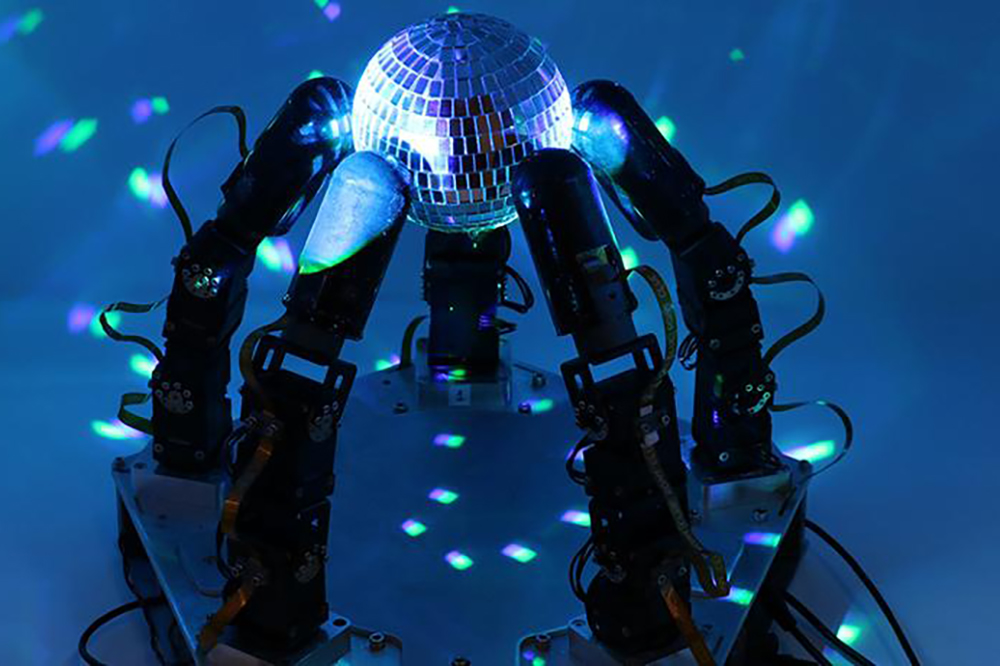
“Researchers at Columbia Engineering have demonstrated a highly dexterous robot hand, one that combines an advanced sense of touch with motor learning algorithms in order to achieve a high level of dexterity.” (Website Columbia Engineering, 28 April 2023) Columbia Engineering reported this on its website on April 28, 2023. The text goes on to say: “As a demonstration of skill, the team chose a difficult manipulation task: executing an arbitrarily large rotation of an unevenly shaped grasped object in hand while always maintaining the object in a stable, secure hold. This is a very difficult task because it requires constant repositioning of a subset of fingers, while the other fingers have to keep the object stable. Not only was the hand able to perform this task, but it also did it without any visual feedback whatsoever, based solely on touch sensing.” (Website Columbia Engineering, 28 April 2023) “While our demonstration was on a proof-of-concept task, meant to illustrate the capabilities of the hand, we believe that this level of dexterity will open up entirely new applications for robotic manipulation in the real world”, said Matei Ciocarlie according to the website. He is the Associate Professor in the Departments of Mechanical Engineering and Computer Science who developed the hand together with his graduate student Gagan Khandate (Photo: Columbia University ROAM Lab).
Preprint on Bar Robots
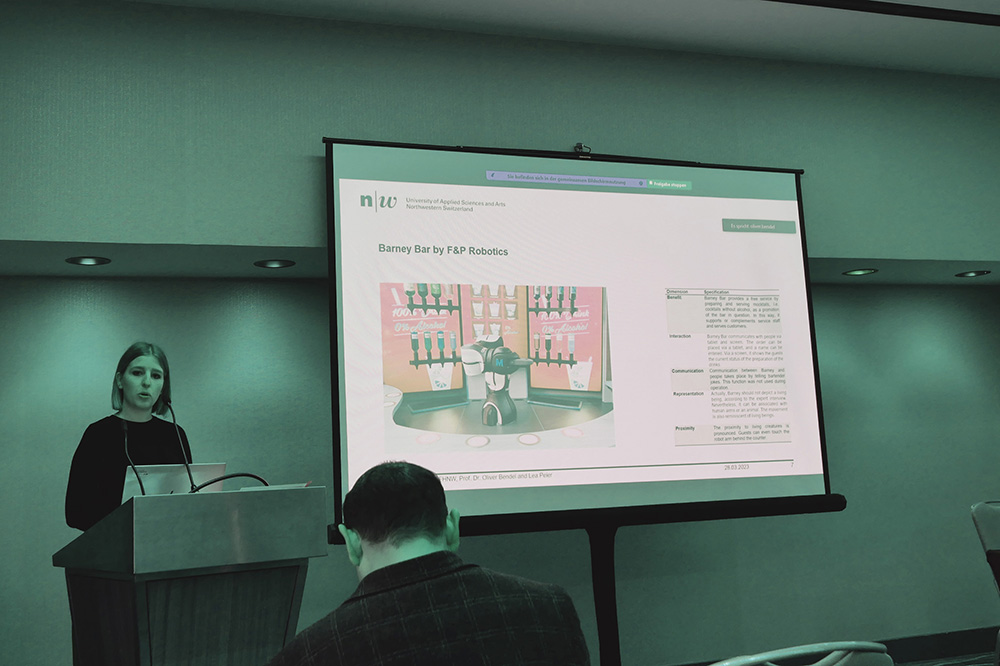
From March 27-29, 2023, the AAAI 2023 Spring Symposia featured the symposium “Socially Responsible AI for Well-being” by Takashi Kido (Teikyo University, Japan) and Keiki Takadama (The University of Electro-Communications, Japan). This time the venue was exceptionally not Stanford University, but the Hyatt Regency SFO Airport. On March 28, Prof. Dr. Oliver Bendel and Lea Peier presented their paper “How Can Bar Robots Enhance the Well-being of Guests?”. The paper has now been published as a preprint and can be downloaded via arxiv.org/abs/2304.14410. From the abstract: “This paper addresses the question of how bar robots can contribute to the well-being of guests. It first develops the basics of service robots and social robots. It gives a brief overview of which gastronomy robots are on the market. It then presents examples of bar robots and describes two models used in Switzerland. A research project at the School of Business FHNW collected empirical data on them, which is used for this article. The authors then discuss how the robots could be improved to increase the well-being of customers and guests and better address their individual wishes and requirements. Artificial intelligence can play an important role in this. Finally, ethical and social problems in the use of bar robots are discussed and possible solutions are suggested to counter these.” More information on the conference via aaai.org/conference/spring-symposia/sss23/.
Preprint on Hugging Robots
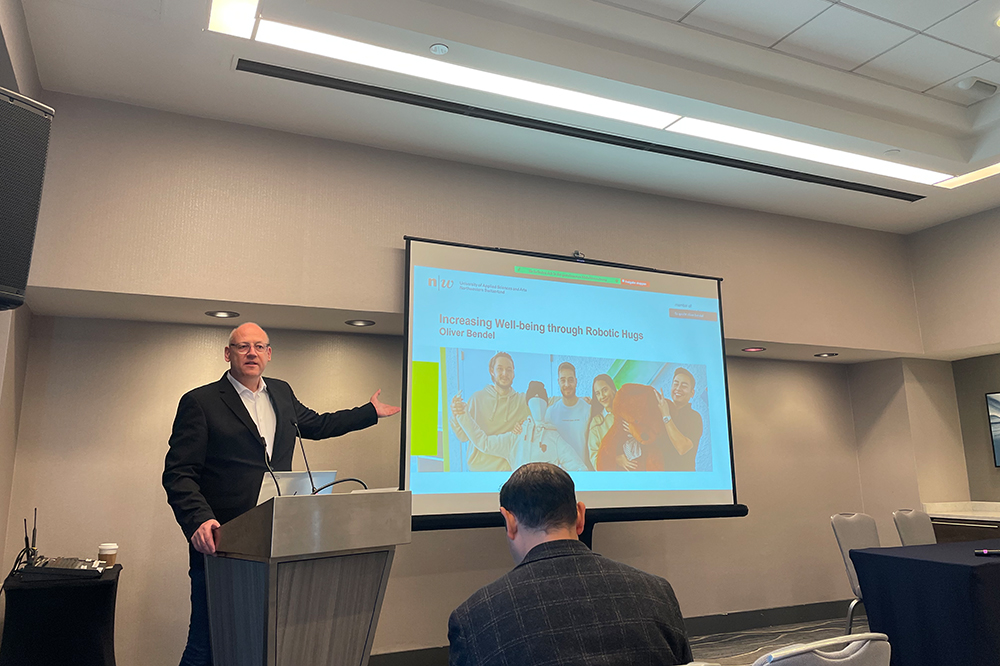
From March 27-29, 2023, the AAAI 2023 Spring Symposia featured the symposium “Socially Responsible AI for Well-being” by Takashi Kido (Teikyo University, Japan) and Keiki Takadama (The University of Electro-Communications, Japan). This time the venue was exceptionally not Stanford University, but the Hyatt Regency SFO Airport. On March 28, Prof. Dr. Oliver Bendel presented the paper “Increasing Well-being through Robotic Hugs”, written by himself, Andrea Puljic, Robin Heiz, Furkan Tömen, and Ivan De Paola. The paper has now been published as a preprint and can be downloaded via arxiv.org/abs/2304.14409. From the abstract: “This paper addresses the question of how to increase the acceptability of a robot hug and whether such a hug contributes to well-being. It combines the lead author’s own research with pioneering research by Alexis E. Block and Katherine J. Kuchenbecker. First, the basics of this area are laid out with particular attention to the work of the two scientists. The authors then present HUGGIE Project I, which largely consisted of an online survey with nearly 300 participants, followed by HUGGIE Project II, which involved building a hugging robot and testing it on 136 people. At the end, the results are linked to current research by Block and Kuchenbecker, who have equipped their hugging robot with artificial intelligence to better respond to the needs of subjects.” More information on the conference via aaai.org/conference/spring-symposia/sss23/.
A “weak” Robot
How do social robots emerge from simple, soft shapes? As part of their final thesis in 2021 at the School of Business FHNW, 23-year-old students Nhi Tran Hoang Yen and Thang Hoang Vu from Ho Chi Minh City (Vietnam) have answered this question posed by their supervisor Prof. Dr. Oliver Bendel. They have submitted eleven proposals for novel robots. The first is a pillow to which a tail has been added. Its name is Petanion, a portmanteau of “pet” and “companion”. The tail could move like the tail of a cat or dog. In addition, the pillow could make certain sounds. It would be optimal if the tail movements were based on the behavior of the user. Thus, as desired, a social robot is created from a simple, soft form, in this case a pet substitute. Petanion is soft and cute and survives a long time. It can also be used if one has certain allergies or if there is not enough space or money in a household for a pet. Last but not least, the ecological balance is probably better – above all, the robot does not eat animals that come from factory farming. The inspiration may have been Qoobo, a pillow with a tail, designed to calm and to “heal the heart”. Panasonic also believes in robots that emerge from simple, soft forms. It promotes its new robot NICOBO as a “yowai robotto”, a “weak” robot that has hardly any functions or capabilities. The round, cute robot has two separate displays as eyes and a tail that it constantly moves. According to the company, it is aimed primarily at singles and the elderly. There could well be a high demand for it, even beyond the target groups (Photo: Panasonic).
ACI 2023 in North Carolina
The Tenth International Conference on Animal-Computer Interaction will be held December 4-8, 2023, in Raleigh, North Carolina, hosted by North Carolina State University. “ACI is the leading International Conference on Animal-Computer Interaction. It is a highly multidisciplinary event drawing researchers and practitioners from diverse backgrounds to share and discuss work and topics related to the research and design of computing-enabled and interactive technology for and with animals.” (Website ACI) The Ninth International Conference on Animal-Computer Interaction was held in Newcastle upon Tyne at the end of 2022. Also this year the organizers are interested in a variety of topics in animal-computer interaction and animal-machine interaction, as the call for papers (CfP) reveals: “Submissions might address topics such as: the role of technology in shaping human-animal relationships; studies and/or analysis of large-scale technology for animal deployments; considerations on the wider context of technology for animal use; methods and reflections on studying the next generation of technology for animals; or how to conduct ACI research in a world where commercial design and deployment of technology for animals outpaces academic thought.” (Website ACI) The CfP can be accessed at www.aciconf.org/aci2023.