In January 2023, the Proceedings of Robophilosophy 2022 were published. Included is the paper “Robots in Policing” by Oliver Bendel. From the abstract: “This article is devoted to the question of how robots are used in policing and what opportunities and risks arise in social terms. It begins by briefly explaining the characteristics of modern police work. It puts service robots and social robots in relation to each other and outlines relevant disciplines. The article also lists types of robots that are and could be relevant in the present context. It then gives examples from different countries of the use of robots in police work and security services. From these, it derives the central tasks of robots in this area and their most important technical features. A discussion from social, ethical, and technical perspectives seeks to provide clarity on how robots are changing the police as a social institution and with social actions and relationships, and what challenges need to be addressed.” (Abstract) Robots in policing is a topic that has not received much attention. However, it is likely to become considerably more topical in the next few years. More information about the conference on cas.au.dk/en/robophilosophy/conferences/rpc2022 (Photo: Anna Jarske-Fransas).
Proceedings of Robophilosophy 2022
In January 2023, the proceedings of Robophilosophy 2022 were published, under the title “Social Robots in Social Institutions”. “This book presents the Proceedings of Robophilosophy 2022, the 5th event in the biennial Robophilosophy conference series, held in Helsinki, Finland, from 16 to 19 August 2022. The theme of this edition of the conference was Social Robots in Social Institutions, and it featured international multidisciplinary research from the humanities, social sciences, Human-Robot Interaction, and social robotics. The 63 papers, 41 workshop papers and 5 posters included in this book are divided into 4 sections: plenaries, sessions, workshops and posters, with the 41 papers in the ‘Sessions’ section grouped into 13 subdivisions including elderly care, healthcare, law, education and art, as well as ethics and religion. These papers explore the anticipated conceptual and practical changes which will come about in the course of introducing social robotics into public and private institutions, such as public services, legal systems, social and healthcare services, or educational institutions.” (Website IOS Press) The proceedings contain the paper “Robots in Policing” by Oliver Bendel and the poster “Tamagotchi on our couch: Are social robots perceived as pets?” by Katharina Kühne, Melinda A. Jeglinski-Mende, and Oliver Bendel. More information via www.iospress.com/catalog/books/social-robots-in-social-institutions.
AI-based Q-bear
Why is your baby crying? And what if artificial intelligence (AI) could answer that question for you? “If there was a flat little orb the size of a dessert plate that could tell you exactly what your baby needs in that moment? That’s what Q-bear is trying to do.” (Mashable, January 3, 2023) That’s what tech magazine Mashable wrote in a recent article. At CES 2023, the Taiwanese company qbaby.ai demonstrated its AI-powered tool which aims to help parents resolve their needs in a more targeted way. “The soft silicone-covered device, which can be fitted in a crib or stroller, uses Q-bear’s patented tech to analyze a baby’s cries to determine one of four needs from its ‘discomfort index’: hunger, a dirty diaper, sleepiness, and need for comfort. Q-bear’s translation comes within 10 seconds of a baby crying, and the company says it will become more accurate the more you use the device.” (Mashable, January 3, 2023) Whether the tool really works remains to be seen – presumably, baby cries can be interpreted more easily than animal languages. Perhaps the use of the tool is ultimately counterproductive because parents forget to trust their own intuition. The article “CES 2023: The device that tells you why your baby is crying” can be accessed via mashable.com/article/ces-2023-why-is-my-baby-crying.
AAAI 2023 Spring Symposia in San Fran
The Association for the Advancement of Artificial Intelligence (AAAI) is pleased to present the AAAI 2023 Spring Symposia, to be held at the Hyatt Regency, San Francisco Airport, California, March 27-29. According to the organizers, Stanford University cannot act as host this time because of insufficient staff. Symposia of particular interest from a philosophical point of view are “AI Climate Tipping-Point Discovery”, “AI Trustworthiness Assessment”, “Computational Approaches to Scientific Discovery”, “Evaluation and Design of Generalist Systems (EDGeS): Challenges and methods for assessing the new generation of AI”, and “Socially Responsible AI for Well-being”. According to AAAI, symposia generally range from 40–75 participants each. “Participation will be open to active participants as well as other interested individuals on a first-come, first-served basis.” (Website AAAI) Over the past decade, the conference has become one of the most important venues in the world for discussions on robot ethics, machine ethics, and AI ethics. It will be held again at History Corner from 2024. Further information via www.aaai.org/Symposia/Spring/sss23.php.
Gendering Hugvie
On December 13th, 2022, the hybrid workshop “Realization of Avatar-Symbiotic Society” was held at the ICSR. It was organized by Dr. Takahiro Miyashita (ATR) and Prof. Dr. Takashi Yoshimi (Shibaura-IT). The description of the workshop was as follows: “This workshop aims at presenting the ongoing progress of the challenges on the Moonshot (MS) human-centered long-term R&D program. It will discuss by focusing on the goal 1 of the MS dealing with the future realization of an avatar-symbiotic society and cybernetic avatars (CAs). In the workshop, semi-autonomous tele-operated robots and CG agents are called CAs. The participants will discuss with speakers who are researchers related to CAs technology about the avatar-symbiotic society which enables to freely and actively participate in society for every person.” (Website ICSR) The first lecture entitled “Avatar and the future society” was given by Prof. Dr. Hiroshi Ishiguro (Osaka University). He introduced Erica, Telenoid, and Hugvie, among others. Hugvie is a technically expandable doll that can be hugged. He also introduced his “Avatar Infrastructure”: “Anyone, including the elderly and people with disabilities, will be able to freely participate in various activities with abilities beyond ordinary people while expanding their physical, cognitive, and perceptual abilities using a large number of CAs.” Prof. Dr. Oliver Bendel mentioned to Hiroshi Ishiguro that two of his former students, Nhi Tran Hoang Yen and Thang Hoang Vu from Ho Chi Minh City, interpreted his Hugvie as a female figure and designed a male figur (Gendering Hugvie) as part of a project on social robots. The roboticist from Osaka replied that his Hugvie doll had no gender, but noted the reception with interest. Other presentations with exciting discussions followed. More information on the conference via www.icsr2022.it.
The CARE-MOMO in Florence
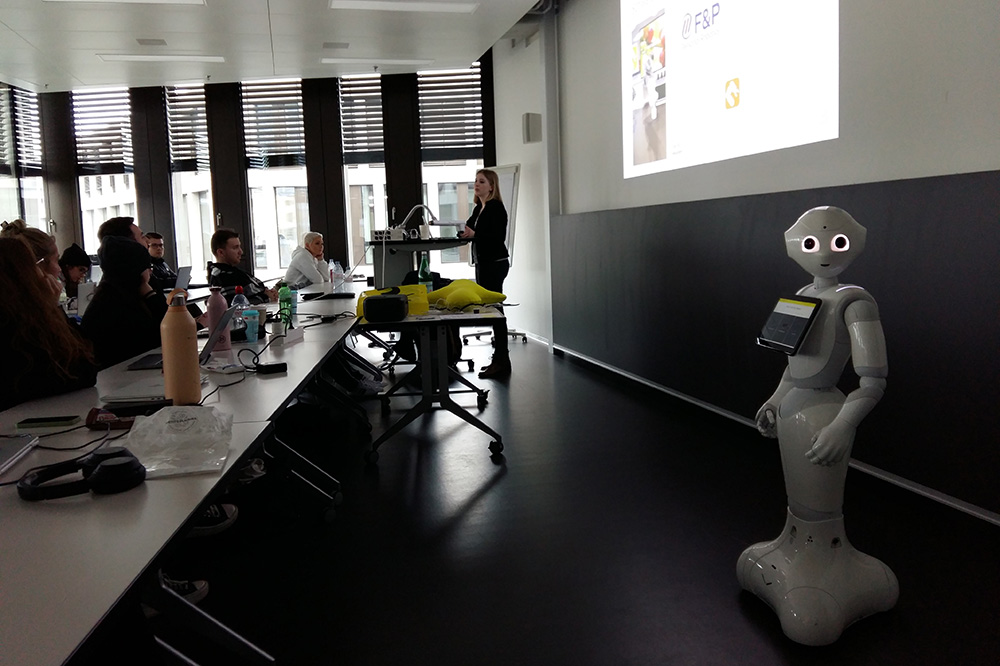
From December 13 to 16, 2022, the ICSR took place, next to Robophilosophy the most important conference on social robotics. Oliver Bendel and Marc Heimann were participating with their paper “The CARE-MOMO Project”. They presented it in a talk on the very first morning at the workshop “Robot Companionship: Applications and Challenges”. They also had a poster presentation on it on Thursday (December 15, 2022). With the help of the morality module, which includes the proven morality menu, care recipients can transfer their moral and social ideas to a care robot like Lio from F&P Robotics (Photo: F&P Robotics). The presentation was well received by the crowded room, including the Chair, who found the approach very interesting, as he pointed out several times. The workshop program can be downloaded here. More information about the conference is available at www.icsr2022.it.
Minding Animals 2024
After an hiatus of six years, Minding Animals will return, with a conference tentatively scheduled to be held 11 – 17 July, 2024. This was announced by the organizers in a message dated December 19, 2022. “Just like the postponed 2021 conference, Minding Animals 5 (MAC5) will be hosted by the Centre for Compassionate Conservation (CfCC) in the Transdisciplinary School at the University of Technology, Sydney (UTS).” (Message from Minding Animals International) The organizers refer to the Minding Animals Bulletin 53 regarding the vision of the conference and the preparation of the authors. “We believe that the greatest threat posed to the planet, to all planetary life, human or nonhuman animal, plant or otherwise, including the current pandemic, is the intersection of animal agriculture and the climate crisis. Hence, the urgency and criticality of climate as the key theme.” (Minding Animals Bulletin 53) Possible subtopics include “The biodiversity crisis and climate change”, “Rewilding and compassionate conservation”, “The animal industrial complex”, “Animals, the circular economy and sustainable food systems”, and “Animals in development and food sovereignty”.
Face Recognition for Bears in the Alps
At the end of the ACI conference, the “Paper Session 6” was held, which was titled “Investigating Human-Animal Relations”. Sarah Webber (University of Melbourne) gave a talk on “Watching Animal-Computer Interaction: Effects on Perceptions of Animal Intellect”. In the experiment, people observed orangutans interacting with computer applications. It was examined how they changed their judgments regarding the animals’ intelligence and behavior. The talk that followed came from Alexandra Morgan (Northumbria University) and was titled “Blind dogs need guides too: towards technological support for blind dog caregiving”. She addressed the needs of blind dogs and showed what gadgets are on the market to assist them. Her team developed an app called “My Blind Dogo” that could help owners of blind dogs. The session ended with a talk on “A Face Recognition System for Bears: Protection for Animals and Humans in the Alps” by Oliver Bendel (University of Applied Sciences and Arts Northwestern Switzerland). He presented an integrated system with cameras, robots, and drones that Ali Yürekkirmaz and he had designed. The ACI took place from 5 to 8 December 2022 in Newcastle upon Tyne. It is the world’s leading conference on animal-computer interaction. More information on the conference via www.aciconf.org/aci2022.
Wearables for Sled Dogs
On the last day of the ACI Conference (December 8, 2022), “Session 5: Sensors & Signals, Part II: Electric Boogaloo” started after the lunch break. Carlos Alberto Aguilar-Lazcano (CICESE-UT3) gave a talk on the topic “Towards a monitoring and emergency alarm system activated by the barking of assistant dogs”. The next presentation was “WAG’D: Towards a Wearable Activity and Gait Detection Monitor for Sled Dogs” by Arianna Mastali (Georgia Institute of Technology). According to her, studies have shown orthopedic injuries to be most common among sled dogs. These like to move very much, but repeatedly exceed their capabilities. To solve this problem, the team has developed a technical solution, a special wearable, with the help of which data on the condition of the animals are generated. “Spatial and Temporal Analytic Pipeline for Evaluation of Potential Guide Dogs Using Location and Behavior Data” was the title of the next talk, given by David L. Roberts (North Carolina State University), followed by “Comparing Accelerometry and Computer Vision Sensing Modalities for High-Resolution Canine Tail Wagging Interpretation”, given by Devon Martin (North Carolina State University). More information on the conference via www.aciconf.org/aci2022.
Talking Eggs
After the keynote on the morning of December 8, 2022, ACI2020 continued with “Paper Session 4: Sensors & Signals, Part I: Origin Stories”. David L. Roberts (North Carolina State University) presented on “Motion-Resilient ECG Signal Reconstruction from a Wearable IMU through Attention Mechanism and Contrastive Learning”. The next talk, “TamagoPhone: A framework for augmenting artificial incubators to enable vocal interaction between bird parents and eggs”, was given by Rebecca Kleinberger (Massachusetts Institute of Technology & Northeastern University). The starting point of her research was that some birds have pre-hatching vocal communication. The last presentation before the lunch break that was given online was “Simultaneous Contact-Free Physiological Sensing of Human Heart Rate and Canine Breathing Rate for Animal Assisted Interactions: Experimental and Analytical Approaches” by Timothy Holder and Mushfiqur Rahman (North Carolina State University). More information on the conference via www.aciconf.org/aci2022.