On Metamorphoses in the Factory
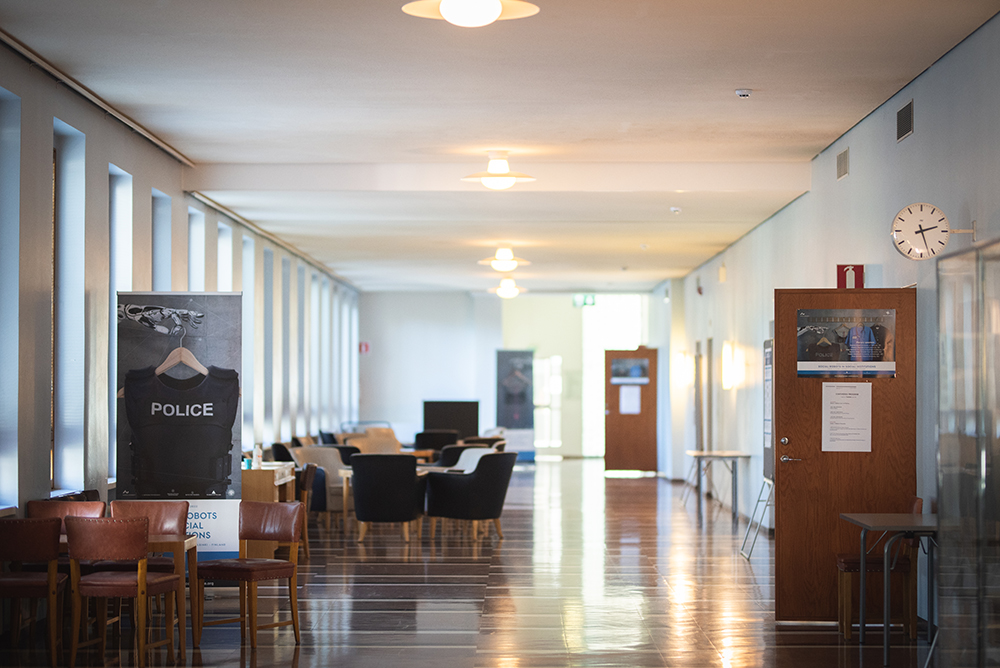
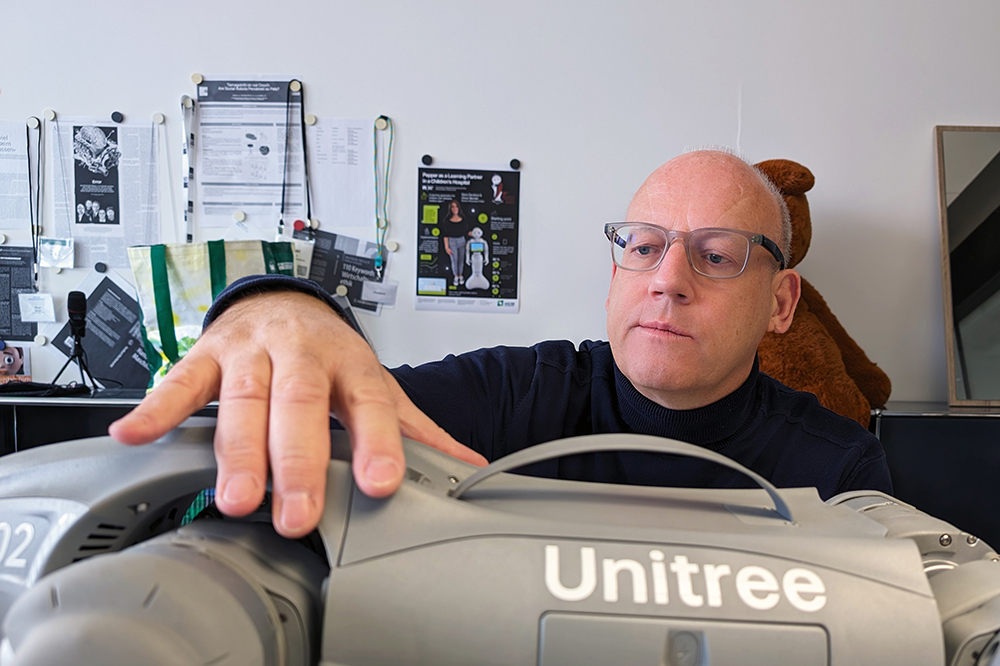
The Workshop “The Social Significance of Human Effort – What Are the Parameters For Positive Human-Robot Interaction In the Context of Industry 5.0?” took place on the third day of Robophilosophy 2024. Prof. Dr. Oliver Bendel gave the lecture “Metamorphoses in the Factory. From Classic Industrial Robots over Cobots and Classic Service Robots to Universal Robots”. From the abstract: “Robots play an important role in industry. In recent years, there have been interesting innovations in production and logistics. Large classic industrial robots are turning into small cobots. Cobots become service robots. Classic service robots are discovering the factory. Metamorphoses are taking place. This talk hypothesizes that recent developments will have a significant impact on workers and work. In particular, the precursors of universal robots could significantly change the factory of the future, just as they will change society as a whole. After all, with universal robots, the boundaries between industrial and service robots are becoming increasingly blurred.” (Website Robophilosophy 2024)

The Social Significance of Human Effort

The third day of Robophilosophy 2024 featured numerous presentations and several workshops. The workshop “The Social Significance of Human Effort – What Are the Parameters For Positive Human-Robot Interaction In the Context of Industry 5.0?” was organized by the renowned Sant’Anna School of Advanced Studies (Pisa, Italy). The moderators were Professors Alberto Pirni and Paolo Dario as well as Oliver Bendel from the FHNW School of Business. They also presented, as did other participants such as Nicola Vitiello, Leonardo Massantini, Danica Kragic Jensfelt, and Margherita Pugnaletto. From the workshop abstract: “This workshop aims to develop a roadmap for understanding the impact of robotics on human employment within the context of Industry 5.0. The workshop explores key factors in this transition, including the risks and benefits of digital automation, ethical considerations regarding worker skills and well-being, and protective measures for workers and consumers. Focusing on the theme of sociocultural risks: devaluation of human labor, the workshop aims to reflect on traditional notions of work, productivity, and the value of human labor in the era of advancing robotics and automation. It challenges the concept of labor devaluation, assesses its impact on worker recognition and efficiency, and questions meritocratic paradigms. To facilitate interdisciplinary dialogue, the workshop engages philosophers and engineers in addressing ethical dilemmas in technology development. It explores the social significance of human effort and movement when interacting with autonomous robots and occupational exoskeletons. By examining these technologies’ adaptability and role in human-machine interaction, especially in workplaces, the workshop intends to contribute to discussions on technological advances and their societal implications.” (Website Robophilosophy 2024)

Keynote by David Chalmers

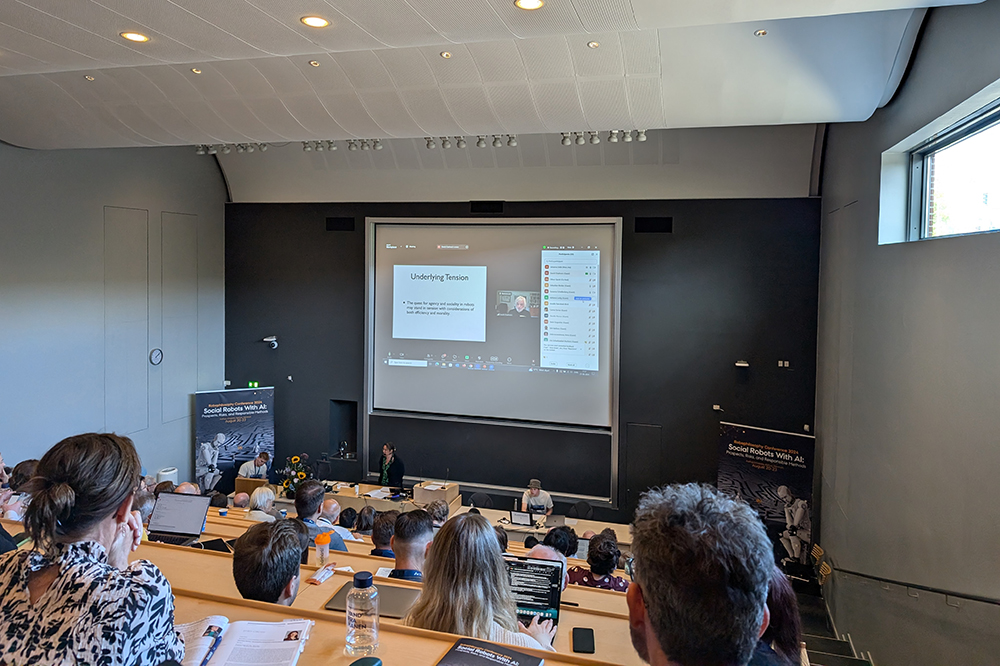
On the second day of Robophilosophy 2024, David Chalmers, an Australian philosopher and cognitive scientist, gave a keynote speech entitled “Does Generative AI Extend the Mind?”. From the website: “Prof. Chalmers is known worldwide, also outside of philosophy, for his contributions to consciousness research in ‘The Character of Consciousness’ (2010), and in particular for identifying more clearly than anyone the tasks for a philosophical account of consciousness (‘the hard problem’ of consciousness). Since recent advances in AI bring Chalmers’ thought experiment of ‘philosophical zombies’ closer to reality, in his current research he combines philosophy and a longstanding interest in AI for the exploration of the status of virtual reality … and the likelihood of creating artificial systems that fulfil the criteria of consciousness.” (Website Robophilosophy 2024) A key statement was: “As social AI systems become increasingly agent-like, they will decreasingly extend the mind …” The final statement was: “The quest for agency and sociality in robotsmay stand in tension with considerations of both efficiency and morality.” The audience applauded the witty and humorous talk.

Keynote by Anthony Elliott

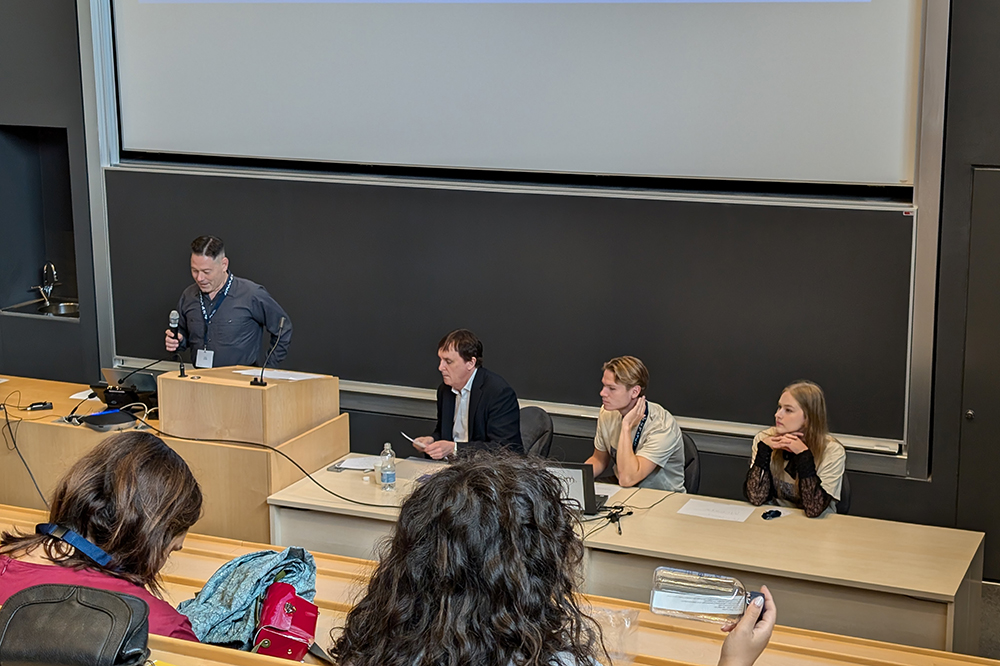
On the second day of Robophilosophy 2024, Anthony Elliott, Distinguished Professor of Sociology at the University of South Australia, gave a keynote speech entitled “May AI Be With You: Agency and Automation in the Age of Algorithmic Modernity”. From the abstract: “From industrial robots to ChatGPT, and from driverless cars to military drones: AI is transforming all aspects of our lives, from the changing nature of work, employment and unemployment to the most intimate aspects of personal relationships. In this presentation, Anthony Elliott focuses on the complex systems of AI – spanning intelligent machines, chatbots, advanced robotics, accelerating automation, big data – and their centrality to new forms of social interaction, organizational life and governance. He argues, provocatively, that today modernity has come to mean smartphones, tablets, cloud computing, big data, automated recommendation systems and predictive analytics. This has heralded the arrival of what he terms ‘algorithmic modernity’, an altogether new ‘stage’ in the ordering techniques of envisioned human mastery. In this automated order of algorithmic modernity, human agency is increasingly outsourced to smart machines. We should understand this phenomenon, Elliott argues, in terms of a containment of both uncertainty and complexity which the digital revolution in social relations poses, but which ultimately denies answers.” (Website Robophilosophy 2024) In his presentation, the sociologist emphasised the risks of AI rather than the opportunities. The photo shows David Gunkel announcing Anthony Elliott’s lecture – he is sitting on the far left.

Keynote by Wendell Wallach

On the first day of Robophilosophy 2024, Wendell Wallach, one of the fathers of machine ethics, gave a keynote speech entitled “Re-envisioning Ethics: From Moral Machine to Extensive Regulation”. From the abstract: “Have we been underestimating the socio-technical challenges posed by ro(bot)s – physical systems and virtual bots? Many of the complexities inherent in managing intelligent systems can not be adequately met by scientific innovation, existing ethical constraints, or weak regulations forged by legislatures under the capture of the AI oligopoly.  In spite of naive future projections, the science we have, and are likely to have in the near future, will not produce AI systems capable of making even satisfactory choices in complex situations where uncertainty reigns, multiple values converge, and the information available is inadequate to project meaningful consequences for various courses of action. AI will pose safety and security risks far beyond those being addressed by the pittance of investment presently directed to build trustworthy systems. Scientific humility is needed. Ethics must be reenvisioned and empowered to work through the plethora of socio-technical obstacles and trials ahead. A vast infrastruture to ensure AI safety will be required.” (Website Robophilosophy 2024) Wendell Wallach went far beyond these hints and gave an overview of the advances and setbacks in machine ethics and AI ethics in recent decades.

Start of Robophilosophy 2024

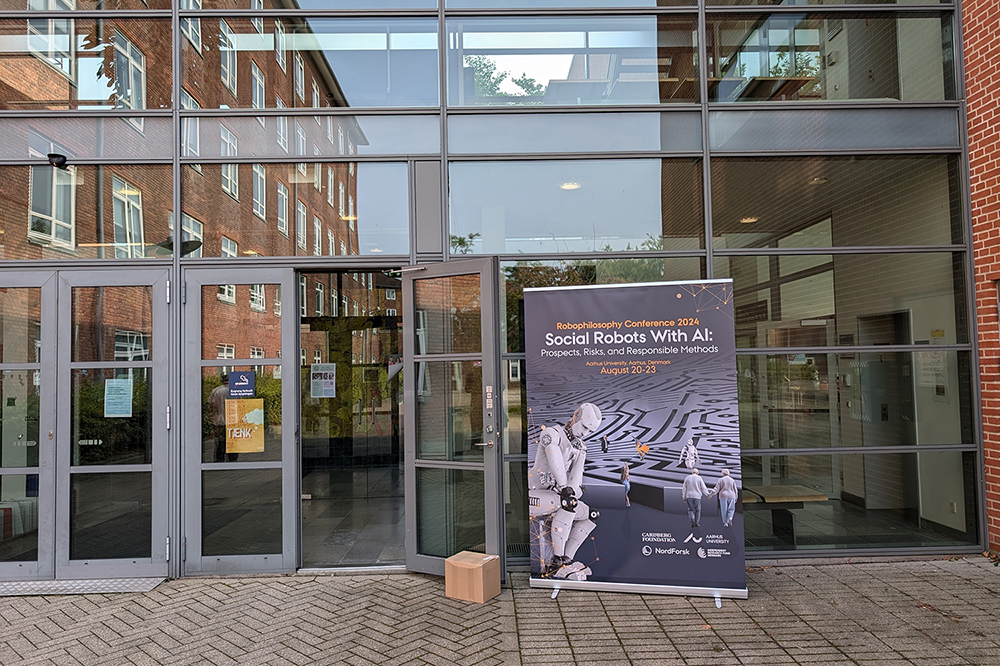
On August 20, 2024, Robophilosophy 2024 was opened with words of welcome from Maja Horst, Dean of the Faculty of Arts at Aarhus University, and Johanna Seibt, Professor of the School of Culture and Society at Aarhus University. The website says: “The international research conference RP2024 will discuss the questions that really matter in view of the new technological potential of social robotics. In over 100 research talks, RP2024 will address concrete and deep issues that reach far beyond safety and privacy concerns into the conceptual and normative fabric of our societies and individual self-comprehension.” (Website Robophilosophy 2024) The first keynote on the first day of the conference was given by Wendell Wallach, one of the world’s best-known machine ethicists. With his book “Moral Machines” (2009), he laid the foundation for a discipline that has been developing in science fiction and science for years and decades. This was followed in 2011 by “Machine Ethics” by Michael Anderson and Susan L.eigh Anderson. In addition to machine ethics, Robophilosophy is dedicated to robot ethics and other interesting perspectives on social robots.

Robots at Arm’s Length

The paper “Robots at arm’s length: Unveiling the dynamics of interpersonal distance preferences in human-robot interactions” by Katharina Kühne, Laura M. Zimmer, Melina Jeglinski-Mende, Oliver Bendel, Yuefang Zhou, and Martin Fischer was accepted at Robophilosophy 2024. The study focuses on the spatial distance between social robots and humans. According to the authors, the results have implications for the design of social robots and the optimization of interactions, especially in educational or medical contexts. Katharina Kühne is a PhD student in the Potsdam Embodied Cognition Group (PECoG) at the University of Potsdam. She has a diploma in language teaching, a master’s degree in linguistics, and a master’s degree in cognitive psychology. She is supervised by Prof. Dr. Martin Fischer (University of Potsdam, head of the PECoG) and Prof. Dr. Oliver Bendel (FHNW School of Business, associated researcher of the PECoG). The results of the study will be presented at Robophilosophy, which will take place in Aarhus from August 20 to 23, 2024.

Robophilosophy Conference 2024

The upcoming international Robophilosophy Conference 2024 in Aarhus is set to tackle the socio-cultural and ethical questions arising from the use of generative multimodal AIs in social robotics. The event will bring together global scholars from humanities, social sciences, social robotics, and computer science, aiming to produce actionable insights and responsibly address the socio-cultural transformations brought about by social robotics. It is part of the Robophilosophy Conference Series, known for its large scale events for humanities research in social robotics. RP2024 highlights the urgency of closer collaboration between tech experts and societal experts to establish research-based regulations. The conference will welcome 80-100 talks in plenaries, special workshops, and parallel sessions of reviewed research papers. Virtual attendance is made possible for those unable to attend in person. Interested parties are invited to submit their papers on the conference topics. Key dates to note: Deadline for workshop/panel proposal submissions is January 31, 2024. Deadline for short papers and posters is February 15, 2024. More information at cas.au.dk/en/robophilosophy/conferences/rpc2024.

About Robots in Policing

In January 2023, the Proceedings of Robophilosophy 2022 were published. Included is the paper “Robots in Policing” by Oliver Bendel. From the abstract: “This article is devoted to the question of how robots are used in policing and what opportunities and risks arise in social terms. It begins by briefly explaining the characteristics of modern police work. It puts service robots and social robots in relation to each other and outlines relevant disciplines. The article also lists types of robots that are and could be relevant in the present context. It then gives examples from different countries of the use of robots in police work and security services. From these, it derives the central tasks of robots in this area and their most important technical features. A discussion from social, ethical, and technical perspectives seeks to provide clarity on how robots are changing the police as a social institution and with social actions and relationships, and what challenges need to be addressed.” (Abstract) Robots in policing is a topic that has not received much attention. However, it is likely to become considerably more topical in the next few years. More information about the conference on cas.au.dk/en/robophilosophy/conferences/rpc2022 (Photo: Anna Jarske-Fransas).

Proceedings of Robophilosophy 2022

In January 2023, the proceedings of Robophilosophy 2022 were published, under the title “Social Robots in Social Institutions”. “This book presents the Proceedings of Robophilosophy 2022, the 5th event in the biennial Robophilosophy conference series, held in Helsinki, Finland, from 16 to 19 August 2022. The theme of this edition of the conference was Social Robots in Social Institutions, and it featured international multidisciplinary research from the humanities, social sciences, Human-Robot Interaction, and social robotics. The 63 papers, 41 workshop papers and 5 posters included in this book are divided into 4 sections: plenaries, sessions, workshops and posters, with the 41 papers in the ‘Sessions’ section grouped into 13 subdivisions including elderly care, healthcare, law, education and art, as well as ethics and religion. These papers explore the anticipated conceptual and practical changes which will come about in the course of introducing social robotics into public and private institutions, such as public services, legal systems, social and healthcare services, or educational institutions.” (Website IOS Press) The proceedings contain the paper “Robots in Policing” by Oliver Bendel and the poster “Tamagotchi on our couch: Are social robots perceived as pets?” by Katharina Kühne, Melinda A. Jeglinski-Mende, and Oliver Bendel. More information via www.iospress.com/catalog/books/social-robots-in-social-institutions.