Grace, the Nurse Android

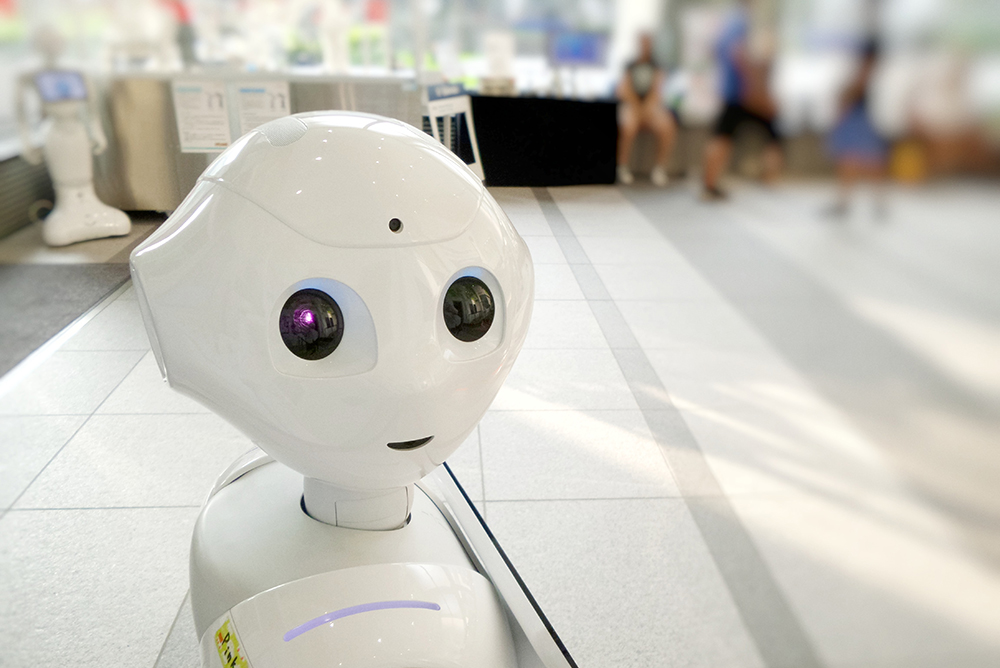
Grace from Hanson Robotics is a special kind of care robot, namely a nurse android. According to the manufacturer, she was created for the COVID-19 pandemic. She is the younger sister of Sophia and Asha, but unlike them, she becomes a useful member of society thanks to her profession and skills. She has a thermal imaging camera in her chest area that she can use to measure fevers. She has mimic, gestural and natural language abilities and can show not only joy but also sadness. Overall, she always looks a little devastated. In a video, she says, “I can visit with people and brighten their day with social stimulation, entertain and help guide exercise, but also can do talk therapy, take bio readings and help health care providers assess their health, and deliver treatments” … Whether the android will gain favor with patients is hard to say. There are individual voices of male persons who long for realistic figures in this field, but the majority of people are likely to be irritated by Grace. Nevertheless, it is fascinating and media-savvy research that Hanson Robotics once again presents. Moreover, the question of whether care robots should have sexual assistance functions arises under entirely new conditions.

The Digger Finger

Radhen Patel, a postdoc in MIT’s Computer Science and Artificial Intelligence Laboratory (CSAIL), and his co-authors Rui Ouyang, Branden Romero, and Edward Adelson presented a sharp-tipped robot finger equipped with tactile sensing to meet the challenge of identifying buried objects. “In experiments, the aptly named Digger Finger was able to dig through granular media such as sand and rice, and it correctly sensed the shapes of submerged items it encountered. The researchers say the robot might one day perform various subterranean duties, such as finding buried cables or disarming buried bombs.” (MIT News, 26 May 2021) The article, titled “Digger Finger: GelSight Tactile Sensor forObject Identification Inside Granular Media,” can be accessed at arxiv.org/pdf/2102.10230.pdf.

Towards Robot Enhancement

In an article for ICTkommunikation published on 21 May 2021 (only available in German), Oliver Bendel outlines the field of robot enhancement. Robot enhancement refers to the enhancement and associated modification or improvement of the robot by the user or a company, for example in functional, aesthetic, ethical or economic terms. Social robots are of particular interest. The article gives several examples of application: Pepper is dressed and accessorized, like REEM, a police robot used in Dubai. AIBO, a robotic dog, is covered in fur. To make a hugging robot smell, you rub it with scents. Or one covers a metal or plastic head with silicone skin or lengthens existing limbs. According to the Zurich-based scientist, a new field of work is needed so that all these measures can be carried out in a systematic and theoretically sound manner. The article entitled “Überlegungen zu Robot Enhancement” can be accessed here.

What We Can Do with Sex Robots

“Anthropomorphic love dolls – the successors of basic blowup dolls – are widely used these days, both in brothels and at home. While they can offer physical comfort and sexual satisfaction, they certainly cannot engage in more complex interactions with their counterparts. However, sex robots can – or at least they ought to. For now, the offer is not extensive and prices are high. The motor abilities of current models are limited and mainly focus on the head, while the body is usually identical to that of a love doll. Obviously, sex robots are made primarily to have sex with. But the user can also talk to and even form a relationship with them. This in mind, we are now starting to think about other applications of humanoid sex robots in the future – at least when their motor skills have improved. The possibilities might surprise you …” (De Gruyter Conversations, 23 April 2021) The full article is available via blog.degruyter.com/what-we-can-do-with-sex-robots-besides-the-obvious/

One Small Flight for Ingenuity

“That’s one small flight for Ingenuity – one giant journey for mankind.” This can be said after the successful experiment on 19 April 2021 with the tiny helicopter on Mars (photo: screenshot from NASA livestream). Ingenuity flew vertically into the air, took a selfie with its shadow, and landed safely back on the ground. The red planet is associated with many expectations and aspirations. At the moment, the surface is being explored in an unprecedented way. In a few years, humans are expected to travel to Mars. In doing so, they will also need advice and support. Because the personnel on Earth are far away, a voice assistant is a possible solution. SPACE THEA is a voicebot that shows empathy (but doesn’t have it, of course). Like GOODBOT and BESTBOT, she recognizes user problems – but unlike those chatbots, she has a voice. SPACE THEA will be developed until August 2021 under the supervision of Prof. Dr. Oliver Bendel at the School of Business FHNW. The project aims to cover several scenarios on the flight to Mars. However, a voicebot could also be useful on the planet itself, for example to control a tiny helicopter.

Hyundai Now Creates Tigers

Hyundai Motor Group has revealed a robot named TIGER, which stands for Transforming Intelligent Ground Excursion Robot. According to the company, it’s the second Ultimate Mobility Vehicle (UMV) and the first designed to be uncrewed. “TIGER’s exceptional capabilities are designed to function as a mobile scientific exploration platform in extreme, remote locations. Based on a modular platform architecture, its features include a sophisticated leg and wheel locomotion system, 360-degree directional control, and a range of sensors for remote observation. It is also intended to connect to unmanned aerial vehicles (UAVs), which can fully charge and deliver TIGER to inaccessible locations.” (Media Release, 10 February 2021) A video can be viewed here. With TIGER, the company has developed a very interesting proof of concept. The combination of legs and wheels in particular could prove to be the solution of the future.

A Fish-inspired Robotic Swarm

A team from the Harvard John A. Paulson School of Engineering and Applied Sciences (SEAS) and the Wyss Institute for Biologically Inspired Engineering has developed fish-inspired robots that can synchronize their movements like a real school of fish, without any external control. According to a SEAS press release, it is the first time scientists have demonstrated complex 3D collective behaviors with implicit coordination in underwater robots. “Robots are often deployed in areas that are inaccessible or dangerous to humans, areas where human intervention might not even be possible”, said Florian Berlinger, a PhD Candidate at SEAS and Wyss in an interview. “In these situations, it really benefits you to have a highly autonomous robot swarm that is self-sufficient.” (SEAS, 13 January 2021) The fish-inspired robotic swarm, dubbed Blueswarm, was created in the lab of Prof. Radhika Nagpal, an expert in self-organizing systems. There are several studies and prototypes in the field of robotic fishs, from CLEANINGFISH (School of Business FHNW) to an invention by Cornell University in New York.

Spot in Chernobyl

Boston Dynamics is known for several two- and four-legged robots. Videos often show spectacular movements and stunts. Surely the scenes have to be shot often to be as impressive as possible. The robot Spot has recently been given some new features. Several media report that it was used in Chernobyl. “A team of engineers from the University of Bristol visited the Chernobyl Nuclear Plant last week to test out Spot, a four-legged robodog made by US-based robotics company Boston Dynamics … Spot is capable of making inspection rounds all by itself and can navigate hostile environments such as the highly radioactive site of the former nuclear power plant. Spot went for a walk around the surrounding areas and into the New Safe Confinement structure, a massive moveable dome of steel meant to keep in dangerous radiation from the plant’s number 4 reactor unit, which was destroyed during the 1986 disaster. The robot’s main task was to survey levels of radiation in the area, creating a three-dimensional map of the distribution.” (Website Futurism, 26 October 2020) Spot and Co. stand in the probably oldest tradition of robotics: They take over tasks that are too dangerous or too strenuous for humans.

Service Robots in Epidemics and Pandemics

On October 14, 2020 the article “Der Einsatz von Servicerobotern bei Epidemien und Pandemien” (“The use of service robots in epidemics and pandemics”) by Oliver Bendel was published in HMD – Praxis der Wirtschaftsinformatik. From the abstract: “Robots have always been used to carry out dangerous tasks or tasks that are not manageable for us. They defuse bombs, transport hazardous materials and work their way into areas inaccessible to humans. The COVID-19 pandemic has shown that even service robots, which are not actually intended for special cases, can provide helpful services in the care of isolated persons and in the containment of diseases. This paper presents four types of service robots. Then it gives examples of robot use during the coronavirus crisis in 2020. Finally, the question in which extent and in what way the robot types can cooperate and whether some of them can be developed into generalists is examined. Business models and operating opportunities are also discussed. The paper shows that cohorts of robots could be vital in the future.” It is part of Volume 57, Issue 6 (December 2020) with a focus on robotics and is available here for free as an open access publication (in German).

Simple, Soft Social Robots

With Hugvie and Somnox Sleep Robot, researchers and companies has made it clear that it is possible to build simple, soft social robots that have a certain utility and impact. This raises hopes for social robotics, which is currently showing some progress, but is still developing slowly. Materials such as rubber and plastic can be used to make simple, soft social robots. These materials can be combined with existing devices such as smartphones and tablets on which you run certain applications, or with simple sensors and electronic components. The project or thesis, announced by Oliver Bendel in 2020 at the School of Business FHNW, will first do research on the basics of simple, soft social robots. The work of Hiroshi Ishiguro and Alexis Block (with Katherine J. Kuchenbecker) will be included. Then, examples of implementation forms are mentioned and sketched. Their purpose and benefits are presented, as well as possible areas of application. One example is to be implemented, whereby speech abilities and sounds can be an option as well as vibration and electrical impulses. The reference to applications in the household, in public space or in the commercial sector should be established. The project will start in March 2021.