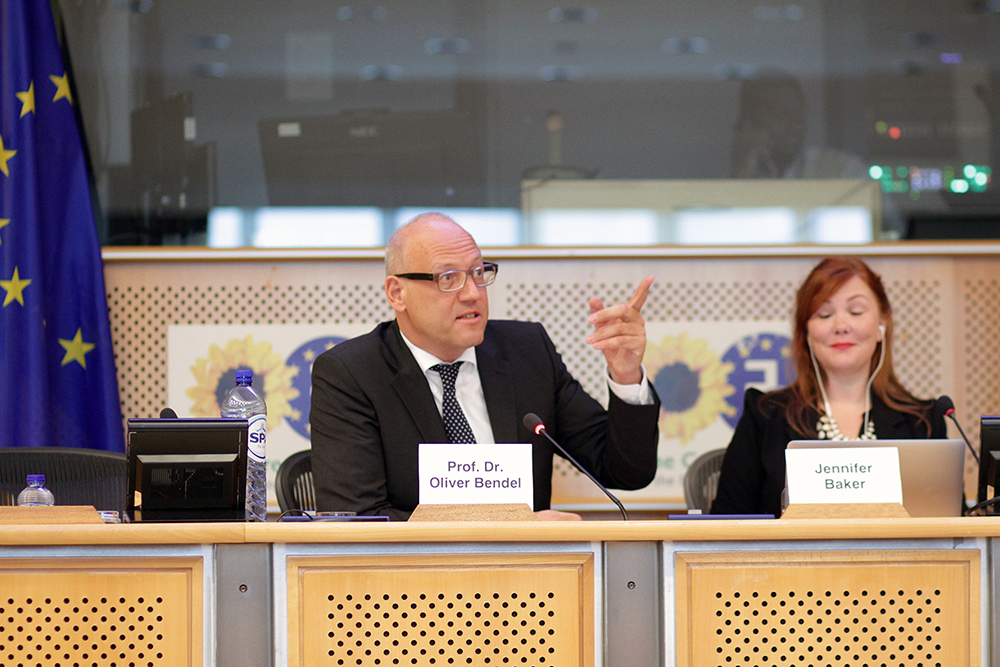
Article 50, “Transparency obligations for providers and deployers of certain AI systems,” of the EU Artificial Intelligence Act (EU AI Act) states: “Providers shall ensure that AI systems intended to interact directly with natural persons are designed and developed in such a way that the natural persons concerned are informed that they are interacting with an AI system, unless this is obvious from the point of view of a natural person who is reasonably well-informed, observant and circumspect, taking into account the circumstances and the context of use.” Ten years earlier, the European Parliament had already sought advice from Oliver Bendel on this very topic. In his presentation, “Moral and Immoral Machines”, delivered at the event “Merging of Man and Machine: Questions of Ethics in Dealing with Emerging Technology” in Brussels on September 8, 2016, Bendel introduced GOODBOT, a chatbot he had initiated in 2013 as part of his research on machine ethics. GOODBOT featured several escalation levels and repeatedly made it clear to users that it was merely a machine. Other speakers in the “Ethics & Society” session included Enno Park, Dana Lewis, Yvonne Hofstetter, and Constanze Kurz. At the “Digital Europe” Working Group conference on robotics on November 8, 2017, Bendel also spoke online about related issues in machine ethics. Referring to a care robot, he raised the question: “Should the robot make clear that it’s just a machine?” The transparency obligations set out in Article 50 entered into force on August 2, 2026 (Photo: Sebastian Raible).
BY OLIVER BENDEL